Epson EF-30 Review: The Compact 1080p Smart Projector Explained
ProjectorsThe projector market is full of compromises. Budget models cut corners on resolution or brightness. Portable models sacrifice smart features. Home theater units get big and expensive fast. The Epson EF-30 threads a needle that many buyers don't realize they're looking for: a genuinely compact 1080p projector with a full smart platform built in, wireless casting from every major ecosystem, and a lamp rated to last years under normal use — all in a package light enough to carry in a backpack.
Design and Build: Small Enough to Mean It
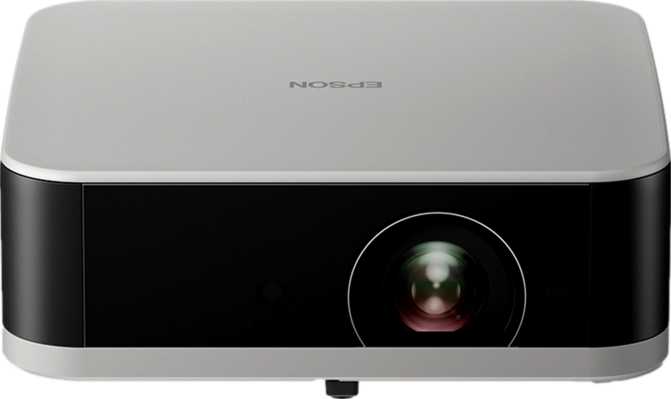
Compact projectors often describe themselves as "portable" when they really mean "not permanently mounted." The Epson EF-30 is legitimately small. At just 200mm wide, 190mm deep, and 70mm tall — roughly the footprint of a large hardback book — it occupies almost no space on a shelf, nightstand, or coffee table. At 1.7 kilograms, picking it up and moving it between rooms is genuinely effortless.
The low-profile form factor is one of its most practical advantages. Most projectors at this resolution tier are bulkier units that require a dedicated surface or ceiling mount. The EF-30 can sit flat on a stack of books, a nightstand, or the floor of a living room without demanding any special treatment.
Build quality reflects a product positioned above entry-level. The chassis feels solid without being heavy. Vents are thoughtfully placed so the unit doesn't need excessive clearance. There are no manual zoom rings or adjustment levers to fiddle with — the setup experience is intentionally minimal.
- Width
- 200 mm
- Depth
- 190 mm
- Height
- 70 mm
- Weight
- 1.7 kg
- Volume
- 2,660 cm³
- Warranty
- 1 Year
Picture Quality: What the Specs Actually Mean
The EF-30's specifications describe something more capable than the form factor suggests. Here is what each element contributes to the real-world viewing experience.
Full HD Resolution
1920×1080 pixels is the native resolution of Blu-ray disc and the standard that Netflix, Disney+, and most streaming platforms use for the bulk of their content. At typical home viewing distances of 2.5 to 4 metres, 1080p on a 100-inch canvas is genuinely clean and film-like. You'd need to sit within about 1.5 metres of the screen to detect individual pixels — at normal couch distances, the picture is entirely satisfying.
10-Bit Color Pipeline
Color depth controls how smoothly a display transitions between shades. An 8-bit system renders around 16 million colors; a 10-bit system exceeds one billion. In practice: skies look smooth rather than stepped, gradients are free of banding, and cinematic color grading is reproduced with visible fidelity. For a projector this compact, 10-bit output is a meaningful advantage over the entry-level alternatives in this category.
HDR Support
The EF-30 handles both HDR10 — the universal standard for UHD Blu-ray and platforms like Netflix and Disney+ — and HLG (Hybrid Log-Gamma), the format used in broadcast HDR. Together they cover virtually every HDR source in everyday use.
Image Size and Throw Distance
A 100-inch diagonal image measures over 8 feet wide — noticeably larger than even a 65-inch television. The minimum throw distance of 1.6 metres means you can place the EF-30 on a coffee table across a standard living room and immediately fill a wall-sized canvas. That combination of large maximum size and short minimum distance makes it genuinely usable in typical domestic spaces without needing a dedicated room.
The Smart Platform: No Extra Hardware Needed
The EF-30 includes a complete built-in smart TV operating environment — not a basic media player bolt-on. Pair it with power and Wi-Fi and you have immediate access to streaming apps, voice-controlled navigation, and a companion smartphone app. No streaming stick or media player required.
Wireless Casting: Every Device Ecosystem Covered
Supporting all four major wireless protocols is rare for a projector of this size. The EF-30 achieves it, meaning the unit works regardless of whether your household runs Apple, Android, Windows, or all three simultaneously:
Voice Commands
Hands-free navigation and content search without touching the remote — particularly useful when the projector is ceiling-mounted or positioned across the room from your seating.
Smartphone Companion App
A dedicated app provides full control and content management from your phone. It works alongside the included remote — both operate simultaneously without conflict.
Audio: Stereo Built In, Flexible Output Options
The EF-30 includes stereo speakers. For a projector this compact, that is a meaningful inclusion — most mini projectors cut corners with a single mono driver. For casual viewing, background streaming, or situations where connecting external audio isn't practical, the onboard speakers deliver a usable listening experience without any setup.
Anyone who wants better audio has genuine flexibility. A 3.5mm audio output jack allows direct connection to a soundbar or powered speakers. Bluetooth supports wireless pairing with any compatible speaker system. Both options are available simultaneously, so you choose based on what you already own rather than what the projector forces on you.
- Built-in Stereo Speakers
- 3.5mm Audio Output Jack
- Bluetooth Wireless Audio
- No S/PDIF Optical Output
Lamp Life and Long-Term Running Costs
The EF-30 uses a traditional lamp light source rather than laser. This has two practical implications: how frequently you might need to replace the light source, and how brightness behaves across years of use.
In eco mode, the lamp is rated for 20,000 hours. At four hours of daily viewing, that equates to approximately 13 years of operation before a replacement is needed. Under typical ownership patterns — evenings, occasional longer sessions — the lamp is something most buyers will never have to think about. That significantly reduces the long-term cost of ownership compared with laser projectors requiring eventual diode replacement.
The honest trade-off with lamp technology is that brightness gradually dims over the lamp's lifetime rather than staying constant. This decline is imperceptible over the short-to-medium term but becomes noticeable as the lamp approaches the end of its rated lifespan. For the overwhelming majority of buyers, it will never be a real-world concern.
- ~13 years at 4 hours/day
- ~5,000+ full-length film viewings
- 101W operating power draw
Connectivity At a Glance
| Connection Type | Epson EF-30 |
|---|---|
| HDMI | 1 Port |
| USB | 1 Port |
| 3.5mm Audio Output | |
| Wi-Fi | |
| Bluetooth | |
| Chromecast Built-in | |
| AirPlay | |
| Miracast | |
| DLNA | |
| Ethernet (RJ45) | |
| VGA | |
| DVI | |
| S/PDIF Optical Audio |
Noise and Power: Living With the EF-30 Day to Day
Fan Noise in Practice
At 28 decibels in standard mode and 23 decibels in eco mode, the EF-30 is genuinely quiet by projector standards. A quiet library sits at roughly 30 decibels. At 23dB in eco mode, the fan is barely above the ambient hum of a typical room — it does not register as intrusive projector noise in the way that louder units do.
This matters more than many buyers anticipate. A loud projector becomes fatiguing during extended viewing, draws attention during quiet film scenes, and is especially unwelcome in bedrooms or small living spaces. The EF-30's noise floor is low enough that it is unlikely to ever become a real annoyance under normal use.
Power Consumption
Operating power draw sits at 101 watts — moderate and expected for a lamp-based projector at this resolution tier. Running the EF-30 for four hours costs roughly the same in electricity as a gaming console or a mid-range television. It is not a significant ongoing cost factor.
Who Should — and Should Not — Buy the Epson EF-30
- People who want a large-screen experience in a bedroom, living room, or rental space without permanent installation of any kind.
- Travellers and frequent movers who need a projector that genuinely travels without requiring a dedicated equipment bag.
- Mixed-device households where Apple, Android, and Windows users coexist — all four major casting protocols are supported simultaneously.
- Anyone who wants a self-contained smart media device without depending on a separate streaming stick or external media player.
- Families or shared households wanting large-screen communal viewing without crowding around a 65-inch television.
- Buyers who need 4K resolution for large-scale precision viewing, particularly at shorter viewing distances from the screen.
- Anyone building a calibrated home theater with multi-source HDMI switching and optical audio integration into a receiver.
- Users who require Ethernet connectivity for reliable wired network performance in managed environments.
- Enthusiasts who specifically seek out HDR10+ encoded content from Amazon Prime Video or Samsung devices.
- Anyone who needs vertical or horizontal lens shift for precise geometric alignment in a permanent ceiling mount setup.
How the Epson EF-30 Compares to the Competition
The EF-30 occupies a distinct position in the compact projector market. Here is how it lines up against the two most common alternatives buyers consider at a similar price point:
| Feature | Epson EF-30 | Compact Laser Projector | Budget 1080p Lamp (Larger) |
|---|---|---|---|
| Resolution | 1080p | Often 1080p | 1080p |
| Light Source | Lamp (20,000h eco) | Laser | Lamp |
| Size / Portability | Very compact, 1.7 kg | Compact, varies | Larger, heavier |
| Built-in Smart Platform | Sometimes | ||
| AirPlay | |||
| Chromecast Built-in | Sometimes | ||
| Fan Noise | 23–28 dB | Often quieter | Often louder |
| Lens Shift | Sometimes | Sometimes | |
| HDMI Ports | 1 | 1–2 | 1–2 |
Laser alternatives typically offer more consistent brightness over their lifetime but carry a higher upfront cost. The EF-30's 20,000-hour eco lamp rating largely closes that gap for real-world longevity. Larger budget projectors may offer more physical flexibility — lens shift, more HDMI inputs — but sacrifice the portability and self-sufficient smart platform that make the EF-30 distinctively useful.
Honest Strengths and Real Limitations
Where the EF-30 Excels
The EF-30's most compelling quality is that it genuinely replaces a streaming device, a television, and an HDMI cable in many scenarios. Achieving that with a full smart platform, all four major wireless casting protocols, Bluetooth audio, 10-bit 1080p projection, and a 1.7kg body is not something every projector in this category even attempts.
The noise levels and lamp longevity make it pleasant to live with over years, not just weeks. A 20,000-hour eco lamp and sub-25dB operation are the kind of specifications that translate into a projector you forget about in the best possible way — it quietly performs, reliably, without demanding attention or maintenance.
Where It Falls Short
The single HDMI port is a recurring practical frustration for anyone who regularly connects multiple physical sources. The absence of lens shift means placement precision is the user's responsibility — a manageable constraint for casual setups but a genuine obstacle for calibrated permanent installations.
Buyers accustomed to the pixel-level clarity of a 4K OLED panel will find 1080p projection has a different visual character — cinematic and immersive at scale, but not a direct replacement for that kind of precision at close viewing distances.
The one-year warranty is shorter than some competitors offer in this category. Extended coverage at the point of purchase is worth factoring into the total cost consideration.
Questions Buyers Actually Ask Before Purchasing
Final Verdict
The Epson EF-30 earns a clear recommendation for a specific kind of buyer: someone who wants a self-contained, wireless-first 1080p projector that can go anywhere, work with any device ecosystem, and run reliably for years without fuss. The combination of AirPlay, Chromecast, Miracast, DLNA, a complete smart platform, and a genuinely compact body is unusual in the lamp projector market and hard to match at any comparable size.
It is not a specialist tool for permanent theater installations or 4K enthusiasts. But for the large portion of the market looking to add a large-screen option to a room without rewiring anything, committing to a fixed installation, or buying multiple additional devices, the EF-30 hits a practical sweet spot that its competition frequently misses.
If wireless flexibility, genuine portability, and a clean daily-use experience are what you need from a projector — the Epson EF-30 is the one to buy.