Edifier M90 Review: Compact Active Speakers with Modern Connectivity
Home Audio SpeakersBookshelf speakers in the competitive mid-range are a crowded, contentious category. Everyone has a favorite, and most recommendations come with caveats. The Edifier M90 enters this space with a proposition that's harder to dismiss than most: a compact active speaker with a genuinely wide connectivity suite, a 2-way driver configuration, and a frequency range that pushes well beyond what human ears can perceive. Whether you're setting up a desktop listening station, a secondary living room system, or your first serious audio upgrade from a Bluetooth soundbar, the M90 has a credible case to make — but it also has limits worth understanding before you commit.
Edifier M90 Specifications at a Glance
| Speaker Type | Active Bookshelf |
|---|---|
| Driver Layout | 2-Way |
| Enclosure | Bass Reflex (Ported) |
| Dimensions (W×H×D) | 133 × 212 × 225 mm |
| Weight per Cabinet | 6 kg |
| Wall Mountable | No |
| Warranty | 2 Years |
| Tweeter | 1-inch |
|---|---|
| Woofer | 4-inch |
| Frequency Range | 50 Hz – 40,000 Hz |
| Audio Inputs | USB, Optical, Bluetooth 6 |
| Subwoofer Output | Yes |
| Smartphone App | Yes |
| Remote Control | Yes (battery-powered) |
Design and Build: Compact Proportions, Serious Presence
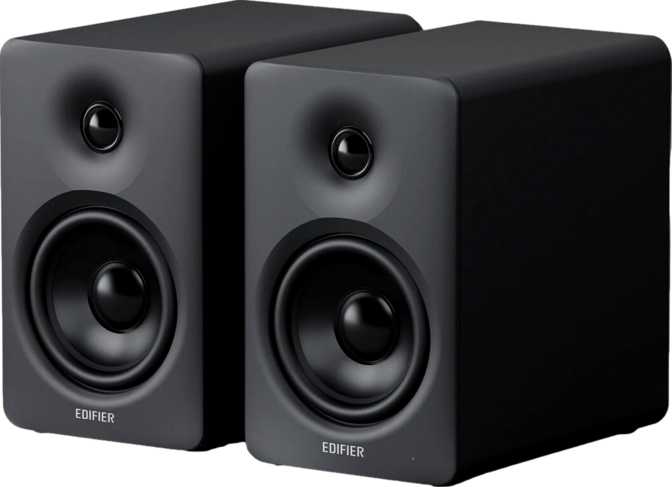
At roughly 133mm wide, 212mm tall, and 225mm deep, the M90 sits comfortably on a standard desktop or bookshelf without demanding a room rearrangement. These are genuinely compact dimensions — each cabinet is roughly the footprint of a hardcover novel, just a bit taller. At 6 kilograms per cabinet, they carry real mass. Lift one and it signals immediately that there are substantial components inside, not the hollow, resonant construction that defines lower-tier competitors.
The enclosure uses a bass reflex design — meaning there's a rear port that allows internal air pressure to reinforce low-frequency output. This is a deliberate acoustic engineering choice that enables a smaller cabinet to produce lower bass extension than a sealed box of the same size. The trade-off: ported speakers can sound looser in the low end if placement is careless. A few inches of clearance from the rear wall is a worthwhile habit to develop.
One firm boundary worth noting up front: the M90 offers no wall-mounting capability. There's no mounting hardware or threaded insert included. These are shelf or desktop speakers only — if your room layout was counting on brackets, that option is simply not available here.
Physical Summary
- 133 × 212 × 225 mm footprint
- 6 kg per cabinet — solidly constructed
- Rear-ported enclosure for extended bass
- 2-year warranty coverage
- No wall-mounting provision
Connectivity: Wired, Wireless, and Everything Between
Rather than committing to a single connection philosophy, the M90 offers three distinct input methods that together cover virtually every modern source scenario without additional hardware.
USB Audio
Connects directly to a computer and bypasses the PC's onboard sound card entirely. The signal stays digital until it reaches the M90's own internal DAC, which typically yields cleaner, lower-noise audio than onboard PC audio. This matters most for anyone who has experienced background hiss or ground-loop hum from a desktop setup — USB audio eliminates that noise path at the source.
Optical (Toslink)
Opens the door to TVs, game consoles, CD transports, and any other source with a digital optical output. The inherent galvanic isolation of an optical connection — no electrical ground path between source and speaker — eliminates an entire category of interference artifacts. This is the ideal choice for living room or gaming setups where a TV or console is the primary source.
Bluetooth 6
The most current Bluetooth standard available, with improved connection reliability and reduced audio latency compared to previous generations. The lower latency matters for wireless video watching — lip-sync drift is far less likely than with older Bluetooth implementations. For daily phone and tablet streaming, connection stability is noticeably better than what earlier versions of the standard offered at this price tier.
Driver Configuration and Sound Performance
The 4-Inch Woofer
A 4-inch woofer won't move the kind of air a larger driver does, but within its operating range it delivers tight, detailed midrange reproduction — the frequency zone where voices, acoustic instruments, and most of the musical content humans actually focus on lives. Expecting chest-felt bass impact from this driver size in a compact cabinet is the wrong expectation. Expecting articulate, present midrange and satisfying low-mid body is not.
The 1-Inch Tweeter
The 1-inch soft dome tweeter is the standard format for this speaker category, and the right choice here. Soft dome tweeters produce smooth, fatigue-free high-frequency reproduction rather than the sometimes piercing presentation that harder tweeter materials can deliver. Extended listening sessions benefit from this characteristic — there's no high-end fatigue accumulating in the background after hours of use.
Upper Frequency Ceiling
The published upper frequency limit extends to 40,000 Hz — well beyond the 20,000 Hz ceiling of human hearing. This indicates support for hi-res audio formats that encode content above 20 kHz. Whether that's audibly meaningful is a genuine debate among audiophiles, but it does confirm the M90's DAC and driver chain are specified for high-resolution source material. Feed it hi-res files or streams and it won't be the limiting factor in that chain.
Lower Frequency Floor
The 50 Hz lower limit is the more practically important number. It tells you that deep sub-bass — the room-shaking rumble of an explosion in a film, the fundamental note of a bass guitar's lowest string — won't be fully reproduced by the M90 alone. This is precisely where the dedicated subwoofer output port becomes relevant, and it's where knowing your upgrade path ahead of time matters most.
Subwoofer Output: The Upgrade Path That Matters
The M90 includes a dedicated subwoofer output port on the rear panel. This is not a standard inclusion at this speaker size and price tier, and it meaningfully changes the long-term value of the M90 as a purchase decision.
What this means in practice: if you start with the M90 as a standalone stereo pair and later find yourself wanting more bass weight — for films, electronic music, or simply room-filling fullness — you can add a powered subwoofer without replacing anything else in your system. The M90 becomes the satellite pair in a 2.1 setup, handling everything above the crossover point while the sub handles the foundation below.
This is an upgrade path, not a requirement. Many listeners will find the M90's native bass output adequate for their content and listening volume. But having the option open matters — the subwoofer port signals that Edifier designed these speakers with a listener's future needs in mind, not just the initial sale.
Why This Port Changes the Value Equation
- No need to replace the M90 when upgrading to a 2.1 system
- Start stereo, add a subwoofer when budget or taste demands it
- Especially valuable for film and electronic music listeners
- A rare feature in compact bookshelf speakers at this size tier
Control and App Integration
Remote Control
The M90 ships with a remote control — powered by conventional replaceable batteries rather than a rechargeable internal cell. For speakers placed as part of a living room or bedroom system, this quickly becomes indispensable: volume adjustment and source switching without getting up from your chair. The lack of a rechargeable battery is the one feature that feels slightly out of step with the rest of the package.
Keep a spare battery set on hand. The remote is not rechargeable.
Smartphone App
The dedicated smartphone app adds a meaningful control layer beyond the remote. Through the app, you can access EQ adjustments, input switching, and speaker-level trimming — the kind of fine-tuning that lets you adapt the sound signature to your specific room acoustics and personal preference rather than accepting a fixed factory sound profile.
App-controlled EQ on bookshelf speakers at this tier is not universal — it's a genuine differentiator for listeners who want to dial in their sound.
Who the Edifier M90 Is Actually For
Great Fit If You...
- Want one speaker system to handle your computer, TV, and phone without a separate DAC, receiver, or extra cabling
- Are upgrading a desktop workstation from a soundbar or basic computer speakers
- Value detailed, articulate midrange reproduction over deep bass impact
- Are open to adding a subwoofer later as your setup and taste evolve
- Want app-based EQ control without bolting an external equalizer onto your signal chain
Look Elsewhere If...
- You need room-filling sub-bass without adding a separate subwoofer to the system
- Your room setup requires wall-mounted speakers — the M90 has no mounting provision whatsoever
- Your sources are analog-only (turntable with RCA output, legacy CD player) — there's no RCA or 3.5mm input
- You need high-SPL output for large spaces — these are calibrated for nearfield to mid-field listening distances
How the Edifier M90 Compares to Its Competition
The M90's clearest rivals are passive bookshelf speakers paired with a budget stereo amplifier, and entry-tier active alternatives. Here's how the key differentiators line up across all three categories.
| Feature | Edifier M90 | Passive Bookshelf + Amp | Entry Active (Competitor) |
|---|---|---|---|
| Built-in Amplification | Yes — active | Requires separate amp | Yes |
| Bluetooth Version | 6 — current gen | None | 5.0 – 5.3 typical |
| USB Audio Input | Rarely included | ||
| Optical Input | Occasionally | ||
| Subwoofer Output | Depends on amp | Rarely included | |
| App EQ Control | Depends on amp/DAC | Sometimes | |
| Driver Layout | 2-way (4" + 1") | Varies | Often single full-range |
| Cabinet Design | Bass reflex (ported) | Varies | Often sealed |
| Setup Complexity | Plug and play | Amp + cabling required | Plug and play |
Honest Assessment: Strengths and Limitations
Where It Earns Its Price
The M90's strongest argument is its connectivity intelligence. Three genuinely useful inputs, a subwoofer output, app-based EQ, and Bluetooth 6 in a compact cabinet is a coherent package for modern multi-source listening. Most buyers won't need to add anything else to their signal chain to make this work from day one.
The physical design reflects considered engineering. Six kilograms per cabinet signals real internal components and a solid enclosure — not the hollow, resonant construction that defines lower-tier alternatives. The bass reflex tuning extends low-end reach beyond what a sealed cabinet of the same footprint could deliver.
The subwoofer output and app EQ are features that grow with your setup. They're the difference between a speaker you'll outgrow in two years and one that adapts to your changing listening needs and preferences over time.
Where Honesty Requires Candor
The 4-inch woofer and 50 Hz bass floor are real constraints. This is not a speaker for bass-forward genres at high listening volumes, nor for cinema-level impact at room-filling levels. That's not a design failure — it's a consequence of physics at this cabinet size. The subwoofer output acknowledges this limitation honestly rather than pretending it doesn't exist.
The non-rechargeable remote is a minor inconsistency in an otherwise current-feeling product. It doesn't affect audio performance, but it's the one element that feels out of step with the rest of the package.
The absence of any analog line input — no RCA, no 3.5mm auxiliary — is the most meaningful limitation for some buyers. Older source equipment with analog-only outputs won't connect directly. If your setup includes a traditional turntable or legacy CD player, an external USB audio converter would be required to bridge that gap.
Common Questions Answered Before You Buy
These are the questions real buyers search for before committing to the Edifier M90.
Final Verdict: Should You Buy the Edifier M90?
A complete review verdict based on specifications, features, and real-world use scenarios
The Edifier M90 is a well-considered active bookshelf speaker for listeners who want modern connectivity without the complexity of a traditional separates setup. USB audio, optical, and Bluetooth 6 in a single compact cabinet covers virtually every contemporary source scenario without additional hardware. The subwoofer output and app-based EQ control give it room to grow with your listening preferences rather than locking you into a static configuration.
Its constraints are real but predictable: this is a nearfield to mid-field speaker with a 4-inch woofer, and deep bass extension requires either adjusted expectations or an added subwoofer. The absence of any analog input limits compatibility with older source equipment — a meaningful caveat if your setup includes legacy gear.
For a desktop workstation, a secondary room system, or a first serious speaker purchase, the M90 earns a clear recommendation. For anyone who already owns a subwoofer or plans to add one, it earns that recommendation more strongly still.