Built for the Long Haul: First Impressions
Most wireless over-ear headphones ask you to choose between comfort, call quality, and staying power. The EarFun Tune Pro doesn't make you choose — it leans hard into one specific promise: you will not think about charging this thing for weeks at a time. Whether that promise translates into a headphone worth your money depends on what else you're willing to live with, and that's exactly what this review breaks down, section by section, spec by spec.
80 hrs
Battery with ANC on
40 mm
Driver unit
BT 5.4
Wireless connection
1.5 yrs
Warranty coverage
Design, Build Quality, and Wearing Comfort
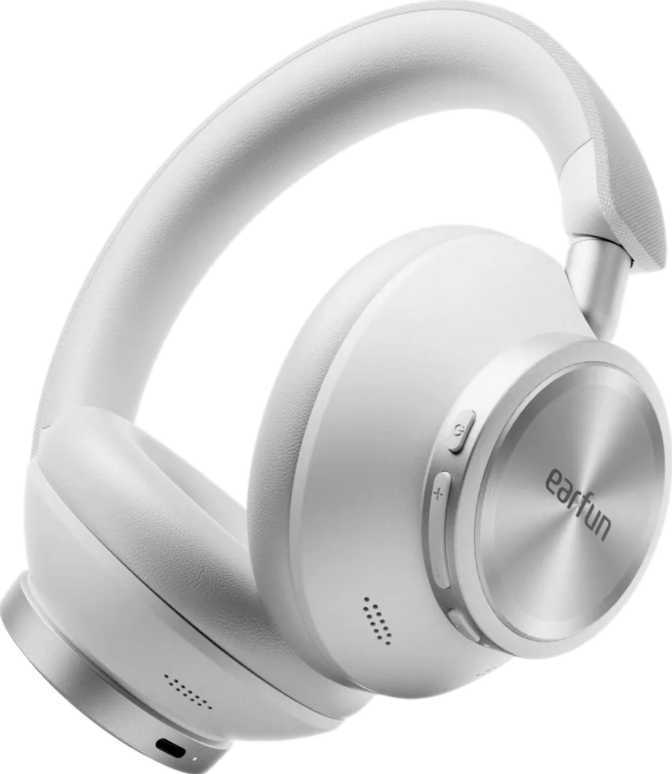
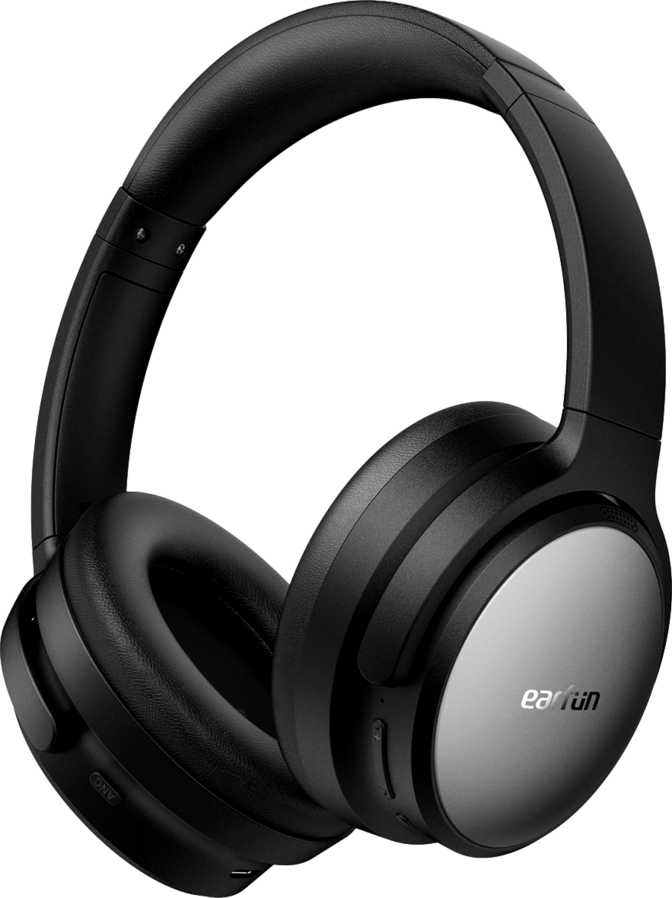
Pick up the EarFun Tune Pro and the first thing you notice is heft. At roughly 289.5 grams, it sits on the heavier end of the wireless over-ear category — most rivals land somewhere between 230 and 320 grams, so this isn't an outlier, but it's also not the headphone you reach for if your priority is "feels like nothing on my head." Over long sessions, that extra mass shows up as warmth and pressure around the ears rather than fatigue at the crown, assuming the headband padding is doing its job, which is the typical trade-off with this build style.
The earcups fold inward, which matters more than it sounds. A non-folding over-ear headphone is an awkward shape to pack — it eats backpack space and doesn't sit flat in a bag. Folding hinges solve that, shrinking the footprint for a commute or a flight.
No travel case included
If you want real protection in transit, budget for a separate pouch or hard case rather than assuming one ships with the unit.
Cable, Connectivity Hardware, and Everyday Handling
The Tune Pro supports both wireless and wired listening, and the cable itself is detachable rather than permanently wired into the earcup. That's a meaningful design choice for two reasons. First, if the battery ever dies mid-flight or mid-meeting, you're not stuck — plug in and keep listening. Second, a detachable cable means if it ever frays or breaks, you replace a $5–10 cable instead of sending the whole headphone in for repair.
The cable itself is built with a tangle-resistant weave, so it won't knot itself into a ball at the bottom of a bag the way cheaper rubber cables do. At 1.3 meters, it's sized for personal devices — phone, tablet, laptop — sitting an arm's length away. It is not long enough to be a home-stereo or amplifier cable, so if your wired use case involves sitting across the room from a desktop DAC, this isn't that cable.
One area where the Tune Pro is upfront about its limits: there's no water or sweat resistance rating at all. This is a headphone designed for desks, commutes, and living rooms — not for rainy runs or sweat-heavy training sessions. If you're shopping specifically for workout headphones, this isn't built for that environment and pushing it there is a genuine risk to the internals.
Sound Performance: How the Tune Pro Actually Sounds
The Driver and What 40mm Really Means
Inside each earcup sits a 40mm driver — large by in-ear standards, and on the bigger side even within over-ear headphones, where 40mm is a fairly common "go big" choice for brands chasing fuller bass response. Bigger drivers generally move more air, which tends to translate into deeper low-end extension and more headroom before bass distorts at higher volumes. That's the upside.
The nuance worth knowing: the Tune Pro does not use a neodymium magnet in its driver assembly. Neodymium magnets are prized in audio because they create a stronger magnetic field for the same size, which generally improves driver efficiency and can sharpen transient response — the snap and immediacy you hear on a kick drum or a plucked bass string. Without confirmation of a neodymium magnet, it's reasonable to infer the driver relies on a more conventional magnet type, which can mean the low end here favors warmth and weight over the kind of tight, fast punch you'd get from a neodymium-equipped driver at a similar price. In practical listening terms: expect bass that's present and satisfying for casual listening, but not the kind of articulate, controlled bass that critical listeners chase.
Noise Management: Three Layers, Not One
This is where the Tune Pro's spec sheet gets genuinely interesting, because it stacks three separate noise-handling technologies instead of relying on just one.
| Noise Layer | What It Does | Best Used For |
|---|---|---|
| Active Noise Cancellation (ANC) | Electronically cancels low-frequency, constant background noise | Engine hum, AC units, airplane cabins |
| Passive noise isolation | Physical seal of the earcup blocks sound mechanically | General ambient noise, no battery cost |
| Ambient sound mode | Pipes outside sound back in through the mics | Hearing announcements, ordering coffee, staying aware in transit |
Having all three means you're not locked into one mode of noise handling. ANC is excellent at killing steady, droning noise but can introduce a faint pressure sensation some listeners notice on long flights — passive isolation alone has no such side effect, just less cancellation power against deep rumble. Ambient mode flips the entire philosophy: instead of blocking the world out, it lets it back in intentionally, which matters more than people expect the first time they need to hear a gate announcement without removing their headphones entirely.
Spatial Audio: What to Actually Expect
The Tune Pro supports spatial audio, which widens the perceived soundstage so audio doesn't feel like it's coming from two points glued to your skull. For movies and certain mixed-for-surround content, this creates a noticeably more enveloping sense of space. It's worth being precise about what isn't confirmed here: there's no indication of head-tracking, which is the feature that adjusts the soundstage as you turn your head (the way AirPods Pro or similar premium implementations work). Treat this as a soundstage-widening feature, not a full head-tracked spatial system, and your expectations will match reality.
Connectivity: Bluetooth 5.4 and the Codec Reality Check
The Tune Pro runs on Bluetooth 5.4, the newest mainstream Bluetooth generation at the time of its design — a genuine upgrade over the Bluetooth 5.0/5.2 chips still common in budget wireless headphones, generally meaning a more stable connection and slightly better power efficiency from the radio itself.
No premium codecs — not even AAC
The Tune Pro does not support aptX, aptX HD, aptX Adaptive, aptX Lossless, LDAC, LDHC, or AAC. AAC is the default high-quality codec for iPhone wireless audio, so iOS listeners stream over the most basic universal codec, SBC.
The practical impact: it works everywhere — Android, iPhone, Windows, Mac, no compatibility headaches — but it caps the ceiling on wireless audio fidelity. For background listening, podcasts, and casual music, that ceiling won't bother most people. For anyone who has trained their ear on higher-tier or lossless streaming and wants that quality preserved over Bluetooth, this is the single biggest technical compromise in the entire spec sheet.
10 m range
Standard Class 2 distance
2-device multipoint
Auto-switches laptop and phone
Manual pairing
No NFC or fast-pair shortcut
Multipoint connectivity supports two devices at once, automatically switching between them. That's genuinely useful for hybrid work: stay connected to your laptop for meetings while your phone rings through for a call, with no manual re-pairing dance.
Battery Life: The Tune Pro's Real Headline
This is the section that defines the product. A 1100mAh battery is feeding a rated 120 hours of playback with ANC off, and 80 hours with ANC running continuously.
To translate that into how you'd actually live with it: at a realistic 3–4 hours of daily listening, 120 hours of capacity stretches to roughly a month of use without ANC, and around three weeks with ANC on the entire time. Most wireless over-ear headphones with ANC, even well-regarded ones, tend to quote somewhere in the 20–40 hour range per charge. The Tune Pro isn't competing in that range — it's operating in a different category of endurance entirely, and for anyone who's been burned by a headphone that needed daily charging, this is the spec that should move the needle.
The trade-off shows up at the charger. A full charge from empty takes about 3 hours, and there's no fast-charging spec listed, meaning there's no indication of a "10 minutes in, hours of playback out" quick-charge feature. The math still works in your favor — you're charging this thing roughly once every few weeks instead of nightly — but if you do let it run all the way to zero, plan to charge overnight rather than expect a quick top-up before you walk out the door.
USB-C charging — one cable for everything
Built-in battery indicator
Sealed, non-removable cell
Everyday Features That Shape the Experience
Calls run through a noise-canceling microphone, and the headphone is fully capable of working as a headset for video calls and voice chat — not just a music device. Controls live directly on the headphone itself rather than on an inline remote on the cable, so volume, track skipping, and call handling happen via on-ear controls whether you're connected wirelessly or wired.
What's included
- Noise-canceling microphone for calls
- Works as a full headset for calls and voice chat
- On-ear controls for volume, tracks, and calls
- 1.5-year warranty — longer than the 1-year category standard
What's missing
- No automatic pause via ear-detection sensor
- No dedicated physical mute button for calls
- No travel bag included in the box
Neither omission is a dealbreaker, but if you're coming from a headphone that had either feature, you'll notice their absence in daily use.
Who This Headphone Is Actually For
The EarFun Tune Pro is built for a specific kind of listener, and being clear about that audience is more useful than a generic "great for everyone" claim.
A strong fit if you are
- A commuter or office worker who wants weeks of use between charges, not days
- Someone juggling a laptop and phone who wants seamless multipoint switching
- A frequent traveler who values a wired backup when battery anxiety isn't worth the risk
- Someone who values universal compatibility over chasing the highest streaming fidelity
Not the right choice if you are
- A gym-goer or runner who needs sweat or splash resistance
- An audiophile chasing aptX, LDAC, or lossless wireless streaming
- Someone shopping for the lightest possible over-ear headphone
- Buying for a child — there's no volume-limiting feature here
How the Tune Pro Stacks Up Against the Category
Rather than guess at specific competing models, it's more useful to place the Tune Pro against the two general tiers it sits between, based purely on what its own spec sheet confirms and omits.
| Category Benchmark | Entry-Level Wireless ANC | EarFun Tune Pro | Premium Wireless ANC |
|---|---|---|---|
| Battery life (ANC on) | 15–25 hours | 80 hours | 25–40 hours |
| Codec support | SBC only | SBC only | Often AAC, aptX, or LDAC |
| Build weight | Lighter, lower-cost materials | 289.5 g | Often lighter, premium materials |
| Multipoint connectivity | Rare or absent | Yes, 2 devices | Common |
| Water resistance | Rare | None | Occasionally present |
| Warranty | Typically 1 year | 1.5 years | Varies, sometimes longer |
The pattern that emerges: the Tune Pro borrows its battery performance from a different weight class entirely — that 80-hour ANC figure would be a standout even among premium-tier headphones — while its codec support and build weight track closer to entry-level expectations. It's a headphone that picked one dimension to dominate and made deliberate trade-offs elsewhere to get there.
Strengths and Weaknesses, Honestly
What works
The case for the Tune Pro starts and ends with endurance — this is, without exaggeration, one of the longest-lasting wireless ANC headphones you'll find at this level, and that single fact changes how you relate to the device day to day. Pair that with genuinely flexible noise handling — three distinct modes instead of one — and a detachable, tangle-resistant cable that gives you a real wired fallback, and you have a headphone engineered around reliability rather than flash.
What holds it back
The honest weaknesses cluster around fidelity and resilience. The complete absence of advanced codecs, including AAC, means this headphone will never be anyone's pick for critical listening over Bluetooth, and the lack of any water or sweat resistance rules it out for active use entirely. The missing neodymium magnet is a subtler mark against it — not something most casual listeners will consciously notice, but a real reason the bass character leans warm rather than tight. None of these are surprises once you understand what the Tune Pro is optimized for; they're simply the cost of a 289.5-gram headphone that runs for 80 hours on a single charge.
Questions Buyers Are Asking
Final Verdict
The EarFun Tune Pro earns its place by solving the one problem that frustrates wireless headphone owners more than almost anything else: running out of battery at the wrong moment. With up to 80 hours of ANC playback and a sensible wired backup built in, it's a headphone you charge on your schedule, not its own.
Buy this if your priority list starts with battery endurance, flexible noise control, and dependable everyday use across a phone and laptop — and you're comfortable trading away hi-res codec support and any water resistance to get there. Skip it if you need workout-ready durability or you're chasing the highest possible wireless audio fidelity. For everyone else — the commuter, the hybrid worker, the traveler who hates charging cables — this is a genuinely smart, well-targeted pick.