DJI Neo: An Honest Look at the Ultra-Light FPV Drone
DronesMost people who want aerial footage face an uncomfortable choice: lug around a drone bulky enough to need its own backpack, or settle for a toy that can barely hold a heading in light wind. The DJI Neo sits in a different category entirely, a flying camera small enough to launch from your palm, light enough to skip past most drone registration headaches, and capable enough to shoot real 4K footage without a learning curve that scares off first-time pilots.
This is not a drone built to chase specs against professional cinema platforms. It is built for the much larger group of people who want smooth, shareable footage of their travels, their dog, their bike ride, or their own face, without carrying a case full of gear or studying a manual for a week first. Whether that trade-off works for you depends on exactly what you are willing to give up, and that is what the rest of this review breaks down.
DJI Neo at a Glance
135 g
Lighter than most phones
~18 min
Max rated flight time
57.6 km/h
Top recorded speed
4K / 60fps
Maximum video capture
Design, Build Quality and Just How Pocket-Sized This Really Is
Pick up the DJI Neo and the first thing you notice is that it barely registers as a weight in your hand. At roughly 135 grams, about 4.8 ounces, it is lighter than almost every smartphone on the market today. That is not a trivial detail. Many aviation authorities around the world treat sub-250-gram drones differently from heavier ones, often with simpler registration requirements, though the exact rules depend entirely on where you live and you should always confirm local regulations before your first flight.
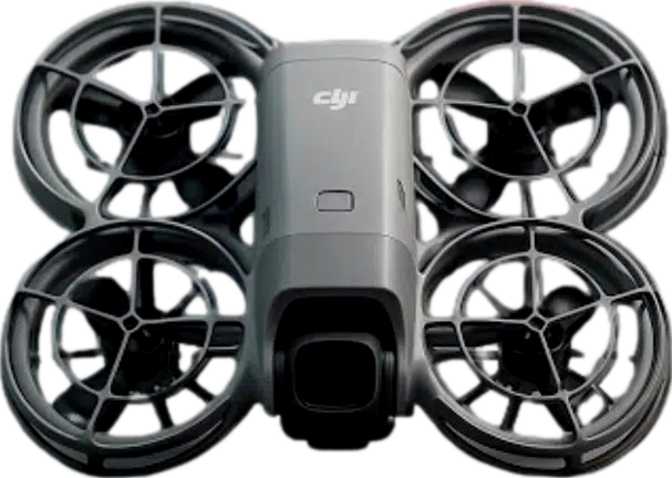
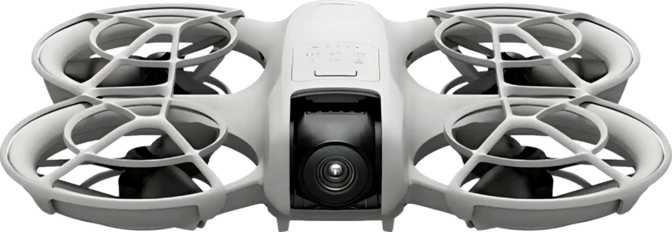
The body itself measures about 157mm wide, 130mm deep, and just under 49mm tall (roughly 6.2 x 5.1 x 1.9 inches), with a total volume close to a single one-liter water bottle. In practice, that means it disappears into a jacket pocket or the side pouch of a daypack without you noticing it is there, a genuine advantage over camera drones that demand their own dedicated case.
Not weatherproof
The DJI Neo is not weather-sealed or splashproof, so light rain, heavy mist, snow, or flying near waterfalls and ocean spray are all situations where you are taking on risk the drone was not built to handle. Paired with an operating range of -10°C to 40°C (14°F to 104°F), this is a fair-weather flyer, not an all-conditions tool.
Flight Performance: What the Numbers Actually Mean in the Air
A maximum flight time of 18 minutes sounds straightforward, but like virtually every drone on the market, that figure is measured in ideal, windless conditions at a steady cruising speed. Push the throttle, fly into a breeze, or hover in place to frame a shot, and you should realistically plan for something closer to 12 to 15 minutes of usable flight time per battery.
Top speed comes in at 16 meters per second, which works out to about 57.6 km/h or 35.8 mph. That is brisk enough to keep pace with a cyclist or a jogger for action shots, but it is not a speed built for aggressive freestyle flying or chasing fast vehicles. If your goal is smooth, cinematic motion rather than adrenaline, this ceiling will rarely feel limiting.
The maximum transmission distance is rated at 10 kilometers, but in real-world use this number matters far less than people assume. Most regions legally require recreational pilots to keep their drone within visual line of sight, and the battery itself becomes the limiting factor long before signal range does. Treat the 10km figure as a measure of signal headroom and interference resistance, not as a real flight radius.
Underneath all of this, the DJI Neo relies on GPS and a built-in compass to hold its position and orientation, with a gyroscope handling in-flight stabilization. Together, these are what allow the Return to Home function to work reliably: if you lose visual contact, run low on battery, or simply want a safe, automatic landing, the drone can navigate back to its takeoff point on its own. For nervous first-time pilots, this safety net does a lot of the emotional heavy lifting.
GPS & Compass
Stable position holding for confident hovering
Return to Home
Automatic recovery if signal or battery runs low
Intelligent Flight Modes
Automated flight-and-camera sequences
No obstacle detection
The DJI Neo does not include obstacle detection sensors. That is a meaningful omission, especially because its small size and FPV capabilities practically invite flying through doorways, around furniture, and close to trees, people, and pets. Branches, ceiling fans, narrow hallways, and low-hanging wires will not be detected automatically, so full responsibility sits with the pilot. Practice in open, low-risk areas before attempting anything tight or technical.
Camera and Video Quality: What You Can Actually Capture
The main camera shoots 12-megapixel still photos, a resolution that will not compete with dedicated photography drones built for large-format prints, but one that is more than sufficient for social posts, blog headers, and casual printing. Where it gets more interesting for enthusiasts is RAW capture support: shooting in RAW preserves far more image data than a standard JPEG, giving you real room to recover shadow detail, fix white balance, and push color grading in post-production.
Light sensitivity tops out at ISO 6400, which gives you a genuine option for dusk, indoor, and overcast shooting rather than being limited strictly to bright daylight. Worth setting expectations honestly here: small drone sensors generally show more visible grain at the top of their ISO range than a phone or mirrorless camera would, so treat ISO 6400 as a usable ceiling for difficult lighting rather than a clean, noise-free setting.
Video is where this drone is clearly built to perform. It records at 4K resolution (2160p) at 60 frames per second, with a movie bitrate of 75 Mbps. That frame rate gives you the option to either capture smooth, lifelike 60fps footage or slow it down in editing for a soft slow-motion effect. The bitrate sits in a healthy middle ground: high enough to preserve fine detail in motion-heavy footage without ballooning file sizes the way uncompressed cinema formats would.
Built-in HDR
Balances bright skies against shadowed ground
Burst Shooting
Rapid stills so you can pick the best frame later
In-Camera Panorama
Stitches wide landscape shots on the drone itself
117.4° Field of View
Immersive wide angle, with some edge distortion
The FPV Camera: Flying From a Pilot's-Eye View
Beyond the standard camera, the DJI Neo includes a dedicated FPV (first-person view) camera mode, a feature that fundamentally changes how flying feels. Instead of watching your drone from the outside as a distant object in the sky, FPV mode puts you behind the eyes of the aircraft itself, as if you were sitting in a tiny cockpit.
This is the feature that separates the DJI Neo from a typical compact camera drone. Standard drones are built to film you or your surroundings from a third-person vantage point; FPV-capable drones are built to make you feel like you are the one flying, weaving, and diving. For content creators, this translates into fast, swooping, immersive shots that feel handheld even though nothing was actually held. For total beginners, it is worth knowing this mode has a steeper learning curve than basic point-and-shoot flying, precisely because you are navigating from the drone's perspective rather than your own.
Battery Life and Charging: Real-World Endurance
The featherweight design philosophy extends directly to the battery. It is a relatively small, removable cell, removable being the operative word, because it means you can carry spares and swap between them in seconds rather than waiting through a full recharge mid-session. Given the realistic 12-to-15-minute flight window, planning around two or three spare batteries is the difference between a quick test flight and a genuinely productive shooting session.
On the charging side, a full charge takes about an hour, which is reasonably fast for a drone battery of this size. If you only own a single battery, you can realistically fit in two flights within a couple of hours rather than writing off the rest of your afternoon waiting for a recharge. Cold weather is worth flagging too: battery chemistry generally loses efficiency as temperatures drop toward that -10°C floor, so expect flight times to shrink further on chilly days, not just stay flat.
Storage, Controls and Smart Flight Features
Storage
The DJI Neo ships with 22GB of internal storage and, notably, no external memory card slot. That is a deliberate simplicity trade-off: there is no card to lose, format incorrectly, or forget to bring, but there is also a hard ceiling on how much footage you can shoot before offloading files. Doing the math against the 75 Mbps bitrate, that internal storage holds somewhere in the neighborhood of 35 to 40 minutes of continuous 4K60 footage, comfortably more than a single battery allows, but tight enough that frequent shooters will want to clear footage between outings.
Controls
Control flexibility is a genuine strength here. The drone supports flying directly from a smartphone through a companion app, the simplest path for total beginners. It also pairs with a dedicated physical remote controller that includes its own screen, the better choice once you outgrow phone-only flying: a physical controller typically extends practical range, removes notification distractions, and gives more precise stick control than touchscreen taps ever can.
Rounding out the feature set are intelligent flight modes, pre-set automated flight-and-camera sequences that handle the flying and framing simultaneously. Combined with GPS-based position holding and the safety net of automatic Return to Home, the overall system is clearly designed to lower the barrier to entry for people who have never flown anything before.
Real-World Scenarios: Who the DJI Neo Is Built For
This Drone Makes Sense If You Are
- A travel or lifestyle creator who wants smooth aerial and FPV-style clips without checking a drone bag at the airport
- A complete beginner who wants automated flight modes and a Return to Home safety net while learning
- Someone curious about immersive FPV flying without committing to a dedicated racing rig and goggles
- A casual photographer who values RAW flexibility and 4K60 video over maximum megapixel count
- Someone who flies occasionally and values grab-it-and-go portability over all-weather durability
This Drone Is a Poor Match If You Are
- A professional photographer who needs high-megapixel stills for large prints or commercial clients
- A pilot who regularly flies in rain, fog, snow, or near water spray
- Someone planning long, uninterrupted flight sessions without carrying spare batteries
- An experienced FPV racer expecting genuine speed and aggressive freestyle handling
- Someone who frequently flies tight indoor spaces and was hoping for automatic obstacle avoidance
How the DJI Neo Compares to Other Compact and FPV-Style Drones
| DJI Neo-Style Hybrid | Traditional Palm-Sized Camera Drones | Dedicated FPV Racing Drones | |
|---|---|---|---|
| Primary purpose | Casual cinematic footage plus immersive first-person flying | Stable, third-person cinematic footage | Speed, agility, racing and freestyle |
| Obstacle detection | None, pilot-dependent | Often includes basic sensors | Rare, skill-dependent |
| Portability | Extremely high, sub-1-liter body, sub-150g weight | High, but typically bulkier | Moderate to low, frame plus goggles plus controller |
| Learning curve | Low for basic flying, moderate for FPV mode | Low | High |
| Best suited for | Beginners wanting stability and an FPV thrill in one device | Travelers and vloggers prioritizing simplicity | Experienced pilots chasing speed and precision |
The honest takeaway: the DJI Neo is not trying to out-spec dedicated racing drones, and it is not trying to match the sensor-laden safety features of larger camera drones either. It carves out a specific middle lane, genuinely portable, genuinely beginner-friendly, with an FPV mode that larger camera drones simply do not offer.
Strengths and Weaknesses: The Honest Take
What It Gets Right
The DJI Neo's biggest win is how effectively it removes friction from flying. The combination of light weight, small footprint, phone-only control option, and automated flight modes means someone can go from never having flown a drone to capturing a usable clip within a single short session, not a small achievement in a hobby that has historically intimidated beginners.
The RAW photo support and 4K60 video give it genuine creative range for a device this size, and the removable battery with a one-hour recharge keeps you shooting rather than waiting.
Where It Falls Short
The lack of obstacle detection is the most consequential weakness, particularly because the FPV mode and compact size both encourage flying in exactly the close, tight spaces where sensors would matter most. The absence of weather sealing rules out a meaningful chunk of real-world conditions.
The modest internal storage with no expansion option means you will need to manage footage actively rather than letting it pile up. None of these are dealbreakers alone, but together they show a drone optimized for ease and portability first, with some traditional safety and convenience features traded away to get there.
Common Questions Buyers Ask Before Purchasing
Final Verdict: Is the DJI Neo Worth Buying?
The DJI Neo earns its place as one of the easiest, most genuinely portable ways to get into aerial and FPV-style content creation. If your priority is grabbing smooth 4K footage, immersive first-person clips, and a stress-free learning curve, without obstacle sensors getting in the way of close, fast flying, or weatherproofing locking you out of bad-weather days, this is a confident buy, especially for beginners and casual creators who value convenience over technical depth.
Skip it if you need all-weather reliability, automatic obstacle avoidance for tight indoor flying, high-resolution stills for professional work, or genuine racing-grade speed. For everyone else who just wants compelling footage with minimal hassle and minimal gear, the DJI Neo delivers exactly what it promises.