Amazon Basics X12 Review: When Fewer Features Means Better Sound
SoundbarsThe Bluetooth speaker market is crowded with products that promise everything: voice assistants, companion apps, Wi-Fi streaming, speakerphone capability, and smart home hooks. Most treat audio quality as a baseline expectation rather than a design priority. The Amazon Basics X12 makes a different calculation — strip away the smart features, refuse the remote control, skip the companion app — and redirect that engineering attention into the wireless audio pipeline itself. The result will disappoint buyers looking for a connected lifestyle device, but will quietly impress anyone whose first question is simply: how does it actually sound?
Design, Build Quality, and Physical Presence
Form Factor
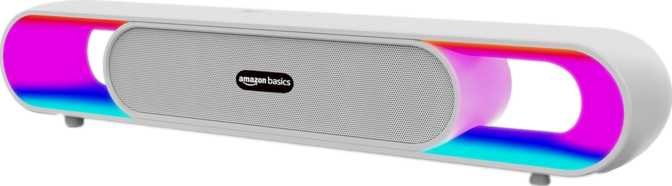
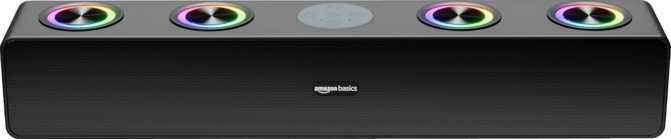
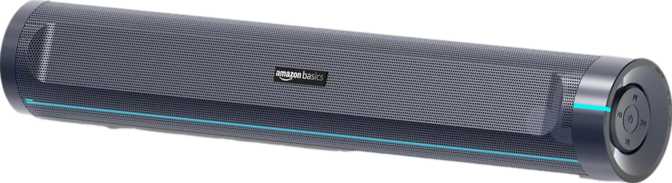
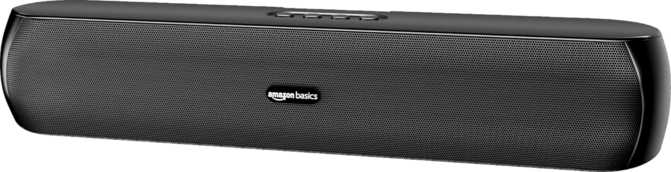
The X12 takes the wide, low-bar shape that works well on desks, nightstands, and bookshelves. At roughly fifteen inches across but only about two and a half inches tall and equally shallow, it carries the visual presence of a compact soundbar without any television-room aspirations. Placed in front of a laptop, along the front edge of a shelf, or on a bedside table, it occupies a horizontal footprint without demanding vertical space.
The extended width matters acoustically, not just aesthetically. With two stereo drivers spread across that span, the physical channel separation is wider than what a compact cylindrical or cube-shaped speaker can achieve. When music carries genuine left-right information — and most modern recordings do — that distance between drivers creates a soundstage that feels more open and dimensional.
Weight and Portability
At just over 600 grams — roughly the weight of a full 500ml water bottle — the X12 sits in a practical middle zone. Heavy enough to stay stable on a surface during bass-heavy playback without vibrating across a desk; light enough to carry between rooms or pack into a bag, though its bar dimensions make it less grab-and-go than a palm-sized speaker. It is not pocket-portable, but it travels reasonably well for its size.
Controls
All physical controls sit directly on the speaker housing. There is no remote control, no companion smartphone app, and no voice command capability — every interaction happens at the device itself. For many users, that simplicity is genuinely appealing: no app that needs to be open to adjust volume, no cloud dependency, no ecosystem account required. For users who prefer to manage audio from across a room, the absence of remote or app-based control is a real friction point worth knowing before buying.
Audio Performance
Stereo Output
The X12 outputs true stereo — two discrete audio channels — which is the right foundation for music playback, film audio, and any content that carries spatial information. This is distinct from many compact speakers that blend both channels into a single mono driver for simplicity. For sustained listening sessions, the difference is tangible: instruments occupy separate positions in the mix, vocals sit forward while reverb trails behind them, and the overall listening experience has depth rather than just volume.
Wireless Audio Codecs
Bluetooth audio without codec negotiation falls back to a baseline compression format that audibly degrades high frequencies and struggles with complex musical passages. The X12 supports three codecs above that baseline, each targeting a different device ecosystem.
AAC
Apple Ecosystem
Apple's native audio codec — the format iPhones, iPads, and Macs negotiate automatically when pairing over Bluetooth. It delivers efficient compression that preserves instrument clarity and treble detail at a standard well above the baseline. Apple users pair, play, and hear a clean signal without additional configuration.
aptX
Android Ecosystem
Qualcomm's standard codec, widely supported across Android smartphones and tablets. It prioritizes lower latency than AAC — meaning audio tracks more tightly with video — and delivers a direct, transparent character that Android users familiar with it will recognize immediately.
aptX Adaptive
Standout Feature
Qualcomm's most advanced consumer wireless audio codec — a variable-bitrate format that scales dynamically based on signal conditions and, at its peak, transmits audio at resolutions that exceed compact disc quality. Finding aptX Adaptive in a speaker at this price tier is genuinely unusual; it typically appears at significantly higher price points.
Bluetooth 5.3 — A Modern Foundation
The X12 uses Bluetooth 5.3, the current generation of the standard. The practical advantages over older versions common in entry-level speakers include improved connection stability at range, faster initial pairing negotiation, and lower power draw on both the speaker and the connected device. In environments with many competing wireless devices — a home office, a shared living space with multiple smart gadgets — the improved interference handling is a real-world benefit, not just a spec upgrade.
Wired Input
A 3.5mm auxiliary input provides a wired audio path that earns its place in the connectivity lineup. Connecting a laptop directly bypasses the wireless chain entirely for a compression-free signal; plugging in a record player or older media player gives legacy sources a modern playback path; wiring a device without strong Bluetooth codec support delivers clean audio without wireless variability. As a growing segment of the portable speaker market eliminates the 3.5mm jack in pursuit of a cleaner exterior, the X12's decision to retain it makes it more versatile than several competitors.
Power Source — Confirm Before Buying
The published specifications for the X12 do not include battery capacity or runtime figures. Before purchasing, confirm in the product listing whether this speaker operates from an internal rechargeable battery, requires USB power, or uses an AC adapter. That single detail determines whether the X12 functions as a portable device or a fixed-desk one, and is the most consequential contextual detail the published specifications do not resolve.
What the Amazon Basics X12 Does Not Include
Each of these absent capabilities will be a dealbreaker for some buyers. Knowing this clearly before purchase is better than discovering it on arrival.
Who the Amazon Basics X12 Is For — and Who It Isn't
- Primarily streams audio from a smartphone or laptop and wants output that reflects the quality of the source
- Values audio fidelity over feature quantity — one clear priority, not a checklist
- Uses a compatible Android device and wants to exploit aptX Adaptive, or uses Apple devices and is satisfied with AAC's strong performance
- Wants a speaker that works reliably without software dependencies, cloud connections, or ecosystem accounts
- Needs occasional wired connectivity for a mixed-source setup — turntable, older device, or direct laptop connection
- Makes regular hands-free calls through a Bluetooth speaker — the absent microphone blocks this entirely
- Relies on Alexa, Google Assistant, or Siri to manage playlists, smart home routines, or timers
- Wants platform-native playback modes like Spotify Connect or AirPlay for seamless streaming
- Needs to adjust volume or skip tracks from across a room without reaching for a source device
- Is building a multi-room audio setup where grouped playback and device linking are expected
How the X12 Compares to the Alternatives
The speaker category the X12 inhabits divides between smart-feature-heavy products that bundle assistants and apps while treating audio as a given, and stripped-down speakers that prioritize playback fidelity above the convenience checklist. The X12 sits definitively in the second camp — but with a technical credential that makes the comparison more interesting than it first appears.
| Feature | Amazon Basics X12 | Smart-Feature Competitors (Same Price) |
|---|---|---|
| Peak Wireless Codec | aptX Adaptive | AAC or standard aptX |
| Bluetooth Version | 5.3 | 5.0 – 5.1 common |
| Channel Output | True stereo (2 channels) | Often single-driver mono |
| 3.5mm AUX Input | Included | Frequently removed |
| Built-in Microphone | None | Typically integrated |
| Voice Assistant | None | Usually Alexa or Google |
| App Dependency | None required | Usually required for setup |
| Long-Term Reliability | No cloud dependency | Cloud-dependent features may degrade |
Competitor characteristics reflect the typical feature set of comparably priced smart Bluetooth speakers as a category, not any specific individual product.
Honest Assessment
What the X12 Gets Right
The aptX Adaptive codec support is the headline strength, and it is a meaningful one for compatible devices. Bluetooth 5.3 provides a stable, modern wireless foundation that holds up in busy environments. The wide stereo driver placement creates a convincing soundstage that compact single-driver speakers cannot replicate.
The AUX input adds real versatility for mixed-source users. And the deliberate absence of app dependencies, cloud connections, and smart home hooks means this speaker will function identically years from now — no software updates required, no discontinued services, no platform changes affecting its operation. That kind of long-term reliability is an underrated quality in a market dominated by devices with cloud-dependent features.
Where the X12 Falls Short
The lack of a microphone is the hardest limitation to look past. It is not a missing convenience — it blocks a use case entirely. Hands-free calls, voice commands, and any form of interactive audio input are off the table at the hardware level.
The absence of Wi-Fi is a permanent architectural ceiling. No future update adds Spotify Connect, multi-room capability, or platform-native streaming. If listening habits evolve toward those features, a different speaker becomes necessary.
No remote control and no app creates a genuine workflow question for anyone who places this speaker beyond arm's reach. At a desk, that is a non-issue. On a shelf across the room, adjusting volume requires walking to the unit or reaching for the source device every time.
Questions Buyers Ask Before Purchasing
Final Verdict
The Amazon Basics X12 is a focused product with a focused purpose. It delivers stereo audio over Bluetooth, supports a codec suite that reaches higher fidelity than its price tier typically allows, connects via wired input for source flexibility, and then gets out of its own way. No app to manage, no ecosystem to commit to, no smart features waiting to be deprecated.
That singular focus is also its hard boundary. No microphone, no remote, no Wi-Fi, no voice assistant, no smart home integration. These are not missing luxuries — they are absent use cases that cannot be recovered.
For the buyer who wants a reliable, audio-quality-first stereo speaker — and particularly one with a compatible Android device capable of exploiting the codec support that most competing products never implement — the X12 earns a clear recommendation. It does less than most competitors on paper, and more than most where the quality of music playback is actually determined.