Codec 1
AAC
Good QualityApple's native audio codec. iPhone, iPad, and Mac users receive solid-quality audio without any setup — it works automatically on all Apple devices with no configuration required.
A compact, Bluetooth-first soundbar with advanced wireless codec support — and significant connectivity limits that matter for traditional TV users.
Our Score
Narrow but Genuine Recommendation
Strong for Bluetooth-first listeners. Limited for TV home theater use.
There's a version of a soundbar that does everything: pulls audio over HDMI, responds to voice commands, streams music directly from the internet, and syncs with your smart home. The Amazon Basics SB25R is not that soundbar. What it is, though, is a rare thing in consumer audio — a device with a clearly defined purpose that it pursues without apology.
If you buy it understanding what it actually does, you'll likely be satisfied. Buy it expecting features it never advertised, and you'll be disappointed. This review exists to make sure you know the difference before spending anything.
The Core Trade-Off
The SB25R trades traditional TV connectivity (HDMI ARC, optical input) and convenience features (remote, app) for a strong Bluetooth audio stack that outperforms most soundbars at this price. Whether that trade makes sense depends entirely on your specific setup.
What you're actually holding and placing on your shelf.
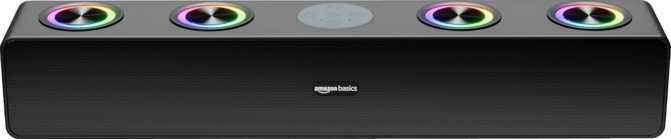
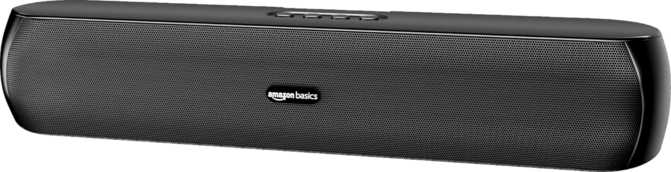
At approximately 17 inches wide, the SB25R fits comfortably beneath small to mid-size televisions without extending past the screen's edges. The low profile — just under 3.8 inches tall and barely 2.8 inches deep — tucks against a wall or sits flat on an entertainment unit without demanding attention. At just under two pounds, repositioning takes seconds and mounting requires no heavy hardware.
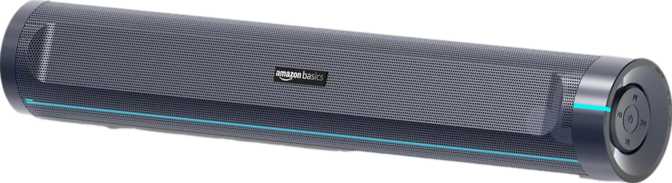
Controls are placed directly on the unit — clean and minimal. What you will not find is a remote control. This is a deliberate omission, not an oversight, and it carries real consequences depending on where and how you use the soundbar.
No Remote Control Included
For desktop or bedroom users within arm's reach, this is entirely manageable. For a living room scenario ten feet from the couch, every volume adjustment requires getting up — a friction point that compounds noticeably with daily use.
The complete picture of how this soundbar connects to your devices.
The SB25R connects in exactly two ways: wirelessly via Bluetooth or wired via a 3.5mm auxiliary input. There is no HDMI port, no optical input, and no Wi-Fi — a deliberately lean connection profile that prioritizes wireless simplicity over traditional TV integration.
The most current consumer Bluetooth standard. Delivers improved connection stability, reduced interference in crowded wireless environments, and lower latency compared to Bluetooth 5.0 — which many competing soundbars still use today.
A wired fallback that bypasses all wireless compression entirely. Delivers audio without codec-related quality loss, and enables older TVs with a 3.5mm headphone jack to connect without any Bluetooth involvement.
Audio codecs determine how much sound quality survives the wireless trip from your device to the speaker.
Most budget soundbars compress audio significantly over Bluetooth. The SB25R supports three codecs — including one that is genuinely rare at this price tier.
Codec 1
Apple's native audio codec. iPhone, iPad, and Mac users receive solid-quality audio without any setup — it works automatically on all Apple devices with no configuration required.
Codec 2
Qualcomm's standard codec. A meaningful improvement over baseline Bluetooth compression, used widely across Android devices. Delivers cleaner, more detailed wireless audio than the fallback default.
Codec 3
Qualcomm's highest-grade wireless audio codec. Dynamically adjusts its transmission rate toward studio-grade fidelity when wireless conditions allow. Normally reserved for premium headphones costing far more.
No aptX Adaptive device? The soundbar automatically falls back to aptX, AAC, or standard SBC — so you still receive good wireless audio quality regardless of what your phone or tablet supports.
Credibility requires stating limitations plainly. These omissions define the product and have real consequences for certain buyers.
The most common TV audio output on modern televisions cannot connect to this soundbar. Your options are limited to Bluetooth pairing or a 3.5mm cable from your TV's headphone jack — if your TV still has one. Many recent televisions have removed this port entirely in favor of HDMI ARC.
Optical (S/PDIF) is the fallback wired TV connection that budget soundbars have relied on for years. Without it, and without HDMI, the SB25R cannot participate in either of the two most common wired TV-to-soundbar connection paths in use today.
No Spotify Connect, no AirPlay, no Chromecast. The soundbar cannot pull audio from your network independently. Playback must come from a Bluetooth device actively paired to it, or through the wired auxiliary cable.
Both are spatial audio formats that create a sense of dimensional sound from a single unit. The SB25R produces strictly two-channel stereo. Cinema content will always present as a front-stage experience — there is no rear channel, height information, or surround simulation of any kind.
Controls live on the device only. There is no EQ adjustment, no preset modes, and no compatibility with Google Assistant, Alexa, or Siri. For those accustomed to modern smart speaker integration, this is a significant departure from current expectations.
What two-channel audio actually delivers in daily use.
Two-channel stereo has been the standard for recorded music for decades and remains entirely appropriate for this purpose. The SB25R delivers a clear, separated stereo image that built-in TV speakers or laptop audio genuinely cannot match.
For content mixed for surround sound, stereo means a front-stage presentation. Dialogue stays centered, and the two speakers create genuine width — but there is no rear channel, no height information, and no simulated surround. More spacious than built-in speakers, but categorically different from a surround system.
Stereo is not inferior — it is simply a different format. Understanding what it delivers in practice prevents the frustration of expecting something the hardware was never designed to produce. For casual TV watching and everyday music listening, stereo is entirely competent.
Match your use case honestly before purchasing.
Sitting within arm's reach means on-device controls are manageable and the audio improvement over built-in speakers is immediately meaningful.
No ecosystem lock-in, no apps, no accounts. Just a speaker that connects and plays — nothing to configure beyond a Bluetooth pairing.
Android users with aptX Adaptive support get real wireless fidelity gains. Even without it, aptX and AAC deliver solid quality from any modern smartphone.
Guest rooms and home offices where a simple audio upgrade is the goal without justifying a larger investment.
When the core goal is any improvement over built-in TV speakers at the lowest possible cost, this delivers on that goal.
Most modern televisions route audio through HDMI ARC. This soundbar cannot participate in that system — even entry-level soundbars from dedicated audio brands offer it at a modest premium.
Soundbars with Dolby Atmos support deliver a meaningfully wider and more layered experience for Netflix, Disney+, and similar services.
Sitting ten feet away with no remote means getting up every time you adjust the volume. Over weeks of daily use, this becomes genuinely tedious.
There is no network connection. The soundbar plays what a paired Bluetooth device sends it — it doesn't pull audio from the internet independently.
How it stacks up against typical alternatives at a similar price.
| Feature | Amazon Basics SB25R | Typical Budget Soundbar |
|---|---|---|
| Bluetooth Version | 5.3 (Latest) | 5.0 (Common) |
| Best Wireless Codec | aptX Adaptive | aptX or SBC |
| HDMI ARC Input | No | Some models |
| Optical Input | No | Widely available |
| Remote Control | No | Standard inclusion |
| Wi-Fi Streaming | No | Not at this tier |
| Dolby Atmos | No | Select models |
| Channel Configuration | 2.0 Stereo | 2.0 or 2.1 with subwoofer |
The trade-off is specific: superior wireless audio quality in exchange for connectivity flexibility and convenience. Budget soundbars from dedicated audio brands at comparable prices frequently include optical inputs and remotes — making TV integration smoother. They simply won't match the SB25R's wireless audio ceiling.
Strengths and weaknesses stated plainly — no spin.
The aptX Adaptive support is the standout quality. For Bluetooth-first users with compatible devices, the wireless audio ceiling here meaningfully exceeds what this price tier normally delivers — not a marginal gap, but a real differentiator over soundbars that top out at standard aptX or SBC.
Bluetooth 5.3 adds tangible connection stability and interference resistance. In crowded wireless environments, this reduces dropouts and pairing friction compared to older Bluetooth versions common in competing products.
The design is compact, lightweight, and unobtrusive — honest about its ambitions. It serves desk and bedroom users well without occupying space or demanding attention.
The complete absence of optical and HDMI inputs is a hard limit with no workaround. If your TV uses HDMI ARC — which describes most modern flat-panel televisions — this soundbar cannot integrate the way buyers typically expect.
The missing remote is not merely an inconvenience. In a living-room setup, it changes how you interact with the audio system every single time you sit down to watch something. Over weeks of daily use, this accumulates into real friction.
Two-channel stereo means cinema content will always feel front-stage, regardless of the source. The gap between this and a Dolby Atmos soundbar is categorical, not incremental.
Straight answers to common pre-purchase questions about the Amazon Basics SB25R.
You are a Bluetooth-first listener who wants a compact audio upgrade and owns a device that takes advantage of aptX Adaptive or aptX. The wireless audio quality is a differentiator that products at this price rarely offer. Small footprint and zero complexity make it an ideal fit for desks, bedrooms, and secondary rooms where you sit close enough to manage on-device controls.
You need TV integration through HDMI or optical, expect to control volume from your couch without getting up, or want spatial audio for movie watching. Other soundbars at similar prices offer those features — they simply won't match this soundbar's wireless audio ceiling.
Buy it for Bluetooth-first listening. Don't buy it for TV home theater use.