Optoma HCPro-5400 Review: 4K Laser Cinema Projection for Enthusiasts
ProjectorsAt a Glance
The Optoma HCPro-5400 is a serious investment in long-term home cinema performance. Laser precision, complete HDR format coverage, and installation-grade optics make it one of the most capable 4K projectors in its class — provided you have the room, the setup, and the supporting equipment it deserves.
Editor's Overall Score
Key Specifications, Translated
Every data point rewritten into what it means for your cinema experience — no spec-sheet language.
Full 3840×2160 resolution — every detail resolved at the screen sizes where it genuinely matters.
Tens of thousands of hours before brightness fades. No bulb replacements, no drift in color accuracy over time.
Near-elimination of banding in sky gradients and skin tones. Beyond what most displays offer.
Commercial cinema territory. The 100–200 inch home range is where performance truly shines.
Quieter than most lamp rivals. Eco mode drops to 25 dB — comparable to a quiet desk fan.
Physical image repositioning on both axes — no digital processing, no image quality loss.
Requires meaningful room depth. Plan 3–4 m back from a 120-inch screen — measuring is essential.
Installation-class hardware. Use ceiling mounts rated 15 kg minimum, anchored to solid structure.
Design and Build Quality
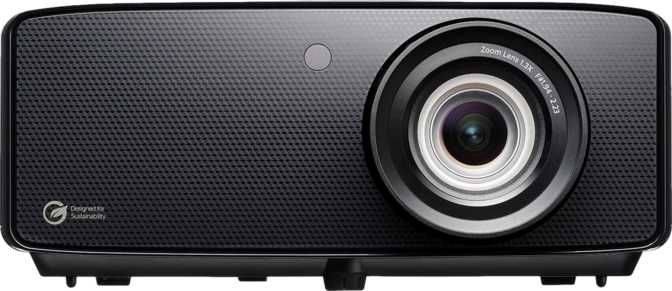
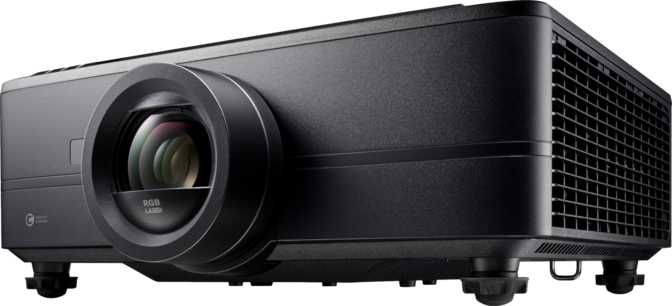
The HCPro-5400 is not trying to be discreet. At 490mm wide and 430mm deep, it occupies real physical space — and at 11.5 kilograms it demands a proper ceiling mount or a rigid, stable surface. This is not a unit you casually place on a coffee table for movie night and tuck away afterward.
That physical presence is purposeful. Laser projection systems require more internal optical and thermal engineering than traditional lamp-based units, and the HCPro-5400's dimensions reflect that discipline. The chassis is built to manage heat efficiently across long projection sessions — something that matters far more than compactness for an installation-class product.
Physical controls are supplemented by a full remote control. The combination of motorized and manual focus and zoom options signals that this was designed with installers and AV professionals in mind. Once ceiling-mounted, every critical adjustment is achievable via remote — practically essential at that weight.
Physical Specifications
- Width
- 490 mm
- Depth
- 430 mm
- Height
- 190 mm
- Weight
- 11.5 kg
- Noise (Standard)
- 28 dB
- Noise (Eco Mode)
- 25 dB
- Power Consumption
- 323 W
Why the Laser Light Source Changes Everything
The HCPro-5400 uses a laser light source rather than a traditional lamp, and this distinction deserves more than a footnote — it redefines the ownership experience entirely.
Traditional lamp projectors require bulb replacements every few thousand hours of use. Each replacement is a cost event and a maintenance interruption. Laser light sources, by contrast, are rated for tens of thousands of hours before meaningful brightness degradation begins. For a projector seeing regular use — nightly movie watching, weekly home theater sessions — this translates to well over a decade of service before the light engine becomes a concern.
Beyond longevity, laser sources maintain more consistent color accuracy over time. Lamp brightness and color temperature drift as bulbs age; the HCPro-5400's laser engine keeps the image you calibrate at setup closely matching what you see years later.
Noise is also a beneficiary. At 28 decibels during standard operation — dropping to 25 decibels in eco mode — the HCPro-5400 runs quieter than many comparable lamp-based projectors. In a quiet room during dialogue-heavy scenes, projector noise is genuinely distracting. At these levels, the unit stays audible but unobtrusive.
Laser vs Lamp at a Glance
- No bulb replacements — laser longevity exceeds any lamp replacement schedule significantly.
- Color calibration stays relevant over years — output profile remains stable, not degrading monthly.
- Lower total ownership cost despite a higher initial investment — no recurring replacement expenses.
- Quieter operation with less thermal load at equivalent brightness levels.
Image Quality: What 4K, 12-Bit, and Full HDR Actually Mean
Native 4K Resolution
The HCPro-5400 outputs at true 4K resolution. At the screen sizes this projector is designed for, resolution genuinely matters. On a 150-inch screen, the difference between 1080p and 4K is visible and meaningful: text is crisper, fine detail in landscapes and close-up shots is resolved rather than softened, and fast motion retains structural clarity. At smaller screen sizes the benefit is subtler — at projection sizes over 100 inches, it is substantive.
Complete HDR Format Coverage
The HCPro-5400 supports every major HDR standard currently in active use — a level of coverage that is relatively uncommon at any price point. Whatever content you play, it receives optimized HDR processing rather than a fallback to standard dynamic range output.
| HDR Format | Optoma HCPro-5400 | Typical Consumer 4K Laser | Lamp-Based 4K |
|---|---|---|---|
| HDR10 | |||
| HDR10+ | Sometimes | Rare | |
| Dolby Vision | Rare | Very Rare | |
| HLG (Broadcast) | Sometimes | Sometimes |
12-Bit Color Processing
Consumer displays typically process color at 8 or 10 bits per channel. The HCPro-5400 operates at 12-bit depth, representing a dramatically larger number of discrete tonal values across each color channel. The practical effect is the near-elimination of color banding — the visible stepping between shades in smooth gradients like sky, skin tones, or cinematic background washes. For a projector targeting cinephiles and color-critical applications, 12-bit processing is a meaningful technical advantage, not a marketing footnote.
Lens System: Shift, Zoom, and Focus
One of the most practically valuable features on the HCPro-5400 is its lens shift capability across both vertical and horizontal axes. Lens shift allows the projected image to be repositioned without physically moving the projector body or introducing keystone distortion.
Ceiling mounts rarely align perfectly with the screen centerline. Without lens shift, any offset must be corrected digitally — a process that degrades image quality. Physical lens shift keeps the image geometrically accurate regardless of where the unit is mounted.
Vertical Lens Shift
Repositions the image up or down without tilting the projector — essential for ceiling-mount installations where the unit sits above the screen centerline.
Horizontal Lens Shift
Moves the image left or right independent of projector position — enables flexible placement in rooms where a centered mount is structurally impractical.
Motorized Zoom + Focus
Both are remote-adjustable after installation. On an 11.5 kg ceiling-mounted unit, this transforms post-install fine-tuning from a physical challenge into a trivial task.
Connectivity: Purpose-Built, Not Feature-Complete
What's Included
| Port / Connection | Detail |
|---|---|
| HDMI | 2 ports — covers source player and streaming device simultaneously |
| USB | 1 port — firmware updates and limited media playback |
| RJ45 Ethernet | 1 port — network management and AV controller integration |
| Wi-Fi | Built-in — network control, not streaming or wireless casting |
| 3.5mm Audio Out | Routes audio directly to powered speakers or external amplifier |
Intentionally Absent
The HCPro-5400 has no Bluetooth, AirPlay, Chromecast, Miracast, or built-in smart TV platform. No dedicated smartphone app, either.
This is a deliberate product philosophy. The projector is engineered around the premise that the signal source is a separate, dedicated device. Bundling streaming platforms and wireless casting adds complexity, firmware overhead, and potential failure points. The HCPro-5400 declines all of that.
Budget for an Apple TV 4K or similar streaming device connected via HDMI. The result delivers a better experience than any built-in platform — and remains independently upgradeable.
Audio: Pass-Through, Not Performance
The HCPro-5400 does not include built-in speakers. In a dedicated home cinema, that is the correct decision. Built-in projector speakers are universally a concession to portability and convenience — never high-fidelity, and acoustically mismatched for a room designed around a 150-inch screen.
The projector does support Dolby Atmos as a pass-through format. Audio encoded in Dolby Atmos from connected sources will be relayed cleanly to an external AV receiver capable of decoding and rendering it. Pair this projector with a proper surround sound system and the audio chain remains uncompromised from source to speakers.
The 3.5mm audio output provides a direct connection to powered speakers or an external amplifier for simpler setups — a practical inclusion for installations where HDMI ARC or optical routing is not available.
Dolby Atmos Signal Path
Who Is the HCPro-5400 Actually Built For?
This Is Your Projector If You...
- Are building or upgrading a dedicated home theater room with controlled lighting.
- Want a projector that remains calibrated and reliable for ten or more years of regular use.
- Prioritize image accuracy, HDR precision, and color depth over smart-device convenience.
- Need professional installation flexibility — ceiling mounting, offset screens, custom AV rack integration.
- Are pairing the projector with a proper AV receiver and surround sound system.
- Watch 4K Blu-ray discs or stream from a dedicated high-end media player.
Look Elsewhere If You...
- Want a single device handling streaming, smart apps, and Bluetooth audio without extra equipment.
- Need to move the projector between rooms or locations on a regular basis.
- Are projecting in a living room with significant ambient light where portable brightness matters most.
- Have a throw distance shorter than 2.2 meters from lens to screen.
- Need wireless casting, Bluetooth audio, or built-in streaming apps straight out of the box.
How It Compares to the Alternatives
The HCPro-5400's trade-offs only make sense when measured against the broader 4K projector landscape.
| Feature | Optoma HCPro-5400 | Consumer 4K Laser | Lamp-Based 4K |
|---|---|---|---|
| Light Source Longevity | Laser — Very Long | Laser — varies | Lamp — periodic replacement |
| HDR Format Coverage | All 4 Formats | Often HDR10 only | Often HDR10 only |
| Color Bit Depth | 12-bit | Typically 10-bit | 8–10-bit typical |
| Lens Shift (H + V) | Both Axes | Rare | Uncommon |
| Motorized Zoom + Focus | Both | Often Manual | Often Manual |
| Max Image Size | 480 inches | 150–200 inches | 150–300 inches |
| Built-in Smart Platform | No | Common | Common |
| Built-in Speakers | No | Usually Yes | Usually Yes |
| Weight / Portability | 11.5 kg — fixed install | 3–6 kg — portable | 3–8 kg |
| Long-Term Maintenance | Very Low | Low | Moderate |
Honest Assessment
Where It Excels
The strengths of the HCPro-5400 are concentrated in exactly the areas a cinema-focused buyer prioritizes. The laser source means you are buying a projector for the long term — not one requiring a bulb replacement in three years, and again two years after that.
Full Dolby Vision and HDR10+ support ensures today's premium content formats are handled without compromise. When you invest in a properly mastered 4K disc or a premium streaming tier, the projector can actually render what the content contains.
The lens adjustment system — motorized zoom, motorized focus, dual-axis lens shift — reflects serious engineering for real-world installation conditions. This is hardware that earns its price over years of use, not just on a specification sheet.
Where It Falls Short
The absence of Bluetooth and built-in smart features is a genuine drawback for buyers expecting a do-everything device. Every content source requires a physical HDMI connection, adding setup complexity in multi-source configurations.
The minimum throw distance of 2.2 meters rules out certain room configurations. The weight and size demand structural ceiling support — this is not a purchase you make without measuring your room and planning your mount carefully in advance.
The single USB port limits peripheral expandability. For buyers not already invested in a separate AV receiver and speaker system, the total system cost rises significantly beyond the projector's own price tag.
Common Buyer Questions
Answers to what real buyers search for before making this decision.
Final Verdict
The Optoma HCPro-5400 is built with a clear and unwavering brief: deliver reference-class 4K laser projection for permanent, dedicated installations. It executes that brief with very few concessions.
If you are building a home theater room, replacing an aging lamp-based projector, or stepping up from a consumer-grade unit, the HCPro-5400 belongs on your shortlist. Budget for a quality AV receiver, a dedicated streaming device, and a proper ceiling mount alongside it — this is a system component, not a standalone device.
For the dedicated enthusiast who plans their cinema room rather than improvises it, the HCPro-5400 is a long-term investment with the engineering to back it up.