Optoma UHZ36 Review: 4K Laser Projector with 240Hz Gaming Performance
ProjectorsMost people shopping for a 4K projector face the same dilemma: pay a premium for laser technology, or settle for a lamp-based unit and manage bulb replacements every few years. The Optoma UHZ36 enters that conversation as a laser projector bringing genuine high-frame-rate gaming capability and Dolby Vision HDR to a form factor compact enough for a media shelf. That combination is rarer than it sounds — and it is what makes this projector worth serious consideration before finalizing any home theater purchase.
Design and Build: Compact Without Feeling Cheap
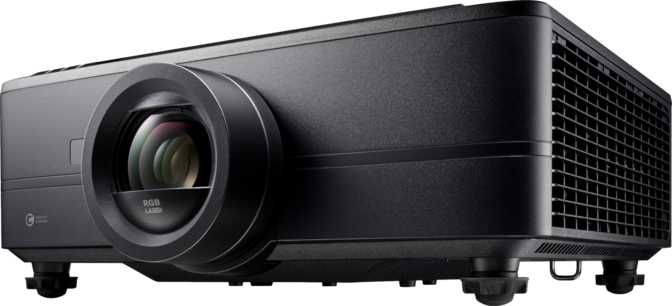
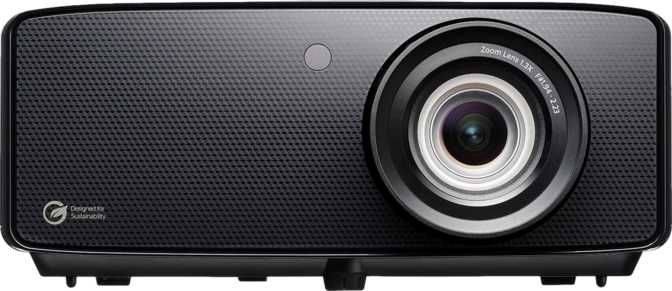
The UHZ36 is notably restrained in its physical presence. At roughly 274mm wide, 114mm tall, and 216mm deep — closer in footprint to a large gaming console than a traditional projector box — it slots onto a media shelf or AV rack without commanding the room. At 3.5kg, ceiling mounting is entirely practical without heavy-duty hardware, though confirming your mounting arm's load rating before installation remains important.
The chassis follows Optoma's clean, matte-finish design language — no unnecessary ornamentation, built to blend into a home theater environment rather than draw attention to itself. Focus and zoom are both manually controlled; there are no motorized adjustments. For a fixed installation this works well, but anyone who regularly repositions the projector will need to re-calibrate the image each time it moves.
Works well for a permanent, fixed installation. Adjust once during setup, leave it set. The controls are accessible and precise enough for careful initial calibration without requiring motorized assistance.
Without horizontal or vertical lens shift, the projector must align precisely with your screen's center line. Off-axis placement creates distortion that keystone correction cannot fully resolve without sacrificing image quality. Calculate throw geometry carefully before purchasing.
Laser Light Source: What 30,000 Hours Actually Means
The UHZ36 uses a laser phosphor light engine rather than a traditional mercury lamp. That distinction has practical consequences well beyond marketing language.
Decades of Lifespan
A conventional lamp requires replacement after 4,000–6,000 hours. At two evening hours daily, the UHZ36's laser source effectively outlasts the product itself — eliminating lamp costs from the ownership equation entirely.
Consistent Brightness
Lamp-based projectors dim progressively as bulbs age. Laser maintains its output level far more consistently — the picture calibration you establish at setup remains accurate for years rather than degrading gradually.
Instant Color Accuracy
Lamps need warm-up time to stabilize color temperature. Laser reaches full performance almost immediately after power-on, delivering accurate color from the very first frame rather than after a stabilization period.
No Ongoing Costs
Replacement lamps are a recurring projector expense — sometimes significant, occasionally discontinued as models age. The UHZ36's laser engine removes that variable entirely from long-term ownership calculations.
Picture Quality: 4K, High Frame Rate, and the HDR Stack
Native 4K Resolution
The UHZ36 outputs at true 4K — 3840 × 2160 pixels. At the screen sizes only a projector can achieve, resolution matters more than it does on a flat-panel display. On a 150-inch image, the difference between 1080p and 4K is visible and meaningful: finer texture in fabric, sharper edges in distant detail, text that is legible rather than soft. If your target screen size is 100 inches or larger, 4K earns its place in ways it often cannot on smaller panels.
240Hz Refresh Rate and 4.4ms Response Time
This is where the UHZ36 steps beyond the typical home theater projector category. Most 4K projectors cap at 60Hz; a growing number reach 120Hz. The UHZ36 doubles that upper limit with 240Hz — a specification that is genuinely rare at this level and carries real meaning for gaming use cases.
At 240Hz, even fast motion in racing games, first-person shooters, and fighting games appears with exceptional clarity. Combined with a 4.4ms response time, the gap between pressing a button and seeing its result on screen becomes imperceptible during normal play. Note that achieving 240Hz requires a source capable of that output rate and an HDMI connection with sufficient bandwidth — verify your gaming console or PC specification before assuming you will reach that ceiling.
HDR Format Support
The UHZ36 covers three HDR formats, addressing the most important content standards in current consumer use.
The most capable dynamic HDR format in wide consumer use — adjusts brightness and color metadata on a scene-by-scene basis. Relatively few projectors at this price support Dolby Vision. Streaming services and disc content are increasingly Dolby Vision-primary.
The universal baseline standard. Supported by virtually all 4K Blu-rays and most streaming services' 4K HDR content. Fully and natively supported — the broadest content compatibility in the HDR ecosystem.
The broadcast-oriented HDR format used by live 4K streams and some cable and satellite providers. Supported here — which matters for live sports and broadcast HDR viewing scenarios.
This format — backed primarily by Samsung and Amazon — uses dynamic metadata similar to Dolby Vision. The UHZ36 plays HDR10+ content using its static HDR10 layer, meaning dynamic tone mapping will not apply. For most viewers watching most content, this distinction is imperceptible. Buyers with heavy Amazon Prime HDR10+ libraries may notice it in specific edge cases.
3D Compatibility
The projector supports stereoscopic 3D with active shutter glasses using DLP-Link technology. 3D has become a smaller part of the home theater conversation than it once was, but for buyers with 3D Blu-ray libraries or specific gaming applications, the capability is present. Compatible glasses are not included and must be purchased separately.
Maximum Screen Size in Practice
The 300-inch optical maximum is a ceiling, not a recommendation. At very large sizes, brightness per square foot drops considerably — a real constraint in rooms that are not fully light-controlled. For a typical home environment with good light management, 100–150 inches at a comfortable viewing distance is where most buyers land, and where image quality and brightness remain well balanced.
Connectivity: Functional but Selective
The UHZ36's connectivity profile is lean by design. Understanding exactly what is and is not present prevents unpleasant surprises at setup time.
- 2 × HDMI inputs — workable for most setups. One for a streaming device or media player, one for a gaming console. Additional sources require an upstream HDMI switch.
- Wi-Fi — enables network connectivity without a wired connection, useful for any streaming content the connected source device provides.
- 3.5mm audio output — direct line to external amplification for simpler setups that do not involve a full AV receiver.
- Remote control — standard inclusion covering all primary projector functions.
- No USB ports — media cannot be played from USB drives, and USB-powered streaming sticks require a separate power source.
- No Ethernet — network connectivity is Wi-Fi only. Wired network stability is not an option for those who prefer it.
- No Bluetooth — wireless headphones and Bluetooth audio devices cannot pair directly to the projector.
- No wireless casting — AirPlay, Chromecast, and Miracast are all absent. A separate HDMI-connected streaming device is mandatory for any phone or tablet mirroring.
- No smart TV platform — the UHZ36 is a display engine with no built-in OS, no app store, and no native streaming. Source devices are mandatory, not optional.
The absence of a smart platform is not universally a weakness. Many enthusiasts prefer a projector without a locked-down operating system — full source control, no performance overhead, no software dependencies. The requirement is simply that you budget for and include a separate streaming device.
Audio: One Speaker, One Purpose
The UHZ36 includes a single 15-watt speaker with Dolby Atmos processing. A built-in speaker at this level handles casual or temporary setups adequately — watching content without assembling an external audio system is entirely viable. The Dolby Atmos certification is genuine, but a single 15W mono driver has real physical limitations on what spatial audio processing can accomplish with one channel.
For any serious home theater application, external audio is the correct path: a soundbar, an AV receiver with surround speakers, or a speaker connected through the 3.5mm output. The internal speaker covers the functional baseline role well and should be treated as exactly that — a baseline, not a destination.
Who Should Buy the Optoma UHZ36
- Serious gamers who want a large-screen display with genuine high-frame-rate capability. 240Hz and 4.4ms response time are competitive figures that translate to real-world performance, not just spec sheet checkboxes.
- Home theater builders whose content is primarily Dolby Vision or HDR10 — both are fully supported, and the laser engine delivers consistent picture quality over time.
- Buyers building an AV ecosystem around a dedicated source device and external audio — this projector rewards that approach rather than constraining it.
- Anyone targeting 100 inches or larger — projectors earn their advantage at these sizes in ways no flat-panel television can match.
- Low-maintenance buyers who want to install a quality projector and not revisit that decision for a decade. The laser engine makes that realistic.
- Anyone expecting wireless casting from a phone or tablet without additional hardware — no AirPlay, Chromecast, or Miracast means a separate streaming stick is a required, non-optional purchase.
- Buyers who rely on USB media playback — the UHZ36 has no USB ports, and there is no workaround short of adding a separate media player to the chain.
- Bright-room setups — laser consistency is an advantage, but no projector competes with a television in a sunlit room. Meaningful light control is non-negotiable.
- Rooms requiring off-center projector placement — the complete absence of lens shift makes installation geometry precise. If projector and screen cannot align on-axis, options are limited.
- Plug-and-play streaming buyers who expect a self-contained experience with built-in apps and wireless casting. The UHZ36 requires a companion ecosystem; it does not supply one.
Competitive Positioning: Where the UHZ36 Stands
The UHZ36 occupies a specific intersection: laser 4K with genuine high-frame-rate gaming support, Dolby Vision, and a compact chassis. That combination narrows the competitive field considerably — direct equivalents are not common at this price level.
| Feature | Optoma UHZ36 | Typical Lamp 4K Projector | Typical Laser 4K — Non-Gaming |
|---|---|---|---|
| Light Source Lifespan | ~30,000 hours | 4,000–6,000 hours | 20,000–30,000 hours |
| Max Refresh Rate | Up to 240Hz | 60Hz (most) | 60–120Hz (most) |
| Response Time | ~4.4ms | 8–16ms typical | 8–16ms typical |
| Dolby Vision | Yes | Rare | Occasional |
| Smart TV Platform | None | Sometimes | Often |
| Lens Shift | None | Often present | Sometimes present |
| USB Ports | None | Usually 1–2 | Usually 1–2 |
Comparisons represent general category characteristics, not specific competing product models.
Honest Assessment: Strengths and Limitations
Where It Delivers
The laser engine is the UHZ36's most durable selling point — in the most literal sense. It removes a recurring cost and maintenance burden that traditional projectors carry indefinitely, and delivers more consistent image performance across the product's operational life. For buyers who want to install a projector and not revisit that decision for a decade, this matters enormously.
The high refresh rate and response time make a meaningful case for this projector in gaming contexts — not as a secondary option to a monitor, but as a genuine alternative when screen size is the priority. Combining 240Hz with laser technology in a 4K projector at this price point is genuinely unusual.
Dolby Vision support gives the UHZ36 a content advantage that compounds over time. Streaming services and disc libraries are increasingly Dolby Vision-primary, and having that format fully realized rather than falling back to standard HDR is a real benefit for regular movie watching.
Where It Falls Short
The absence of lens shift is a genuine constraint on installation flexibility, not a minor omission. For buyers who cannot position the projector precisely on-axis with their screen, it creates a real problem that keystone correction alone cannot cleanly resolve without degrading image quality.
The lean connectivity — no USB, no Bluetooth, no wireless casting protocols — means the UHZ36 requires companion devices that add cost and setup complexity. None of those gaps are fatal to a well-planned system; all require acknowledgment and budget allocation before purchasing.
The single-channel internal speaker is adequate as a functional baseline and nothing more. External audio investment is necessary for any serious home cinema ambition.
The one-year warranty period is shorter than what some competitors offer at this price level — a detail worth factoring into long-term ownership confidence, particularly for a projector intended as a multi-year centerpiece investment.
Questions Real Buyers Ask Before Purchasing
Final Verdict
The Optoma UHZ36 is a projector built around two genuine priorities: laser-grade reliability and high-frame-rate performance. If both of those matter — and particularly if a large-screen gaming display that also handles premium HDR movie content is the goal — it delivers on both fronts in ways that are difficult to find combined elsewhere at this price level.
Go in with clear expectations. This is a display engine, not a complete home theater system. A separate streaming device, a proper audio solution, and careful attention to room geometry given the absence of lens shift are requirements, not suggestions. Those conditions define a good ownership experience; they are not reasons to avoid the product.
For the buyer who games seriously, values low-maintenance laser operation, and plans to build a proper AV stack around a quality projector core, the UHZ36 earns a strong recommendation. For the buyer who wants a self-contained, plug-and-play streaming experience with wireless casting and built-in apps, this is not the right unit — and knowing that clearly before purchasing is precisely the point.
- Laser longevity — no lamp costs
- 240Hz high-frame-rate gaming
- Dolby Vision HDR support
- True 4K up to 300" projection
- No built-in smart platform
- No lens shift
- No USB / Bluetooth / casting