Claw SM70 Full Review: A Wired Headset Built for the Desk
HeadphonesOverall Rating
3.5
out of 5
A reliable wired desktop headset that excels in the right environment
Performance Ratings
The Claw SM70 in Context
There's a growing counter-movement in the headset market — a quiet pushback against battery anxiety, Bluetooth pairing failures, and the endless firmware updates that come with modern wireless headsets. The Claw SM70 plants its flag firmly in that territory. It's a wired, over-ear headset designed to sit on your desk and do its job without asking for a charge, a pairing session, or a companion app.
The SM70 is not trying to compete with feature-rich wireless alternatives — it's offering a different set of trade-offs entirely. Understanding those trade-offs is the key to knowing whether this is the right headset for you, and that's exactly what this review breaks down.
Key Specifications
- Driver Size
- 40mm Dynamic
- Impedance
- 32 Ohms
- Sensitivity
- 97 dB / mW
- Frequency Range
- 18 Hz – 28,000 Hz
- Cable
- 4m, Detachable
- Connection
- Wired Only
- Fit Type
- Over-ear, Closed-Back
- Microphone
- Yes (On-Device Controls)
Design and Build
Purpose-built for the desk, not the commute
Physical Form
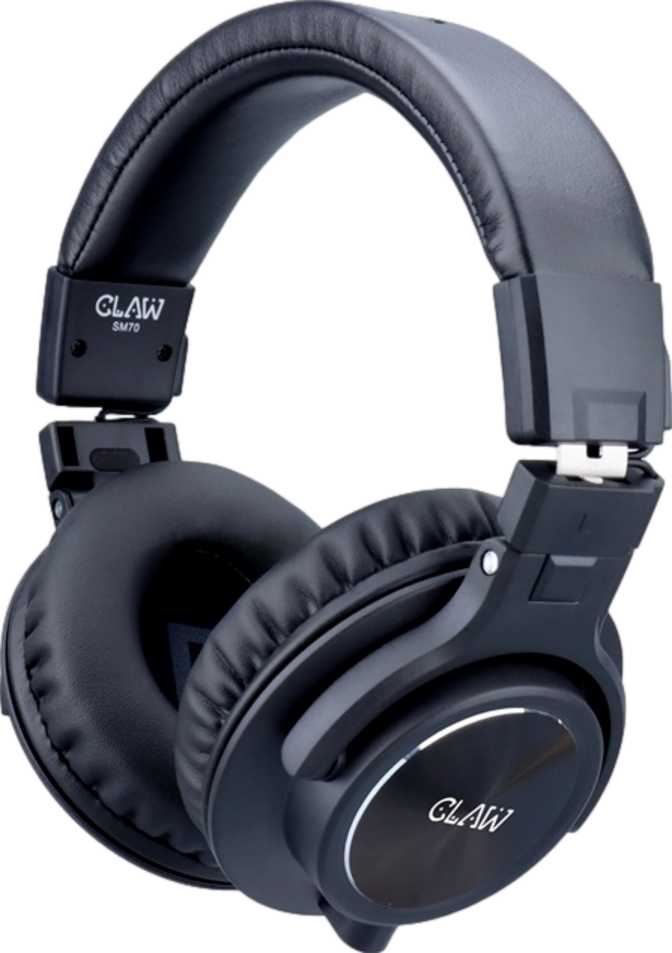
The SM70 is an over-ear headset — the earcups fully encircle your ears rather than pressing against them. This design contributes to comfort during extended sessions and passive acoustic isolation from the room. If you spend three or four continuous hours in front of a screen, the over-ear format distributes clamping pressure more evenly than on-ear alternatives.
The headset does not fold. That's a deliberate trade-off rather than an oversight. Without a folding hinge mechanism, the SM70 eliminates a common mechanical failure point and simplifies overall construction. The included travel bag addresses storage between desk sessions — think of it as a protective shell rather than a commuter accessory.
The non-folding frame is a genuine inconvenience for anyone who travels with headphones. The SM70 is not a portable headset — and it doesn't position itself as one.
The Cable: 4 Metres of Intent
The cable runs to four metres — approximately thirteen feet. That length signals the intended environment immediately: a desktop setup where the headset connects to a tower PC on the floor, a recording interface on a shelf, or a monitor positioned at distance. In that context, four metres provides real freedom of movement without tugging against a taut cable every time you lean back.
Crucially, the cable is detachable. Cables are statistically the most failure-prone component of any wired headset, and being able to swap a damaged cable rather than retiring the unit carries genuine long-term value.
- Tangle-free construction keeps the run manageable on any desk
- Detachable design enables cable replacement without retiring the headset
- Four metres of cable is cumbersome anywhere outside a fixed workstation
Sound Performance
What the hardware delivers — and what it doesn't
Driver & Efficiency
Each earcup houses a 40mm dynamic driver — the standard size in mainstream headphone design, balancing bass extension against structural rigidity. At 32 ohms, these headphones sit firmly in the easy-to-drive range. Any standard audio output — laptop headphone socket, PC front panel, gaming console controller, or USB adapter — will reach full volume without needing an external amplifier. A sensitivity rating of 97 dB per milliwatt means the headset converts signal to sound efficiently without demanding excessive power.
Notable Driver Choice
The SM70 uses ferrite magnets rather than the neodymium magnets standard across most mid-range headphones. Ferrite is heavier and less magnetically potent, which can affect driver responsiveness and transient detail — a distinction informed buyers will want to factor in.
Frequency Coverage
The SM70's frequency range extends below the standard lower boundary of human hearing at the bass end and well above it at the treble end. Practically, bass content doesn't roll off before it becomes audible, and high-frequency detail isn't clipped prematurely. Whether a wider-than-standard range translates into meaningfully better perceived sound depends on driver tuning — something raw numbers alone can't capture.
18 Hz
Low End
28 kHz
High End
Passive Isolation
The SM70 uses closed-back construction — the rear of each earcup is sealed, trapping sound inside the cup and blocking ambient noise from entering. The physical seal of the earcup against your head is engineered to dampen interference, making it effective in home offices, gaming rooms, and light recording environments.
- No battery drain, no latency, no processing artifacts
- Handles HVAC hum, conversation, and keyboard noise well
- No transparency mode — external audio is fully blocked
- Won't match ANC depth in genuinely loud open-plan spaces
Headset Functionality
Controls, microphone, and what's noticeably absent
On-Device Controls
Controls are positioned on the earcup itself rather than along the cable. This keeps the cable uncluttered and means volume adjustments are handled directly at the cup — a natural position for a stationary desktop headset where your hand is always within reach.
The absence of an in-line remote also means no fumbling along four metres of cable to find a button. For a desk-bound setup, on-cup controls are the more ergonomic choice.
There are no automatic features of any kind: no wear-detection to pause playback when you lift the headset off your head, no voice-activation, and no adaptive audio modes. This is a physical headset with manual controls only.
Microphone Capability
The SM70 supports full headset operation with a built-in microphone, handling calls, voice chat in multiplayer games, and basic voice recording without additional hardware. For everyday communication needs — team meetings, online gaming, casual content creation — it performs adequately out of the box.
No Physical Mute Button
There is no dedicated mute control on the SM70. Silencing the microphone requires going through software or platform controls. In team calls, multiplayer voice chat, or recording sessions, this becomes a recurring friction point that compounds quickly.
Who Is the Claw SM70 For?
Matching the right buyer to the right headset
Well-Matched For
Desktop Gamers & PC Users
The 4m cable is a genuine advantage for tower rigs with floor-level audio outputs. Wired audio delivers consistent fidelity with zero battery management — plug in and play, every time.
Home Recorders & Content Creators
Suitable for light voiceover work, podcast monitoring, and casual recording where operational simplicity matters more than studio-grade driver specifications.
Remote Workers & Video Call Users
A dedicated headset that never needs charging, delivering consistent audio quality through long meeting days and back-to-back calls without interruption.
Longevity-Focused Buyers
The detachable cable turns the most failure-prone component into a replaceable part, extending the headset's practical lifespan considerably beyond fixed-cable alternatives.
Not the Right Match For
Commuters & Travelers
The non-folding frame and four-metre cable make this impractical anywhere outside a fixed desk. There is no sensible way to use this headset on the move.
Wireless Users
The SM70 is wired-only with no Bluetooth capability whatsoever. If cutting the cable is a priority, this is the wrong starting point entirely.
Active & Outdoor Users
Zero water resistance and no sweat protection means physical activity puts this headset at avoidable risk of permanent damage.
Loud Open-Plan Office Workers
Passive isolation reduces ambient noise meaningfully, but won't approach the near-silence that active noise-cancelling headsets deliver in genuinely loud environments.
Competitive Positioning
How the SM70 stacks up against logical alternatives
| Feature | Claw SM70 | Typical Budget ANC Headset |
Typical Entry Studio Headset |
|---|---|---|---|
| Connection | Wired Only | Wired & Wireless | Wired Only |
| Noise Management | Passive Isolation | Active Cancellation | Passive Isolation |
| Cable Design | Detachable, 4m | Fixed, Shorter | Fixed, 1.2–2m |
| Foldable | No | Usually Yes | Usually No |
| Impedance | 32Ω — Easy to Drive | Varies | 32–64Ω |
| Magnet Type | Ferrite | Neodymium | Neodymium |
| Travel Bag | Included | Sometimes | Rarely |
| Microphone | Included | Sometimes | Rarely |
| Battery Required | No | Yes (Wireless) | No |
Context: Competitor columns represent general category characteristics, not specific named products. The SM70's strongest differentiator is the detachable long-format cable. Its primary disadvantage is the ferrite magnet driver configuration versus the neodymium-based competitors that populate the same price range.
An Honest Assessment
Strengths and real limitations — without the marketing gloss
Where It Gets It Right
Detachable Cable
The right engineering call. Many budget headsets skip this and buyers regret it. The SM70 makes cables replaceable rather than product-ending, extending the headset's lifespan without repair complexity.
Generous Cable Length for Desktop Use
Four metres provides genuine freedom of movement at a fixed workstation — a length that serves a desktop environment well and would be cumbersome anywhere else.
Consistent, Reliable Passive Isolation
Closed-back isolation has no battery drain, no processing latency, and no artifacts. It simply works — consistently and without maintenance.
Universal Compatibility at 32 Ohms
Works from any standard audio output without an amplifier — plug in and it reaches full volume from any device you're likely to own.
Included Travel Bag
A practical storage inclusion often absent at this tier. Best understood as a protective shell for desk storage rather than a travel accessory.
Where It Falls Short
Ferrite Magnet Drivers
An unusual driver configuration at any tier. Ferrite magnets are heavier and less magnetically efficient than the neodymium standard, which can affect transient responsiveness and overall driver efficiency.
No Physical Mute Button
A functional gap for communication-heavy users. Managing the microphone through software rather than a tap on the headset is a daily friction point in meeting-heavy or team-gaming environments.
Non-Folding Design
Paired with a four-metre cable, this is genuinely a stay-at-desk product. The use case is intentionally narrow — but buyers who don't recognise that before purchasing will feel the mismatch immediately.
No Water Resistance
Zero protection against moisture. Any active or outdoor use scenario puts this headset at avoidable risk of permanent damage.
No Smart Features
No ambient mode, no auto-pause on removal, no spatial audio. Buyers migrating from modern feature-rich headsets will notice these absences immediately.
Questions Real Buyers Ask
Honest answers before you commit
3.5
out of 5
Recommended
For desktop & stationary use
Final Verdict: A Focused Headset for a Specific Buyer
The Claw SM70 is a headset that knows what it is. Wired, over-ear, closed-back — with a four-metre detachable cable, a built-in microphone, and passive noise isolation — it is built for the desk and delivers that use case cleanly.
The detachable cable is a meaningful long-term reliability advantage. The closed-back isolation is consistent and artifact-free. The 32-ohm impedance means plug-and-play compatibility with every standard audio source you own. These aren't flashy selling points — but they're practical ones that compound over months and years of daily use.
Buy it if you game, work, or create at a fixed desk and want a wired headset that outlasts its cable without demanding battery management or Bluetooth troubleshooting.
Skip it if your audio life happens mostly in motion, or if you rely on ANC or wireless convenience — the SM70 serves a very specific buyer, and you'll know within a session whether you're that buyer.