boAt CineHead E1 Review: Big Screen on a Budget, With Real Trade-offs
ProjectorsPerformance Breakdown
Key Specifications at a Glance
First Look: What the boAt CineHead E1 Is Really About
The home projector market has expanded well beyond the dedicated home theater crowd. More people now want a big-screen experience without committing floor space to a television — and without spending television money. The boAt CineHead E1 lands squarely in this space: a compact smart projector that promises a cinematic stretch of picture without the price of entry that traditionally came with it.
boAt built its reputation making earbuds and headphones for everyday consumers, and the CineHead E1 reflects that same design philosophy — accessible, feature-packed for the price, and built around the idea that entertainment should not require an engineering degree to set up. Whether that translates into a product worth buying depends heavily on what you expect from it.
This review breaks that down honestly — from the brightness ceiling that defines where this projector is usable, to the wireless connectivity that genuinely overdelivers for the category.
Quick Summary
- Form Factor
- Compact flat-surface smart projector
- Dimensions
- 200 × 178 × 133 mm
- Weight
- Approx. 1.2 kg
- Warranty
- 1 Year
- Min. Throw Distance
- 1.2 metres from wall
Design and Build: Compact Enough to Move, Solid Enough to Stay
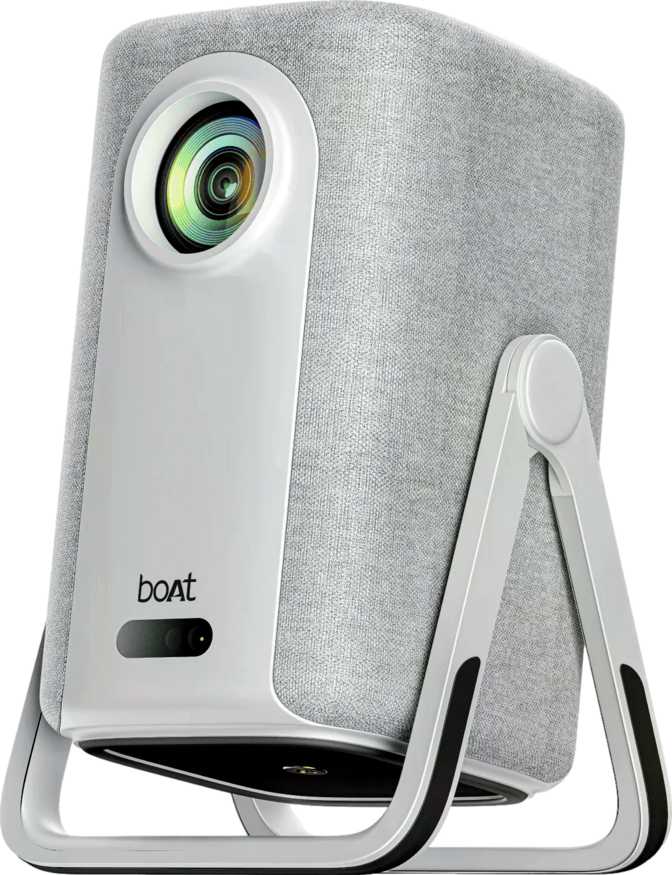
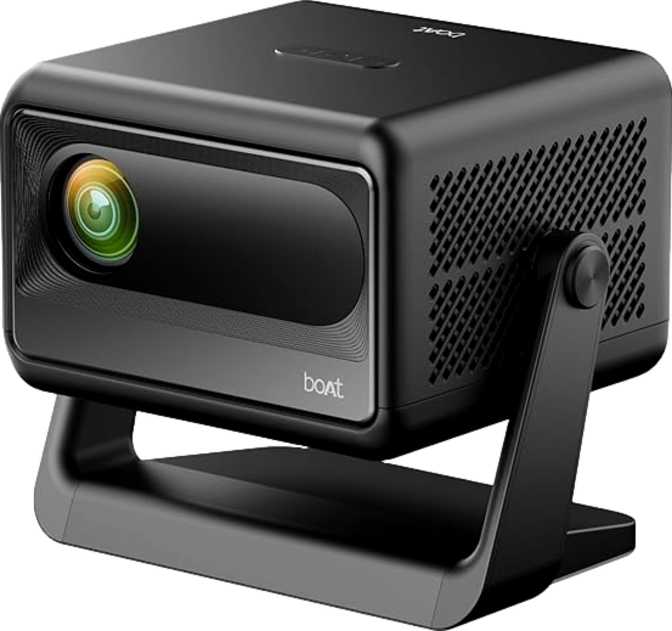
The CineHead E1 occupies a footprint roughly the size of a thick hardcover book — 200mm wide, 178mm deep, and 133mm tall. It is not a pocket projector, but it is genuinely portable in the sense that relocating it from a living room shelf to a bedroom desk is a two-second decision rather than a logistics exercise.
At approximately 1.2 kilograms, it sits in a comfortable middle ground — substantial enough to feel like a proper appliance, light enough that no one is mounting it on a ceiling bracket permanently. The form factor is clearly designed for placement on a flat surface: a coffee table, a shelf, or a nightstand.
The build reflects boAt's typical approach — functional and purposeful rather than premium. This is not a criticism at the price point; it is context. The unit draws 65 watts during operation, which is typical for a projector of this class and lamp type, and meaningfully lower than high-brightness projectors that run north of 200W.
Design Limitation to Know
There is no lens shift mechanism, either horizontal or vertical. To center the image on your wall or screen, you will need to position the unit carefully — small physical adjustments to the projector's placement are your only correction tool if the image drifts off-center.
For a fixed home setup, manageable with patience and a stable surface.
For frequent repositioning across rooms, each move requires a fresh alignment effort.
Projection Quality: An Honest Assessment
This is the section that separates confident buyers from disappointed ones — it deserves directness.
The 150-lumen output performs well in fully darkened rooms and acceptably with curtains drawn in dim conditions. In any ambient light — a lit living room, daytime indoors — the image washes out noticeably.
Verdict: Evening-only in controlled environments.
720p HD resolution is clear and watchable at typical viewing distances of 3–4 metres. The step below Full HD becomes noticeable when sitting close or viewing fine-detail content, but for casual movie viewing it holds up well.
Verdict: Sufficient for casual viewing at distance.
Up to 150 inches diagonally is possible, but the larger the image, the thinner the light spread. In a dark room, 80–100 inches delivers the best balance of size and visible brightness. Minimum distance from the wall is 1.2 metres.
Verdict: Sweet spot is 80–100 inches in the dark.
The CineHead E1 does not support HDR10, HDR10+, or Dolby Vision. Content encoded with high dynamic range is displayed without that enhanced contrast and color extension. Expected at this price tier but worth knowing.
Verdict: Standard color range only — no HDR.
Smart Features and Connectivity: Where the CineHead E1 Overdelivers
If projection quality is the CineHead E1's area of compromise, connectivity is where it earns genuine respect for its category.
Built-in Smart TV Platform
The CineHead E1 includes a full smart TV interface, which means it does not require an external streaming stick or set-top box to access online content. You can stream directly from the projector without plugging anything in — fewer cables and fewer remotes simplifies the experience considerably.
- Voice commands supported for hands-free control
- Dedicated smartphone app for remote control and interface access
- Sleep timer for scheduled shutoff
Wireless Casting: All Four Major Protocols
Covering all four protocols means the CineHead E1 accommodates virtually any device a household might own, regardless of platform.
- AirPlay iPhone and Mac users can mirror or cast content natively — uncommon at this price point and a genuine advantage for Apple ecosystem households.
- Chromecast Cast directly from any Chrome browser or Cast-compatible app on Android phones, tablets, and computers without extra hardware.
- Miracast Screen mirroring for Windows laptops and compatible Android devices without needing a shared Wi-Fi network.
- DLNA Stream locally stored media from a NAS device, computer, or any DLNA-compatible server on your home network.
Physical Connections
Audio Performance: The 3W Reality
The CineHead E1 has a single built-in speaker rated at 3 watts. The spec sheet lists Dolby Atmos support, which here functions as an audio processing and optimization layer rather than a full spatial audio system — a single mono driver has physical limits that no amount of signal processing can fully overcome.
For context: 3 watts from a single driver produces sound suitable for a quiet room at modest volume. It handles dialogue clearly under normal conditions. It does not fill a large room, does not reproduce bass with any weight, and will feel thin during action sequences or music.
This is a common reality for compact projectors, not a unique failing of this unit. The 3.5mm audio output and Bluetooth connectivity make pairing a soundbar, portable speaker, or headphones straightforward — and that path produces a dramatically better audio experience. Treating the built-in speaker as a convenience for setup and casual use is the right frame of mind.
Audio Quick Facts
- Single mono speaker — no stereo separation
- 3W output does not fill large rooms or reproduce bass
- Dolby Atmos processing improves dialogue clarity within hardware limits
- Bluetooth lets you pair any wireless speaker or headphones easily
- 3.5mm jack for wired speakers or soundbars as a permanent solution
Lamp Life and Long-Term Value
The CineHead E1 uses a traditional lamp light source rather than a laser. The lamp is rated for 20,000 hours of use at standard brightness and extends to 30,000 hours in the projector's eco mode, which reduces brightness to preserve bulb life.
To translate those numbers: at two hours of use per day, the standard lamp rating represents roughly 27 years of use before replacement becomes relevant. Even at four hours daily, lamp longevity is a non-issue for the useful lifetime of the product.
The trade-off of a lamp-based system versus laser is that lamps can degrade gradually in brightness over time, while laser light sources tend to maintain consistent output for longer. At typical home use frequencies, this distinction is academic rather than practical for most buyers.
Real-World Usage Scenarios
Who the CineHead E1 Is Genuinely For
-
Casual evening movie nightsDarkening the room and watching films or streaming shows on a large surface is exactly where this projector delivers. The smart platform removes the need for a cable ecosystem.
-
Renters and apartment dwellersThe compact footprint and easy repositioning make this a practical choice for people who cannot or do not want to wall-mount a large television.
-
Mixed Apple and Android householdsFew projectors at this price simultaneously support both AirPlay and Chromecast. Households with mixed devices will find the CineHead E1 genuinely accommodating without extra hardware.
-
Secondary bedroom or supplementary screen useAs a secondary entertainment device rather than a household's primary screen, the brightness and resolution limitations matter considerably less.
Who Should Look Elsewhere
-
Anyone who wants to use it in ambient lightA living room with standard daytime lighting will wash the image out significantly. This is a dark-room tool without exception.
-
Buyers prioritizing audio qualityThe 3W mono speaker is genuinely limited. If you cannot or will not pair external audio, frustration is likely, especially for music or action content.
-
Home theater enthusiasts expecting 1080p or HDRThe CineHead E1 is not a home theater projector. The resolution and HDR limitations reflect its casual-viewing positioning clearly.
-
Gaming setupsWith a single HDMI input and no indication of a low-latency gaming mode or gaming-optimized picture preset, this is not the right tool for performance-sensitive gaming.
How It Compares to Logical Alternatives
The CineHead E1 is positioned between bare-minimum budget projectors and proper mid-range units. Here is how it stacks up against the two most logical competing tiers.
| Feature | boAt CineHead E1 | Entry-Level Laser Portable | Mid-Range 1080p Smart Projector |
|---|---|---|---|
| Brightness | 150 lumens | 300–500 lumens | 2,000–3,500 lumens |
| Resolution | 720p HD | 1080p Full HD | 1080p Full HD |
| Light Source | Lamp (20K h) | Laser | Lamp or Laser |
| AirPlay | Rarely at this tier | Sometimes | |
| Chromecast Built-in | Sometimes | Sometimes | |
| Built-in Smart TV | Sometimes | ||
| Price Tier | Budget | Mid-Range | Mid to Upper |
| Best For | Dark-room casual viewing | Portable bright environments | Primary home theater |
Competitor data represents typical category characteristics, not specific named models. Exact specs vary by brand and model.
Strengths and Limitations: The Full Picture
Where It Genuinely Excels
The CineHead E1's greatest strength is not one feature — it is the combination of a full smart platform, four wireless protocols, and a straightforward setup experience, all in a package that does not demand much physical space or technical knowledge.
AirPlay on a product at this price bracket is unusual, and households invested in the Apple ecosystem will feel that advantage immediately. No competing-tier product consistently offers both AirPlay and Chromecast natively.
The lamp longevity is also a quiet asset. At any typical home use pattern, running costs over the projector's useful life are effectively zero beyond electricity — there is no lamp replacement budget to plan for.
Where It Falls Short
Brightness is the primary limiting factor, and it is not one that can be configured away. The 150-lumen output defines the environments where this projector is usable — buyers who understand that going in tend to be happy; those who discover it after purchase tend to be disappointed.
The single 3W speaker means audio is always a separate consideration. Pairing external audio from day one is not optional if sound quality matters — it is a prerequisite.
The lack of any lens shift means physical placement is your only alignment tool, which adds friction for buyers who want flexibility. The one-year warranty reflects the budget nature of the product — longer coverage would have added meaningful reassurance.
Frequently Asked Questions
The questions real buyers search before purchasing — answered directly.
Final Recommendation
The boAt CineHead E1 is a carefully positioned product that does specific things well and makes no pretense of doing everything. Its wireless ecosystem — smart TV platform, AirPlay, Chromecast, Miracast, and DLNA all in one unit — is genuinely impressive for its category and will satisfy households frustrated by the platform fragmentation of budget projectors.
The honest ceiling: this is a dark-room projector, full stop. Its brightness output and 720p resolution are correctly matched for casual evening viewing in a controlled environment, not for a living room cinema replacement or a primary family screen substitute.
Buy It If You:
- Have a dedicated dark viewing space
- Want flexible wireless casting for mixed devices
- Plan to pair external audio from day one
- Need a compact secondary-room screen
Skip It If You:
- Need bright-room or daytime use
- Prioritize 1080p or HDR picture quality
- Want this as your household's main screen
- Plan to use it for performance gaming
For its intended purpose — casual dark-room viewing with exceptional wireless flexibility — and used with eyes open about its limitations, the boAt CineHead E1 delivers genuine value at its price point.