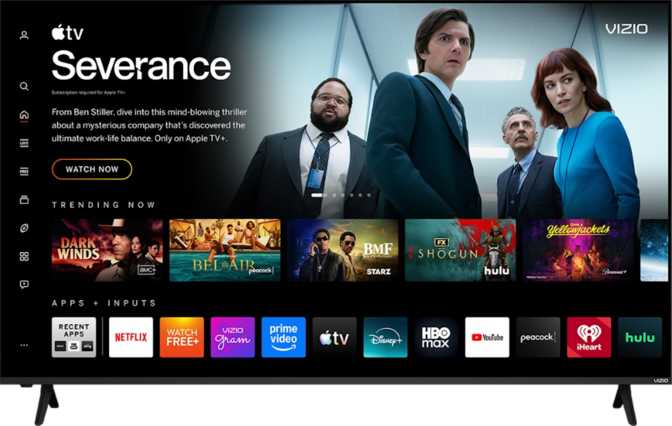
Vizio VQM75C-1004 75-Inch Mini-LED QLED TV: An Honest Full Review
TVsAt 75 inches, a television stops being furniture and starts being architecture. The Vizio VQM75C-1004 enters that category armed with a display technology stack that, until recently, was the exclusive territory of sets costing significantly more. Mini-LED backlighting combined with QLED quantum dot color sits at the top of the LCD technology pyramid — and Vizio has packaged it into a panel size that commands a room. Whether that package delivers on its promise, and whether it is the right choice for your specific living room, is exactly what this review works through.
Display Technology: Mini-LED and QLED Explained
Understanding what is inside the panel — and why it changes what you see
What Mini-LED Actually Does
Most LCD televisions use a backlight — a layer of LEDs behind the panel that illuminates the image. Traditional sets use relatively few, large LEDs arranged around the edges or spread sparsely behind the screen. Mini-LED changes this by packing thousands of much smaller LEDs into that same backlight layer, organized into independently controlled zones.
The practical result: when one part of your picture needs to be very bright — the moon in a night sky scene — and another part needs to stay very dark — the surrounding sky — the VQM75C-1004 can crank up the LEDs in that zone while dimming the rest. This is called local dimming, and Mini-LED does it with far more precision than conventional LED backlighting, delivering darker blacks and more brilliant highlights simultaneously, in the same frame.
QLED: Where the Color Comes From
Layered on top of the Mini-LED backlight is a quantum dot filter — what Vizio markets as QLED. Quantum dots are nanoscale semiconductor particles that convert the backlight's light into extremely pure, precisely defined colors. The result is a wider color gamut: colors that are more vivid and accurate than a standard LCD panel can manage.
The 10-bit color depth enables over one billion distinct colors — compared to roughly 16.7 million on a standard 8-bit panel. This eliminates color banding in gradual transitions like sunsets or skin tones, and when combined with the quantum dot layer, the VQM75C-1004 shows you what content creators actually intended to put on screen rather than an approximation of it.
HDR Support: All Four Formats, Zero Gaps
The VQM75C-1004 supports every major HDR format currently in use. This matters because different studios and streaming services use different formats — and a TV that skips one leaves some of your content looking worse than it should.
The universal baseline HDR standard. Almost all HDR content supports this as a minimum, ensuring broad compatibility across every platform.
Dynamic metadata upgrade to HDR10. Used by Amazon Prime Video and Samsung-mastered content for scene-by-scene tone mapping optimization.
The premium HDR format with frame-by-frame metadata. Used by Netflix, Apple TV+, Disney+, and most prestige streaming services globally.
The broadcast HDR standard for live TV and select streaming services. Ensures correct HDR handling on traditional broadcast signals.
Picture Quality in Practice
Resolution, optimal seating distance, viewing angles, and real-world anti-glare
At 3,840 × 2,160 pixels spread across a 74.5-inch diagonal, the pixel density lands at 59 pixels per inch. This figure has a direct relationship with how close you can sit before individual pixels become visible to the naked eye — and it dictates the sweet spot for where your sofa should be.
Optimal Seating Distance
At this panel size and pixel density, the recommended viewing distance is 6 to 9 feet. Closer than 6 feet and pixel structure may become visible on sharp-edged content. Beyond 9 feet, the 4K resolution advantage diminishes — though HDR and color depth benefits remain visible at greater distances regardless of how far you sit.
Viewing Angles: 178 Degrees Both Ways
One historical weakness of QLED and LCD technology broadly — compared to OLED — has been color and contrast shift when viewed from the side. A 178-degree horizontal and vertical viewing angle rating on the VQM75C-1004 suggests Vizio has implemented a wide-viewing-angle panel treatment, likely through a diffusion layer that scatters light more broadly across the room.
In practical terms, guests seated at the far edges of a sofa or watching from an adjacent chair should experience color and contrast that closely matches what the center viewer sees. This meaningfully closes the viewing angle gap that has historically favored OLED in social viewing settings.
Anti-Reflection and Ambient Light Sensing
The anti-reflection coating addresses a genuine real-world problem: windows, lamps, and overhead lights that create glare hotspots on a glossy screen. With a matte or semi-matte coating, those glare patches are diffused rather than reflected directly into the viewer's eyes — a meaningful difference in any room that isn't perfectly light-controlled.
The ambient light sensor works in tandem, reading the brightness level in your room and adjusting the panel's backlight automatically. In a dim evening environment the TV dials down to a comfortable level; in a bright daytime room it boosts brightness to maintain image integrity against ambient wash. Both features are practical quality-of-life additions, not marketing flourishes.
The 60Hz Refresh Rate: The Spec That Deserves Honest Discussion
This is where full transparency matters — especially for gamers
Important for Gamers
The Vizio VQM75C-1004 has a native 60Hz refresh rate. PlayStation 5 and Xbox Series X both support 120fps game modes, and a 60Hz panel cannot display more than 60 frames per second regardless of what the console outputs. If you play fast-paced, frame-rate-sensitive games competitively, this TV will bottleneck that experience. The HDMI 2.1 ports are capable of the bandwidth required for 4K/120fps — but the panel itself is the hard ceiling. Do not assume HDMI 2.1 implies a 120Hz display; in this case, it does not.
For most content — streaming, cable, broadcast, and movies — 60Hz is completely adequate. Virtually all streaming content is delivered at 24, 30, or 60 frames per second, and this TV handles all of it natively without any compromise.
For casual gaming, single-player titles, story-driven games, or anyone who simply does not prioritize frame rate above all else, 60Hz is not a meaningful limitation. The concern is specific to high-frame-rate competitive gaming. Be clear-eyed about your priorities before committing to this panel.
Connectivity: Ports, Wireless, and Smart Features
Everything the Vizio VQM75C-1004 connects to — wired, wireless, and smart
Wired Connections
Three HDMI ports, all running the HDMI 2.1 specification, cover the most important input standard. One carries eARC (Enhanced Audio Return Channel) — the current-generation standard that allows uncompressed, high-bitrate audio to flow from the TV back to a connected soundbar or AV receiver over a single HDMI cable.
eARC's higher bandwidth enables lossless Dolby TrueHD and DTS-HD Master Audio passthrough — the formats found on 4K Blu-rays. This matters directly if you plan to pair the VQM75C-1004 with external audio equipment.
- 3x HDMI 2.1 ports
- HDMI eARC on one port
- 1x USB port (recording + media playback)
- No 3.5mm headphone jack
- No external memory card slot
Wireless
Wi-Fi 6 (802.11ax) is the current generation of wireless networking, offering lower latency, better performance in congested multi-device environments, and improved efficiency compared to Wi-Fi 5. For a 75-inch primary TV that will likely be the heaviest network consumer in most households, Wi-Fi 6 is exactly the right specification.
Bluetooth 5.2 enables pairing with wireless headphones, soundbars, and keyboards — and provides the path for private listening that the absent headphone jack does not. Miracast support allows screen mirroring from compatible Android and Windows devices without a dongle.
- Wi-Fi 6 (802.11ax) — latest standard
- Bluetooth 5.2
- Miracast screen mirroring
Smart Platform
Built-in Chromecast and AirPlay cover essentially every major casting ecosystem simultaneously. Android phones and Chrome browsers cast natively, while iPhone and iPad users stream via AirPlay without any additional hardware. This dual-ecosystem support is genuinely useful in mixed-device households.
Voice assistant integration covers both Google Assistant and Amazon Alexa. Apple Siri and HomeKit are not supported — a notable gap for heavily Apple-invested households, where AirPlay content streaming is the only Apple-ecosystem bridge available.
- Chromecast built-in
- AirPlay built-in
- Google Assistant & Amazon Alexa
- USB recording support
- Built-in browser, sleep timer, child lock
- No Apple HomeKit / Siri
Audio: Honest About Its Limitations
Adequate for everyday viewing — a soundbar investment is the intended path for cinematic experiences
The built-in speaker system delivers 20 watts total across two channels. At this panel size and tier, internal speakers are always a compromise — physics and cabinet depth constrain what is acoustically possible inside a slim panel chassis. Dolby Atmos decoding is present, meaning the TV can process object-based audio tracks from streaming services; however, the two-channel speaker configuration cannot reproduce spatial overhead audio without a compatible soundbar or surround sound system.
Dolby Digital and Dolby Digital Plus decoding are fully supported, and the digital audio output alongside HDMI eARC means the TV can pass audio to external systems cleanly and without lossy conversion. For anyone who invests in a soundbar — particularly an eARC-compatible model — the VQM75C-1004 provides exactly the right infrastructure to support it.
For casual viewing, background content, or news, the built-in speakers are sufficient. For film, music, sports, or any immersive content, a soundbar is the natural companion purchase. This is true of virtually every flat-panel television at any price point, and the VQM75C-1004 is no exception to that reality.
Audio Specifications
- 20W total output (2 × 10W stereo)
- Dolby Atmos decoding
- Dolby Digital Plus support
- Dolby Audio processing
- HDMI eARC for lossless audio passthrough
- No dedicated subwoofer
Physical Dimensions and Installation Considerations
Size, weight, and what to confirm before mounting day
Size and Weight
At roughly 65.7 inches wide and 37.6 inches tall, this is a substantial piece of equipment. The 19.7-kilogram weight — approximately 43 pounds — matters in two practical ways: wall mounting requires hardware rated for that load, and positioning the TV safely is unambiguously a two-person job. Do not attempt solo installation.
The 73.2mm panel depth means it sits close to the wall but is not ultra-slim — typical for a Mini-LED chassis that houses significantly more backlight components than a standard edge-lit set. Account for that depth when assessing wall clearance or media console placement.
Wall Mounting
VESA mount compatibility means the VQM75C-1004 can be hung on any standard-pattern wall bracket. Confirm the specific VESA hole pattern — which Vizio does not publish prominently — before purchasing a mount, as 75-inch panels can vary between 300×200 and 600×400 patterns depending on chassis design. A mismatched bracket is a costly mistake at this panel size.
Who This Television Is For
Match your use case to this TV before committing
A Strong Match For
- Primary living room setups where image quality and screen size are the top priorities
- Households that stream 4K HDR content from Netflix, Disney+, Apple TV+, or Amazon and want a panel that does justice to that content
- Mixed Apple and Android households that want wireless casting from both ecosystems without adapters or extra hardware
- Viewers with primary seating 7 to 9 feet from the screen, where 4K resolution makes a visible, meaningful difference
- Buyers planning to connect a soundbar via HDMI eARC who want the audio infrastructure properly in place
- Anyone upgrading from a 1080p set or an older 4K without Mini-LED or full HDR format support
A Weaker Fit For
- Dedicated gamers who prioritize 120fps performance — the 60Hz native panel is a hard ceiling that no console setting can override
- Apple HomeKit households expecting Siri integration — this TV does not support HomeKit voice or smart home control
- Users who need more than one USB device connected simultaneously — only one USB port is available
- Very large rooms with primary seating beyond 12 feet, where 4K pixel density starts to plateau as a differentiator
- Anyone who relies on wired headphone connectivity directly from the TV — the 3.5mm jack is absent from this model
Competitive Positioning: How It Fits the Market
Vizio VQM75C-1004 vs. typical competitors at the 75-inch Mini-LED tier
At the 75-inch Mini-LED QLED tier, the VQM75C-1004 competes with comparable offerings from TCL, Hisense, and Samsung's entry-to-mid Mini-LED lines. The key differentiators to assess are refresh rate, HDR format coverage, casting ecosystem breadth, and port configuration — where results vary considerably between brands.
| Feature | Vizio VQM75C-1004 | Typical Competitor |
|---|---|---|
| Native Refresh Rate | 60Hz | 60Hz–120Hz (varies by model) |
| HDR Formats | All 4: HDR10, HDR10+, Dolby Vision, HLG | Usually 3 of 4 formats |
| Casting Ecosystems | Chromecast + AirPlay (both) | Varies; rarely both included |
| Voice Assistants | Google Assistant + Alexa | Typically one primary assistant |
| HDMI Ports | 3x HDMI 2.1 (all ports) | 2–4 ports (mixed 2.0 and 2.1) |
| HDMI eARC | Common at this tier | |
| Warranty Period | 1 Year | Standard 1 Year |
The Vizio's strongest competitive advantages at this tier are simultaneous Chromecast and AirPlay support, full four-format HDR compliance, and universal HDMI 2.1 across all three ports. Its primary structural weakness against sets like Samsung's QN85 or TCL's 6-Series 75-inch is the 60Hz panel in an era where 120Hz is increasingly accessible at comparable price points.
Strengths and Weaknesses in Full
An honest editorial assessment of what this television does well and where it falls short
Where It Excels
Mini-LED Picture Quality
The Mini-LED QLED combination is the VQM75C-1004's most compelling attribute. It delivers a materially superior picture over standard LED LCD — deeper blacks, more precise local dimming, and a color volume that standard sets simply cannot match. In a darkened room with HDR content, the visual difference is not subtle.
Four-Format HDR Coverage
Supporting HDR10, HDR10+, Dolby Vision, and HLG simultaneously means the TV processes every HDR format the market currently produces correctly. Regardless of which studio or streaming service creates the content, the VQM75C-1004 handles it — a genuine advantage over sets that omit one or two formats and leave gaps in your library.
Current-Generation Wireless Stack
Wi-Fi 6 paired with Bluetooth 5.2 is the right wireless specification for a 75-inch primary television. Wi-Fi 6 handles congested multi-device environments better, and Bluetooth 5.2 enables stable wireless audio accessories. Simultaneously supporting Chromecast and AirPlay is uncommon at this tier.
HDMI 2.1 Uniformity Across All Ports
All three ports run at full HDMI 2.1 bandwidth with one carrying eARC. This uniformity beats many competitors that mix 2.0 and 2.1 ports, leaving some inputs with reduced capability and creating frustrating configuration decisions for buyers.
Where It Falls Short
60Hz Native Refresh Rate
The 60Hz panel is the most significant limitation to acknowledge. As 120Hz becomes increasingly standard at this price tier, the VQM75C-1004 falls behind for buyers who game at high frame rates or who want flexibility for future use cases. This is a deliberate product positioning choice — but it matters if your use extends beyond streaming and broadcast.
No Apple HomeKit or Siri
Apple HomeKit and Siri are absent from the smart home integration. For households deeply invested in Apple's ecosystem, this is a real gap — not a workaround situation. AirPlay is supported for content streaming, but that is a different capability from smart home control.
Lean Port Count
A single USB port and the absent 3.5mm headphone output are friction points. Neither is a dealbreaker, but they reflect a port complement that is slightly lean relative to the size and market positioning of this television. Bluetooth partially compensates for the missing audio jack.
Built-in Audio Requires a Companion
Twenty watts across two channels is adequate for casual use only. For film, concerts, or spatial gaming audio, a soundbar is effectively required — an additional cost to factor into the total investment alongside the TV itself. The eARC infrastructure is ready; the companion cost is not.
Frequently Asked Questions
Answers to the questions real buyers search for before purchasing
Final Verdict
Vizio VQM75C-1004 — 75-Inch Mini-LED QLED
The Vizio VQM75C-1004 75-inch is a picture-quality-first television built on a genuinely premium display foundation. Mini-LED backlighting and QLED quantum dot color visibly improve the viewing experience for anyone who sits down with HDR content — and this TV handles every HDR format the market currently produces. The wireless stack is current, casting support is universal, and the HDMI 2.1 ports provide the right infrastructure for high-bandwidth devices across all three inputs.
For the household that primarily watches streaming content, 4K Blu-rays, and broadcast television, the VQM75C-1004 punches at or above its price point on image quality. The trade-off is the 60Hz native refresh rate — a specification that is increasingly hard to overlook at this panel size and tier as 120Hz becomes the new baseline for competitors. If you do not game at high frame rates, this is a non-issue. If you do, it is a material limitation that warrants looking at alternatives.
For the streaming-first household, the VQM75C-1004 earns a confident recommendation. Confirm your gaming priorities before committing, and budget for a soundbar to complete the experience.
Recommended for streaming-first households. Approach with caution if 120fps gaming is a priority.
Editorial rating based on specification analysis and competitive context.