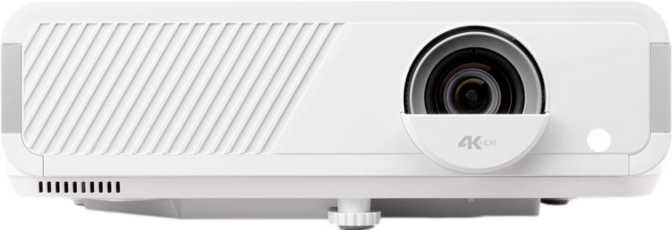
ViewSonic LX720-4KC Review: An Honest Look at 4K Laser Performance

ViewSonic LX720-4KC Review: An Honest Look at 4K Laser Performance

Projectors
4K
Native Resolution
3,500
ANSI Lumens
240Hz
Refresh Rate
1ms
Response Time
20Kh
Laser Life (Eco)
300″
Max Screen Size
8.2

Overall Score / 10

Editor's Choice

Exceptional laser 4K imaging and rare 240Hz gaming credentials, with real but defined trade-offs in placement and audio.

Performance Breakdown

Image Quality9.0
Gaming9.5
Connectivity7.5
Audio6.0
Long-Term Value8.5
Placement Flexibility6.5

There is a specific type of buyer the ViewSonic LX720-4KC was built for: someone who wants a true 4K image that fills a wall, needs brightness that fights back against ambient light, and refuses to babysit lamp replacements every couple of years. That buyer exists in large numbers, and for most of them this projector lands exactly where it should. For a few others, the trade-offs will sting. Understanding the difference before handing over your money is what this review is about.

Design and Build Quality

Physical Footprint

At roughly 312 mm wide and just over 100 mm tall, the LX720-4KC has the proportions of a chunky hardcover book. It slots onto a shelf, fits a standard ceiling mount bracket, and won't demand architectural accommodations. The weight sits at 3.5 kilograms — light enough for one person to position comfortably, but substantial enough to feel settled once placed. This is a room-anchored device, not a portable one. The distinction is important: it is designed to live somewhere and stay there.

Why the Laser Light Engine Changes Everything

Traditional projector lamps degrade visibly over time — colors wash out, brightness drops, and eventually you are ordering a replacement bulb at real cost. The LX720-4KC uses a laser light source instead, which doesn't behave that way. The laser carries a rated lifespan of 20,000 hours in its power-saving mode. At four hours of use every single day, the light source would reach that endpoint in approximately fourteen years.

This is not just a convenience benefit — it is a long-term value argument. The accumulated cost of two or three traditional lamp replacements over a projector's life frequently equals or exceeds the price premium that laser units command. That calculation lands firmly in the laser's favor here.

Physical Specifications

Width
312 mm
Height
104 mm
Depth
234 mm
Weight
3.5 kg
Light Source
Laser
Laser Life (Eco)
20,000 hours
Noise (Standard)
32 dB
Noise (Eco)
26 dB
Warranty
1 year
Warranty note: One year is on the shorter end for a laser projector at this tier. Many direct competitors offer two or three years.

Image Quality: What the Specifications Actually Mean

Resolution and Sharpness

The LX720-4KC outputs native 4K — the 3840×2160 standard. At the sizes this projector can produce, pixel density determines whether a large image looks like cinema or an oversized slideshow. At 4K, even on a 150-inch screen, individual pixels disappear at normal viewing distances. Text is crisp, fine detail in nature documentaries resolves cleanly, and fast action sequences hold their structure rather than dissolving into blur. For buyers upgrading from 1080p projectors, the improvement is substantial and immediately apparent. For buyers stepping up from a 4K television, the experience is different — not necessarily sharper per inch, but dramatically larger in scale.

Brightness: When 3,500 Lumens Is Enough

At 3,500 ANSI lumens, the LX720-4KC sits firmly in the bright tier for consumer and prosumer projectors. In a controlled dark room, this level is excellent — colors appear saturated, blacks have genuine depth, and the image holds up at larger screen sizes. In a room with moderate ambient light, the image remains watchable, though some vibrancy is sacrificed. In fully lit spaces with open windows, this projector — like essentially every projector — will struggle. The key takeaway: 3,500 lumens gives meaningful flexibility over lower-output competitors, but controlled lighting remains the baseline requirement for the best experience.

HDR Support Explained

The LX720-4KC supports HDR10 — the dominant standard for streaming services, 4K Blu-ray, and gaming consoles — and HLG (Hybrid Log-Gamma), the broadcast format used for live sports and TV content. Coverage here is practical and widely applicable. What it does not support is HDR10+ or Dolby Vision: both are premium dynamic HDR formats that adjust tone-mapping on a scene-by-scene basis rather than using a single static profile. For most viewers, the absence won't be noticeable. For home theater purists with Dolby Vision-mastered content libraries, this limitation is real and worth acknowledging before purchasing.

240Hz and 1ms: The Gaming Specification

A 240Hz refresh rate and a 1ms response time have very little to do with watching films and everything to do with gaming. These figures place the LX720-4KC in rare territory among 4K projectors. At 240Hz, on-screen motion updates 240 times per second, producing exceptionally smooth gameplay. At 1ms, the lag between controller input and image response is effectively imperceptible. The practical caveat: achieving 4K at 240Hz requires a capable gaming PC with appropriate HDMI bandwidth. Current-generation consoles typically top out at 4K/120Hz. The full 240Hz specification requires the right source hardware to realise.

Throw Distance and Placement Flexibility

The minimum throw distance of 1.1 meters means the projector needs to sit at least that far from the wall or screen to produce any image. This is a standard short-to-mid throw range — not ultra-short throw, but workable for most living rooms, dedicated media rooms, and home offices.

The LX720-4KC has no lens shift — neither vertical nor horizontal. Lens shift allows a projector to physically offset the projected image without physically moving the unit itself, which is useful for rooms where the ceiling mount position isn't perfectly centred with the screen. Without it, placement precision matters significantly more. The projector must be positioned carefully relative to the screen to avoid keystone distortion. Digital keystone correction can compensate, but optical alignment produces cleaner results — and planning your mounting position thoroughly at the outset will pay long-term dividends in image quality.

  • Minimum throw distance: 1.1 m from screen
  • Maximum screen size: 300 inches diagonal
  • 3D projection: Supported with compatible glasses
  • Vertical lens shift: Not available
  • Horizontal lens shift: Not available

Connectivity: Well-Equipped, With One Notable Gap

Wired Connections

Two HDMI ports handle the primary device connections — typically enough for a gaming console and a streaming stick, or a Blu-ray player and a laptop, simultaneously connected without swapping cables. One USB port allows playback directly from a flash drive, which pairs naturally with the external memory slot for flexible offline media access.

The most notable omission is the absence of an Ethernet port. The LX720-4KC is entirely dependent on wireless networking for all internet-based functionality. For most home users this will never matter. For installations in locations with congested wireless networks or unreliable Wi-Fi coverage, this is a genuine limitation — one that competing models at similar price points sometimes address.

There is no VGA, no DVI, and no S/PDIF optical audio output. The missing S/PDIF is the only absence that affects modern setups: buyers with older A/V receivers that rely on optical digital audio will need to route sound via HDMI ARC or the 3.5 mm analog output instead.

Wireless Ecosystem

The wireless story is notably strong, with coverage across every major platform — Apple, Android, Windows, and beyond. No dongles or secondary devices are required.

  • AirPlayNative Apple device mirroring — iPhone, iPad, and Mac without additional hardware or apps.
  • Chromecast Built-InDirect casting from Android devices, tablets, and Chrome browsers on any platform.
  • MiracastExtends wireless compatibility into the Windows and broader Android ecosystem beyond Chromecast coverage.
  • BluetoothPair wireless speakers, headphones, or input devices directly to the projector.
  • Smartphone App and Voice CommandsFull control from a mobile device or by voice — the physical remote becomes entirely optional.
No Ethernet port. Wi-Fi only. Installations with poor wireless coverage should plan for a mesh network or extender.

Smart TV Platform and Audio

Built-In Smart Platform

The LX720-4KC includes a built-in smart TV platform that brings streaming services, apps, and internet browsing to the projector directly — no external device required. This makes it viable as a standalone entertainment system for users who want a clean, minimal-cable setup.

The practical caveat: built-in smart platforms in projectors tend to trail dedicated streaming devices in app library breadth, interface responsiveness, and update frequency. Major streaming services will work well. Users who depend on niche apps or expect the slickest possible interface may find a dedicated streaming stick worth plugging into one of the HDMI ports as a straightforward optional upgrade.

Audio: Budget for External Sound

The built-in speaker delivers 10 watts from a single channel — adequate for small rooms and background listening, but undersized for the large-screen cinema experience that the 4K laser image promises. There is no stereo separation.

Dolby Atmos is listed as supported. In practice, Dolby Atmos as designed requires a multi-speaker arrangement around the room. What the LX720-4KC provides is signal passthrough: it forwards the Atmos audio to a compatible external receiver via HDMI. The built-in speaker does not produce spatial audio. For any serious home theater or gaming use, pairing with a soundbar or A/V receiver is not an optional upgrade — it is a practical requirement at this screen scale. The 3.5 mm audio jack covers simpler analog setups.

Operating Noise Levels

At standard brightness, the LX720-4KC runs at 32 decibels — audible in a very quiet room during a hushed scene, roughly equivalent to the ambient hum of a quiet library. In its power-saving mode, that figure drops to 26 decibels, which most viewers won't consciously notice over content playing at normal volumes.

Whether this registers as bothersome depends on the room. Acoustically treated home theater spaces make any fan noise more apparent during quiet passages. Open-plan living areas with typical background ambience will mask it entirely.

3D Compatibility

Active 3D content is supported with compatible glasses. For buyers with existing 3D Blu-ray libraries or 3D-capable gaming setups, this adds genuine value to the package. For buyers with no interest in 3D content, the feature has no impact on any other aspect of the projector's performance or day-to-day operation.

3D glasses are not included in the box. Buyers intending to use this feature will need to source compatible active-shutter glasses separately. The 3D capability does not affect 2D image quality in any way.

How It Compares to the Competition

The LX720-4KC's clearest competitive differentiator is its 240Hz/1ms gaming specification at 4K laser quality — genuinely rare in this category. Its clearest gaps are the missing Ethernet port and the absence of lens shift, both of which competitors at similar price points sometimes provide.

Feature ViewSonic LX720-4KC Typical 4K Laser Competitors
Brightness3,500 ANSI Lumens2,000–4,000 lumens (varies widely)
Refresh Rate240HzTypically 60Hz–120Hz
Response Time1msTypically 10ms–50ms
Laser Life (Eco)20,000 hours15,000–25,000 hours
Lens ShiftNot availableVariable — some include, many don't
Ethernet PortNot includedPresent on many competing models
HDR FormatsHDR10 + HLGHDR10 standard; Dolby Vision on premium units
Max Screen Size300 inchesTypically 200–300 inches
WirelessAirPlay, Chromecast, Miracast, BTVaries — often fewer options

Who Should Buy the ViewSonic LX720-4KC

Strong Match

  • Dedicated home theater owners who control their room's lighting and want a large, laser-stable 4K image without any ongoing lamp maintenance costs.

  • Serious gamers who want big-screen gameplay with the low-latency responsiveness of a gaming monitor. The 240Hz/1ms combination at native 4K is rare in this category and represents the single clearest differentiating argument for gaming-focused buyers.

  • Households in the Apple or Android ecosystem who want wireless casting to work natively — no dongles, no additional devices, no configuration headaches.

  • Buyers who prioritize long-term ownership economics and want to avoid thinking about light source replacements for the foreseeable future.

Consider an Alternative If

  • You expect to use it in fully lit rooms or with windows open during the day. No consumer projector at this brightness handles that scenario well, and this one is no exception.

  • You are a home theater purist who requires Dolby Vision or HDR10+. Neither format is supported — HDR10 is the ceiling here.

  • Your installation requires an Ethernet connection for stable network performance. The LX720-4KC is Wi-Fi only with no wired networking option available.

  • You expect the built-in speaker to carry the audio experience. At this screen scale, a separate audio investment is a practical requirement, not a luxury add-on.

An Honest Assessment

What the LX720-4KC Gets Right

The laser light engine alone reframes the long-term economics of projector ownership. Competitors still relying on mercury lamps will need two or three bulb replacements over a typical ownership period — costs that quietly negate their initial price advantages. The LX720-4KC eliminates that calculation entirely, and the 20,000-hour laser rating reflects a genuine engineering commitment rather than a marketing detail.

The 4K image at 3,500 lumens gives real-world brightness flexibility that lower-output competitors cannot match. The gaming specifications — 240Hz and 1ms at native 4K — are rare enough in the projector category that they represent a genuine differentiator for the right buyer. And the wireless coverage across Apple, Android, and Windows is thorough enough that the projector functions as a complete, standalone entertainment system without additional hardware being strictly necessary.

Where It Falls Short

The absence of lens shift is the most practically inconvenient limitation. Placement flexibility that competing models achieve with a simple dial adjustment becomes a fixed installation commitment with the LX720-4KC. Measure wrong and digital correction artifacts become a permanent feature of the image.

No Ethernet port is a pragmatic inconvenience rather than a fatal flaw, but it is a gap that competing models sometimes close. The single-channel 10W speaker requires buyers to budget for external audio from day one — treating it as optional would be a mistake at this screen scale. And the one-year warranty sits short of what this tier typically delivers: a projector expected to anchor a room for a decade deserves more coverage than that.

Common Buyer Questions

Yes — the LX720-4KC will project onto any flat, light-coloured surface. However, a proper projector screen significantly improves contrast, colour uniformity, and detail accuracy compared to a painted wall. At this level of image quality, a screen investment will make a visible difference and is strongly recommended.

Both current-generation consoles connect via HDMI and work fully with the LX720-4KC. Console users will get 4K at up to 120Hz — well within the projector's capability. The full 240Hz specification requires a capable gaming PC with appropriate HDMI bandwidth, as current consoles don't output at that refresh rate.

Portability is limited. At 3.5 kilograms without a carry case or battery pack, and requiring a mains power connection, this is not an outdoor projector in the portable sense. In a sheltered outdoor setup with a nearby power outlet and a screen it is technically functional — but it was designed to be room-anchored, not moved between locations.

At 3,500 lumens, a standard 1.0 gain screen performs well in controlled dark-room setups. If the installation has any ambient light challenges, a higher gain screen in the 1.2 to 1.5 range helps concentrate brightness at the primary viewing angle where it matters most.

Streaming services compress their 4K video, which at very large screen sizes can introduce visible artifacting compared to physical 4K Blu-ray. The LX720-4KC is fully capable of displaying the complete quality of whatever source you feed it — at large sizes, the limiting factor is typically the source's compression, not the projector itself.

Final Verdict

8.2
out of 10
Editor's Choice

The ViewSonic LX720-4KC makes a clear and serious argument for itself. The laser light engine reframes the long-term economics of projector ownership. The 4K image at 3,500 lumens delivers real-world brightness flexibility that lower-output competitors cannot match. The 240Hz gaming specification at native 4K is, for the right buyer, a genuinely rare differentiator in this product category.

Buy it if your room can be darkened, your placement allows for a fixed mount position without requiring lens shift, and either gaming performance or laser longevity — or both — are part of your purchase criteria. Plan for a dedicated audio investment from day one, not as an afterthought.

Hold off if Dolby Vision is a non-negotiable requirement for your content library, if Ethernet connectivity is essential for your setup, or if you were hoping the built-in speaker would be sufficient for serious home theater use on its own.

Selin Yıldız Ankara, Turkey

Monitor & Display Technology Reviewer

Color scientist and display technology writer who evaluates monitors for designers, photographers, and gamers alike. Runs factory calibration checks, panel uniformity scans, and response-time measurements to expose what manufacturers prefer to hide in their spec sheets.

Monitors Display Calibration Color Science Gaming Displays Professional Screens
  • X-Rite Colorimetry Certified
  • BSc in Visual Arts & Design Technology
View Full Profile