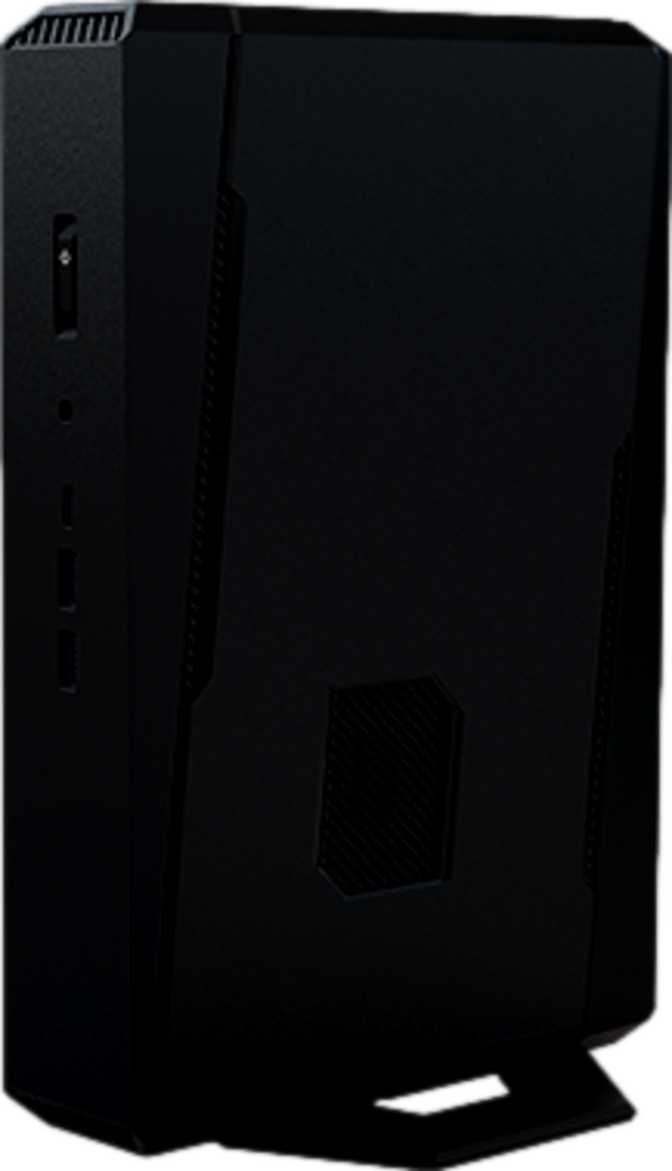
SimplyNUC Jean Canyon Review: Workstation Performance in a 3-Liter PC
Mini PCsThe SimplyNUC Jean Canyon arrives at a moment when the small-form-factor desktop market has matured far beyond basic browsing boxes and media players. This machine is not an appliance — it is a serious workstation that happens to fit in a space roughly the size of a hardcover novel stood on its spine. What SimplyNUC has built here is an argument that you no longer have to choose between desk footprint and computational ambition. The Blackwell-generation GPU, professional-grade memory, and massive internal storage create a configuration that will surprise anyone who assumes compact means compromised.
Design and Build Quality
Physical form, thermal philosophy, and chassis expectations
Physical Form and Footprint
The Jean Canyon measures 282mm tall, 187mm deep, and just 56mm wide — a slim tower orientation that plants a surprisingly small rectangle on your desk. At under three liters of internal volume, it is genuinely portable in a way that conventional tower desktops never are, but it does not pretend to be something you slip into a bag. This is a stay-at-your-desk machine with a semi-permanent presence.
The dimensions reveal SimplyNUC's thermal philosophy: go vertical to allow heat to rise naturally, keep the system narrow to encourage directional airflow, and accept that a tightly managed 50-watt processor is the right heart for a body this compact. There is no room for excess here, and the design makes no concessions toward it.
Build Quality Expectations
SimplyNUC builds NUC-category machines for professional buyers — corporate deployments, embedded installations, and prosumer desktops that need to be reliable over long cycles rather than impressive at launch. The Jean Canyon continues that lineage. Expect a metal-primary chassis with restrained industrial styling rather than RGB accents and aggressive ventilation grilles. This machine is meant for a desk, not a showcase.
Chassis Dimensions at a Glance
- Height
- 282 mm
- Depth
- 187 mm
- Width
- 56 mm
- Total Volume
- ~2.95 liters
- CPU TDP
- 50W (sustained)
- Form Factor
- Micro-ATX Slim Tower
The Processor: Mobile DNA, Desktop Application
Intel hybrid architecture · 24 cores · 5.4GHz peak boost · 50W TDP
CPU Architecture Explained
The Jean Canyon uses a laptop-class Intel processor mounted directly to the board in a fixed BGA package — it cannot be swapped out, but it benefits from precisely tuned power delivery designed around a 50-watt thermal ceiling. That ceiling sits meaningfully higher than the 15–28W range of typical ultra-portable laptop chips, while remaining far more conservative than a full desktop processor's heat output.
The chip employs Intel's hybrid architecture: eight high-performance cores clocked at 2.7GHz base handle demanding, latency-sensitive single-thread work, while sixteen efficiency cores at 2.1GHz absorb background tasks and parallel workloads without burning through the power budget. The result is 24 cores handling 24 simultaneous execution threads.
Cache and Boost Clock Reality
Individual performance cores boost to 5.4GHz — a peak that matches or exceeds many recent desktop chips for single-thread tasks like compiling code, sequential simulations, or demanding game engine workloads. The combined L2 and L3 cache stack totals 76MB — exceptionally large for this thermal class. More cache means the processor reaches for RAM less often during data-intensive workflows like video editing, large dataset analysis, and virtualization environments. The performance benefit is real and measurable.
Benchmark Performance
Bars represent relative performance normalized against high-end desktop-class reference points. Actual measured scores shown.
A PassMark multi-core result of 56,136 places this machine in desktop workstation territory. It handles professional video editing in real time, sustains complex containerized development environments, and runs demanding creative applications without the throttling that plagues thinner machines running the same chip in tighter power envelopes.
The GPU: Blackwell Architecture in a Mini PC
NVIDIA Blackwell · 4,608 shaders · GDDR7 · Ray tracing · DLSS · DirectX 12 Ultimate
Architecture and What Blackwell Means Here
The GPU inside the Jean Canyon is based on NVIDIA's Blackwell architecture — the same generation that defines NVIDIA's most recent product family. This is not a legacy chip refreshed with a new name. Blackwell introduced architectural refinements in shader efficiency, ray tracing hardware, and AI acceleration that translate into better frame rates per watt, improved visual quality in supported applications, and a generational leap in DLSS performance compared to prior architectures.
Raw Compute Capability
The GPU carries 4,608 programmable shader processors, 144 texture mapping units, and 48 render output units — a configuration delivering over 23 teraflops of single-precision floating-point compute. One teraflop equals one trillion mathematical operations per second. The texture fill rate exceeds 362 billion texels per second and the pixel fill rate clears 121 billion pixels per second. Together, these numbers enable complex scene rendering for modern games above 1080p and for 3D or visualization software handling millions of polygons simultaneously.
GDDR7 Memory and Bandwidth
The GPU carries 8GB of GDDR7 — the newest generation of graphics memory — running at an effective 25,400MHz across a 128-bit interface. That combination produces over 405GB/s of memory bandwidth, exceeding what equivalent GDDR6 configurations achieved in prior generations. The 8GB frame buffer handles 1440p gaming across most current titles and 4K gaming with considered quality settings. For professional use, it covers moderate 3D scenes, GPU-accelerated rendering pipelines, and AI inference workloads without issue.
Competitive with full desktop mid-to-high-range discrete cards — notably achieved inside a sub-3-liter chassis.
Feature Support
GPU Specification Summary
- Shader Units
- 4,608
- Texture Units (TMUs)
- 144
- Render Outputs (ROPs)
- 48
- VRAM
- 8GB GDDR7
- Memory Bandwidth
- 405.8 GB/s
- GPU Boost Clock
- 2,520 MHz
- Process Node
- 4 nm
- PCIe Version
- PCIe 5.0
Memory
96GB DDR5 ECC · 6400MHz · Dual-Channel · Maximum Configuration
The Jean Canyon ships with 96GB of DDR5 memory running at 6,400MHz across a dual-channel architecture — and this is also the system's maximum. The memory is fully populated from the factory. That figure is not a gaming specification. It is a workstation specification: one that enables multiple heavy applications to run simultaneously, holds large datasets entirely in active memory during analysis, sustains multiple virtual machines or containers side by side, and handles high-resolution media projects without constant cache-swapping to storage.
The DDR5 standard at this speed provides significantly more bandwidth to the processor than DDR4 configurations, which directly benefits cache-sensitive workflows including compilation, simulation, and layered creative applications.
ECC Memory Support
Error-Correcting Code memory automatically detects and corrects single-bit errors on the fly. For everyday users, this operates invisibly in the background. For anyone running persistent services, financial applications, or scientific workloads where a corrupted result could have real consequences, it is a meaningful and rarely available safeguard at this form factor.
Storage
8TB NVMe SSD · PCIe Gen 5 · Flash-based · No Secondary Bay
The Jean Canyon includes an 8TB NVMe solid-state drive. NVMe connects the drive directly to the processor via the PCIe bus rather than through the older SATA pathway — producing dramatically faster data access than any spinning hard drive or SATA SSD can offer. PCIe Gen 5 connectivity pushes that advantage further.
At 8TB, this is an unusual specification at this form factor. Most compact desktops ship with 1–2TB drives, forcing users to external storage for large media libraries, project archives, or local datasets. The Jean Canyon eliminates that friction. An 8TB internal drive holds a complete video production library, a full software development environment with all dependencies, a large game library, or years of professional project files — all accessible at NVMe speeds without external cables cluttering the desk.
No Secondary Internal Bay
There is no additional internal storage slot. The 8TB NVMe configuration is the internal storage solution as shipped. Given the capacity, this is unlikely to be a practical limitation. USB 4 at 40Gbps and Thunderbolt 4 provide fast external expansion when archival capacity eventually becomes necessary.
Connectivity
Ports, display outputs, and wireless standards
Wired Ports and Display Output
The rear panel provides two HDMI 2.1 ports and two DisplayPort outputs, enabling up to four simultaneous displays at 4K. HDMI 2.1 handles 4K at 120Hz or 8K at 60Hz on compatible monitors — directly useful for high-refresh-rate 4K displays and expansive multi-monitor setups. Six USB Type-A ports running at USB 3.2 Gen 2 speeds deliver up to 10Gbps each — no port shortage on a machine this compact. One USB 4 port at 40Gbps handles high-bandwidth accessories or fast external storage enclosures. One Thunderbolt 4 port supports docks, high-speed peripherals, and additional display connectivity. A 3.5mm audio jack is present; there is no optical audio output.
A single Gigabit Ethernet port handles wired networking. Gigabit remains sufficient for most LAN and high-speed internet connections. Buyers with multi-Gigabit internet plans or NAS-intensive workflows should factor this single-port limitation into their planning.
Wireless Connectivity
Wi-Fi 7 (802.11be) is the headline wireless specification — the newest Wi-Fi generation, offering significantly higher throughput than Wi-Fi 6E and reduced latency through Multi-Link Operation. The Jean Canyon can sustain network transfers to a Wi-Fi 7 router at speeds that previously required a physical cable, while remaining fully backward compatible with older Wi-Fi standards. Bluetooth 5.4 handles wireless peripherals, audio accessories, and input devices without requiring a separate adapter.
Port Summary
- 2× HDMI 2.1 (4K@120Hz)
- 2× DisplayPort
- 6× USB-A 3.2 Gen 2 (10Gbps)
- 1× USB 4 (40Gbps)
- 1× Thunderbolt 4
- 1× Gigabit Ethernet (RJ45)
- 1× 3.5mm Audio Jack
- Wi-Fi 7 (802.11be)
- Bluetooth 5.4
Who the SimplyNUC Jean Canyon Is For
Matching the machine to the right buyer before you spend
The Jean Canyon Is Ideal For
-
Professional Creatives in Tight Spaces
Video editors, motion graphics artists, and photographers who want workstation-class capability without dedicating a full tower and wide desk to it. The memory, GPU, and storage all align directly with professional editing workflows.
-
Developers and Data Analysts
The 96GB of RAM and 24-core processor make it practical to run multiple Docker containers, virtual machines, and full IDEs simultaneously without resource conflicts. ECC support adds reliability for outputs that others depend on.
-
Corporate and Professional Deployments
SimplyNUC's institutional track record means the Jean Canyon is built for long-cycle reliability — well suited to office deployments, research labs, and embedded professional installations.
-
1440p Gamers Who Also Work Professionally
The Blackwell GPU and DLSS support make it a capable 1440p gaming machine. For someone who values desk space and needs real workstation performance from the same device, this is a legitimate dual-purpose option.
You Should Look Elsewhere If
-
Your Budget Is Tight
This is a premium machine designed for demanding workloads. Web browsing, office productivity, and light media consumption do not justify anything close to this level of specification or cost.
-
Peak Gaming Frame Rates Are Your Only Priority
A full tower with a high-end desktop discrete GPU will sustain higher frame rates in the most demanding gaming loads, where full-size thermal headroom matters. The Jean Canyon is a dual-purpose machine, not a purpose-built gaming rig.
-
You Need Future Expandability
The processor is soldered, memory is at its 96GB ceiling, and there is no internal expansion slot for additional cards or drives. Configure it exactly as needed at purchase — there is no upgrade path for any core component.
-
You Plan to Train Large AI Models
The 8GB frame buffer handles inference and many generative tasks. Training very large neural networks from scratch requires more VRAM than this chassis accommodates. The Jean Canyon suits AI application, not AI research infrastructure.
Competitive Positioning
How the Jean Canyon stacks up against logical alternatives in adjacent categories
| Feature | SimplyNUC Jean Canyon | Typical Mini PC (Mid-Tier) | Compact Workstation Tower |
|---|---|---|---|
| CPU TDP | 50W sustained | 15–28W | 65–125W |
| GPU Tier | Blackwell discrete · 23+ TFLOPS | Integrated graphics only | Discrete mid-range |
| System RAM | 96GB DDR5 ECC | 16–32GB DDR5 | 32–64GB DDR5 |
| Internal Storage | 8TB NVMe | 512GB–2TB NVMe | 1–4TB NVMe |
| Chassis Volume | ~3 liters | 0.5–1.5 liters | 10–20+ liters |
| Display Outputs | 4 (2× HDMI 2.1 + 2× DP) | 2–3 | 2–4 |
| Wireless | Wi-Fi 7 (802.11be) | Wi-Fi 6 / 6E | Wi-Fi 6E or absent |
| ECC Memory | Yes | No | Varies |
The Jean Canyon occupies a specific and underserved niche: it out-muscles standard mini PCs on every meaningful axis while undercutting compact workstation towers on physical size and — potentially — power consumption. Its closest competition comes from other purpose-built workstation-class SFF systems, not consumer NUC-style boxes.
Honest Assessment
Strengths where they exist, limitations stated plainly
Where It Genuinely Excels
The Jean Canyon's most compelling achievement is not any individual specification — it is the coherence of the overall configuration. The 96GB of RAM, 8TB of storage, and Blackwell GPU form a system where no major component bottlenecks another. That kind of intentional balance is rarer than it should be in compact systems, and it shows in real-world multi-application use.
Connectivity is a genuine strength. Four display outputs, six high-speed USB-A ports, Thunderbolt 4, USB 4, and Wi-Fi 7 cover professional peripheral ecosystems without compromise. Very few machines at this physical size match that port selection.
For workloads that fit its profile — professional creative work, development, data-intensive analysis, and capable 1440p gaming — the Jean Canyon delivers on every front without the thermal throttling that undermines thinner systems running the same chip in tighter power envelopes.
Limitations You Need to Know
The processor, operating at a 50-watt laptop TDP, cannot match the sustained compute output of a true desktop CPU under extended heavy loads. CPU-only workloads that run continuously for hours — long renders, exhaustive compile jobs — will be slightly slower than a same-budget tower desktop with a full-power chip. This is a thermal physics reality, not a design flaw.
The GPU's 8GB frame buffer, while using the newest GDDR7 memory with excellent bandwidth, constrains very large 3D production scenes and ML model training beyond inference scale. The physical reality of a three-liter chassis imposes limits that engineering cannot fully overcome.
The fixed memory ceiling deserves stating once more: 96GB handles virtually every current professional workload, but it is an absolute ceiling — not a starting point. Buyers who anticipate their needs growing beyond this over a multi-year ownership period have no internal upgrade path.
Frequently Asked Questions
What real buyers search for before committing to this machine
Final Verdict
The SimplyNUC Jean Canyon is built for a specific kind of buyer who knows exactly what they need: maximum capability in minimum physical space, configured for professional work that demands generous memory, fast large-capacity storage, and a modern GPU — without the footprint, noise, and cable management complexity of a conventional tower.
For developers running complex environments, analysts managing large datasets, creative professionals with demanding editing workflows, or buyers who want a capable gaming machine that doubles as a real workstation, the Jean Canyon makes a compelling case. Its specification choices are coherent and intentional, and the Blackwell GPU gives it graphics capability that prior generations of compact desktops simply could not offer.
The scenarios that argue against it are narrow: extended CPU-only rendering that benefits from a full desktop chip's higher sustained power envelope, very large-scale ML model training, or a clear expectation that internal configuration needs will grow. For everyone outside those constraints, the Jean Canyon delivers on every promise its specification set makes — in a package that earns its place on any serious professional desk.
Verdict at a Glance
- Workstation-class memory in a 3-liter chassis
- Next-gen Blackwell GPU with DLSS & ray tracing
- 8TB NVMe eliminates external drive dependency
- Excellent port selection with Wi-Fi 7 included
- ECC memory for professional-grade reliability
- 50W CPU cap versus full desktop chip sustained power
- No internal expansion path — configure at purchase