Roborock RockMow S108 Review: Full Real-World Analysis
Robotic Lawn MowersThe Roborock RockMow S108 is a mid-to-upper-tier robotic lawn mower built for gardens up to 800 m² with real contours, unpredictable weather, and homeowners who want genuine set-and-forget autonomy. It earns that promise more convincingly than most.
Overall Rating
Design and Build: What You Are Actually Getting
Physical presence, materials, and weather resistance
Physical Presence
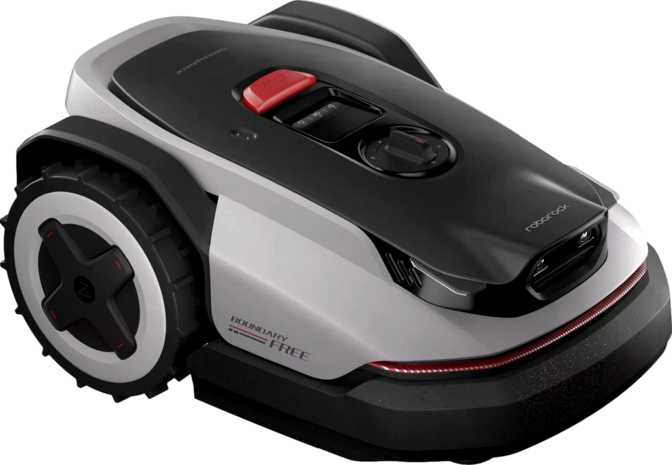
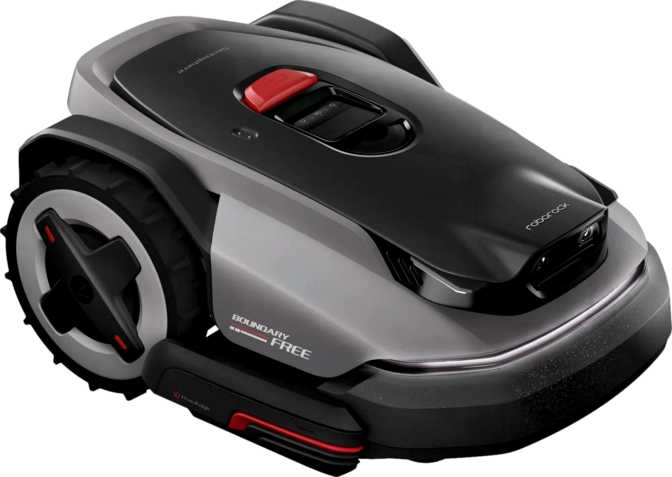
At roughly 42 cm wide and just under 27 cm tall, the S108 has a low-slung silhouette that lets it duck under garden furniture and navigate tighter spaces with less fuss than bulkier competitors. Its footprint is compact enough to move around freely without dominating your garden visually.
At 13.4 kg, it carries genuine weight — a reassuring sign of real internal components: motor, battery, and chassis that feel engineered rather than assembled. Lighter robotic mowers can feel flimsy; the S108 does not.
An onboard display panel means you do not need your phone to check status or confirm basic operation — useful for quick checks without unlocking an app.
Weather Resistance
Outdoor tools live through seasons, and the S108 is built knowing it will face them. It is rated to operate in the rain — not just "light drizzle tolerant," but actively designed to keep working when the sky opens.
The combination of rain sensing, frost detection, and weather adaptation (explored further in the features section) makes this a genuinely all-conditions tool rather than one that retreats indoors at the first cloud. For gardens in climates with unpredictable weather, this distinction matters considerably.
420mm
Width
270mm
Height
13.4kg
Weight
2yrs
Warranty
Core Performance: Translating Specs Into Real Lawn Results
Coverage, efficiency, slope capability, and cutting flexibility
Coverage and Efficiency
The S108 is designed for gardens up to 800 m² — roughly the size of two standard suburban plots combined. Its operational ceiling sits at 960 m², giving headroom for real-world conditions: obstacles, patterns, recharging interruptions, and terrain variation.
Working through that space, it covers approximately 185 m² per hour. An 800 m² garden takes just over four hours of active mowing, spread across autonomous sessions the mower schedules itself.
Slope Handling
Tackling gradients is where many robotic mowers expose their limits. The S108 handles slopes of up to 45% — a rise of roughly 24 degrees, a hill where you would notice the incline walking up it.
Most budget robotic mowers cap out at 25–35%. At 45%, the S108 is firmly mid-to-upper tier on this metric, making it viable for gardens with genuine contours, not just flat suburban turf.
Slope Rating Comparison
Cutting Height Flexibility
Nine discrete height positions span 20 mm to 60 mm. The low end delivers a tight, formal lawn finish. The upper end suits meadow-style grass, recovery cutting after heavy growth, or deliberately relaxed seasonal management.
Nine settings across that range gives meaningful granularity — you are dialling in a preference with real precision, not choosing between three rough options.
Key Features: What They Mean in Practice
Real-world meaning behind every major capability
Weather Intelligence
Rain sensor, frost sensor, and weather adaptation work as a trio. The rain sensor halts mowing to protect waterlogged turf — wet grass tears rather than cuts. The frost sensor prevents blade-tip damage to frosted grass that causes weeks of yellowing. Weather adaptation ties both signals together, adjusting behaviour autonomously so you never micromanage the forecast.
Obstacle Detection
Sensors identify objects in the mower's path and navigate around them. Garden furniture, toys, plant pots, and everyday clutter no longer require a manual "clear the deck" routine before each session. Very low flat objects — a forgotten hosepipe, for example — can still catch sensor arrays off guard, but the system handles the vast majority of real-world garden obstacles reliably.
Anti-Theft Protection
A machine left unsupervised in the garden is an obvious target. The S108 combines PIN code lockout — rendering the unit inoperable without the correct code — with app-based alerts that flag if the mower is lifted or moved unexpectedly. For a tool that lives outdoors day and night, this integrated security layer is a meaningful safeguard.
Mulching System
Rather than bagging clippings, the S108 shreds cut grass into fine particles that fall back onto the lawn. Those clippings decompose and return nitrogen to the soil — acting as a natural slow-release fertiliser. Over a full season, mulching contributes visibly to lawn density and colour. It also eliminates the clippings bag entirely: one less maintenance task, permanently.
Auto-Docking and Scheduling
When the battery runs low or a session completes, the S108 returns to its charging base automatically. Combined with app-based scheduling, this creates a fully autonomous loop: set your preferred maintenance frequency, and the mower handles everything else — including knowing when to recharge and resume. No human prompt required.
Smart Home Integration
The S108 works natively with both Amazon Alexa and Google Assistant. Start, stop, or check status with a voice command — no app required for routine interactions. This is not a transformative feature, but it is consistent with how a modern connected device should behave. If you already have a smart home ecosystem, the S108 slots into it without friction.
Power and Charging: The Energy Story
Voltage, motor efficiency, and what the charge time means operationally
The S108 runs on a 21.6V battery system drawing 60 watts during operation. That voltage and wattage combination describes a motor tuned for efficiency and consistent torque — appropriate for a machine that mows frequently and lightly rather than occasionally tackling jungle-level growth.
The standout figure is charge time: 75 minutes from depleted to full. That is genuinely fast for this product category. Many competitors take two to four hours to recharge, meaning the S108 returns to mowing sooner after each break — which matters most for larger gardens requiring multiple sessions to complete a full cut.
The battery is integrated rather than user-removable. That is standard for weather-sealed robotic mowers — it keeps the unit protected against the elements — but it does mean that if battery health degrades over the years, replacement involves the unit rather than a simple cell swap. Factor that into a long-term ownership view.
Charge Time: S108 vs Category
Lower bar = faster charge = more time mowing per day
Connectivity and App Experience
Wi-Fi, Bluetooth, and why Roborock's software history matters
The S108 connects via both Wi-Fi and Bluetooth. Scheduling, zone management, status monitoring, and firmware updates all live in Roborock's companion app. The brand's connected-device experience — refined through years of indoor robot vacuum development — carries genuine polish. The interface is typically cleaner and more reliable than those from brands newer to connected devices.
Bluetooth handles close-range setup and direct commands; Wi-Fi handles ongoing remote control and scheduling from anywhere. The two-protocol approach is practical: if you are standing next to the mower, Bluetooth responds faster. If you are at the office wanting to trigger a session, Wi-Fi does the work.
-
Dedicated Smartphone App
Full control over schedules, zones, mowing modes, and real-time status from anywhere with a data connection.
-
On-Device Display
Basic status, mode selection, and operation can be confirmed directly on the mower without touching your phone.
-
Dual-Protocol Connectivity
Bluetooth for proximity setup and immediate commands; Wi-Fi for remote scheduling and monitoring when away from home.
Who the Roborock RockMow S108 Is For
Ideal owners and clear cases where this mower is the wrong choice
- Your garden sits between 400 and 800 m² with moderate to significant contours
- You want a tool that genuinely runs itself day-to-day without constant supervision
- You already use Alexa or Google Assistant in your home
- You value weather intelligence that protects your lawn automatically
- You prefer mulching over bagging clippings
- You want a mower that recharges and resumes autonomously without manual intervention
- Your garden significantly exceeds 800 m² — coverage becomes strained and efficiency advantages shrink
- You have a completely flat, simple lawn under 300 m² where more affordable options perform equally well
- Your garden has dense landscaping with very low, flat ground-level obstacles that sensor systems tend to miss
- You prefer to mow on a manual, occasional schedule rather than frequent automated passes
- You need a swappable battery for extended operation without returning to the charging base
Competitive Positioning
How the S108 stacks up against the logical alternatives in the same price range
| Feature | Roborock RockMow S108 | Entry-Level Robotic Mower | Mid-Range Competitor |
|---|---|---|---|
| Recommended Area | 800 m² | 200–400 m² | 600–800 m² |
| Max Slope | 45% | 25–35% | 35–40% |
| Charge Time | ~75 min | 90–180 min | 60–120 min |
| Cutting Height Range | 20–60 mm (9 settings) | 20–50 mm (3–5 settings) | 20–60 mm (5–7 settings) |
| Frost Sensor | Sometimes | ||
| Smart Home Integration | Alexa + Google | Varies | |
| Anti-Theft | Basic or absent | Sometimes | |
| Mulching | |||
| On-Device Display | Varies |
Competitor specifications represent typical values for the market segment. Individual products may vary. The S108's primary differentiation sits in its slope rating, frost sensing, fast charge time, and the quality of its connected app experience.
Honest Assessment: Strengths and Weaknesses
An unvarnished look at where this mower excels and where it falls short
The S108's strongest suit is the combination of slope capability and weather intelligence. For gardens that are not flat and predictable, those two factors alone make it substantially more suitable than cheaper alternatives. A mower that retreats from a slope or stops at the first drizzle requires constant human intervention — undermining the entire premise of autonomous operation.
The 75-minute recharge is a genuine operational advantage that compounds over time. A mower that gets back to work quickly completes more ground across a day than one that sits idle on its base for hours. At the upper end of its recommended coverage range, this efficiency matters tangibly.
Roborock's app ecosystem — built on real connected-device experience — delivers a software experience noticeably cleaner than many first-generation outdoor robot brands. That translates into reliable scheduling, fewer frustrations, and a device that behaves consistently rather than erratically.
The non-removable battery is a long-term consideration worth acknowledging. It is the industry standard for weather-sealed units, and not a dealbreaker, but battery health will degrade over years and replacement is a unit-level service rather than a user-level swap.
The 22 cm cutting width requires higher mowing frequency to maintain results across larger gardens. The S108's autonomous scheduling manages this by design — it mows more often in shorter passes — but it is inherently slower per pass than a wider-deck machine. In a garden at the upper boundary of its coverage rating, this scheduling intensity is something to be aware of.
Operating noise sits at 60 dB regardless of mode — roughly equivalent to a quiet conversation at close range. That is typical for robotic mowers in this category, and unobtrusive in most garden settings, but worth noting for properties with noise-sensitive neighbours or close boundary fences.
Common Questions Buyers Ask Before Purchasing
Straight answers to the questions that appear most in search
Final Verdict
Should You Buy the Roborock RockMow S108?
The Roborock RockMow S108 is a well-considered robotic lawn mower for gardens up to 800 m² — particularly those with slopes, variable weather, and the kind of complexity that trips up cheaper alternatives.
Its slope capability, fast recharge cycle, multi-sensor weather intelligence, and the quality of Roborock's connected ecosystem combine into a package that delivers genuine, trustworthy autonomy. This is not a mower that requires daily babysitting — it is one built to run itself through real-world conditions.
It is not the right choice for flat, simple small gardens where more affordable options are perfectly adequate, or for gardens that significantly exceed its coverage sweet spot. But for its target scenario — a moderately complex, mid-to-large suburban or semi-rural garden where true autonomy is the goal — it delivers what it promises. If that describes your garden, the RockMow S108 earns a confident recommendation.
Verdict Score
4.5/5
Best suited for:
Mid-to-large gardens up to 800 m² with slopes, mixed weather, and owners who want hands-off, intelligent lawn maintenance.