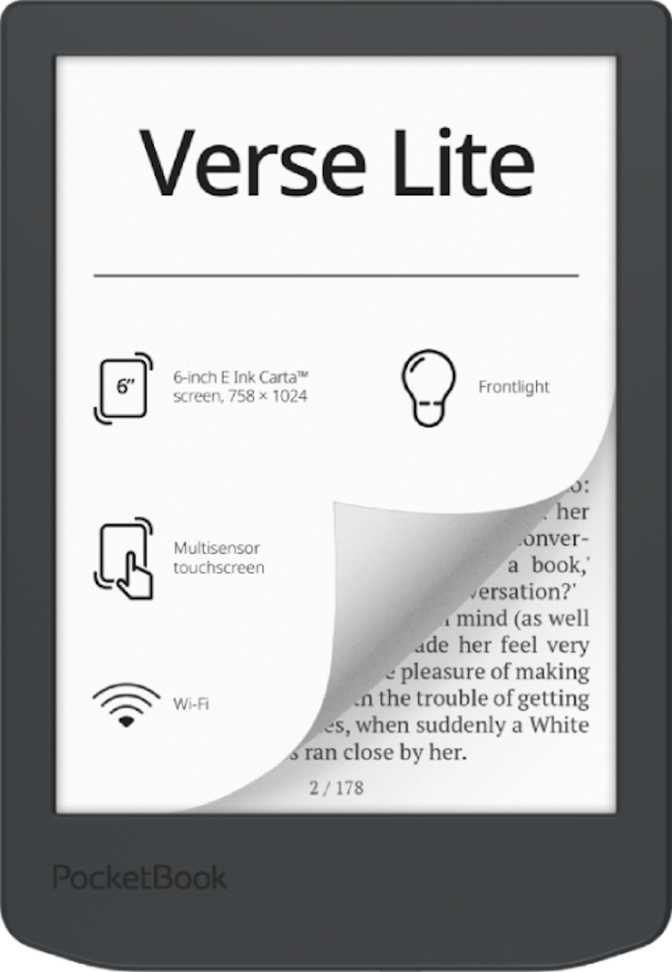
PocketBook Verse Lite Review: A Focused E-Reader for Text-First Readers
E-readersThe PocketBook Verse Lite is a clean, text-focused e-reader that trades audio features and a razor-sharp display for broad format compatibility, outstanding battery endurance, and a genuinely light, pocketable build. It is not the most feature-rich device in its class — but for the right reader, it does not need to be.
Editor's Rating
4.0 / 5
Good for Text-Only Readers
A No-Frills E-Reader That Gets the Basics Right
The e-reader market has a problem: most devices either cost too much or sacrifice too much. Premium models pile on features that casual readers never use, while bargain-bin options cut corners where it actually hurts — on the screen and the reading experience itself. The PocketBook Verse Lite positions itself squarely in the middle, promising a clean, comfortable reading device without the premium price tag.
Whether that promise holds up depends entirely on what you need from a dedicated reading device — and understanding that is exactly what this review is here to help you figure out.
Design and Build: Thin, Light, and Understated
170 g
Total Weight
7.6 mm
Thickness
108 × 156 mm
Width × Height
At 170 grams and just 7.6mm thick, the PocketBook Verse Lite is genuinely pocketable in a way that larger tablets and even some competing e-readers are not. To put that weight in perspective, it's lighter than most smartphones on the market today, which matters significantly during long reading sessions. Holding a device for an hour or two while lying in bed or commuting becomes fatiguing fast if it's dense and heavy. The Verse Lite does not fight you.
The footprint falls comfortably within the standard 6-inch e-reader form factor — sized to fit naturally in one hand without stretching your thumb to reach the screen edges, and slim enough to slip into a jacket pocket or a small bag without adding noticeable bulk.
Build Limitations Worth Knowing
- The screen has no branded damage-resistant glass coating — a protective case or sleeve is strongly recommended for bag carry.
- There is no weather sealing of any kind. Bath reading, poolside use, and caught-in-the-rain scenarios all carry real risk of device damage.
The Display: Where It Matters Most
An e-reader lives or dies by its screen, and this is where the PocketBook Verse Lite makes its strongest argument.
Sharpness and Clarity
The 6-inch e-paper display renders text at 212 pixels per inch. The threshold where text stops looking pixelated to most readers sits around 200 ppi — this display crosses that line comfortably. Standard print books reproduce text equivalent to roughly 150–170 ppi when scanned and displayed digitally, meaning what you see on this screen is actually sharper than what you'd read off a printed paperback page. Letters are clean, edges are crisp, and extended reading does not produce the eye strain associated with backlit LCD or OLED screens.
The 758 × 1024 pixel resolution is standard for this display class and handles both text and simple graphics without issue. This screen is optimized for text — illustrated books or comics will not look their best at this tier of e-paper rendering.
Built-In Lighting
The self-lit front-light illuminates the screen from the edges inward rather than shining light directly into your eyes the way a phone or tablet does. This distinction matters enormously for reading comfort, particularly at night or in dim environments. You can read in a dark room without straining your eyes or disturbing a sleeping partner.
The anti-reflection coating on the screen surface reduces glare in bright conditions — sunlight, office lighting, and overhead lamps all become manageable. Reading outdoors in direct sunlight is genuinely comfortable in a way that is simply impossible on glossy smartphone screens.
Anti-Glare Coating
Comfortable in direct sunlight and bright rooms
Front-Lit Screen
Gentle, eye-friendly light for night reading
Touchscreen
Tap to turn pages, pinch to resize, tap to define
16 Grayscale Shades
Standard e-paper rendering, ideal for text content
Note on touch-only navigation: There are no physical page-turn buttons on the Verse Lite. If you prefer tactile controls or read with gloves in cold weather, this is a meaningful consideration before purchasing.
Performance: Functional, Not Fast
Inside the Verse Lite sits a dual-core processor paired with 512MB of RAM. For most reading tasks — turning pages, adjusting font size, tapping dictionary lookups — this hardware is entirely sufficient. The experience is not snappy in the way a modern smartphone feels; there is a brief flash and refresh with each page turn that is characteristic of e-paper technology itself, not a processing limitation.
Where the performance ceiling shows itself is in more demanding tasks. Complex PDF layouts with heavy graphics, large scanned documents, or rapidly switching between menus can feel sluggish. For a reader who opens a book and reads it, this is a non-issue. For someone who annotates dense PDFs, jumps frequently between documents, or uses the built-in browser intensively, the hardware starts to feel constrained.
Storage Capacity
The device ships with 8GB of onboard storage and has no memory card slot — this is the total and final capacity. An average novel in standard ebook format occupies roughly 2–5MB. Even at the upper end, 8GB holds thousands of books. If your library is primarily text-based fiction and non-fiction, storage will never be a concern.
Storage works fine for:
- Standard EPUB and MOBI novel collections
- Thousands of text-based ebooks
- Library borrowed titles
Storage gets tight with:
- Large scanned or illustrated PDFs (50–200MB each)
- Academic paper collections
- Mixed media document libraries
Connectivity: Wi-Fi Only, No Bluetooth
The Verse Lite connects via Wi-Fi (802.11n / Wi-Fi 4). This is the previous generation of Wi-Fi standard, not the latest 802.11ac or Wi-Fi 6, but it is more than adequate for downloading ebooks, syncing libraries, and light browsing — all tasks that involve small data transfers. You will not notice the difference between Wi-Fi 4 and newer standards when downloading a novel.
The Bluetooth Absence — What It Means in Practice
This device produces no audio output of any kind:
- No Bluetooth: wireless headphones and external speakers cannot be paired
- No 3.5mm headphone jack: wired audio is not supported either
- No built-in speaker: there is no onboard audio hardware
- Audiobooks and text-to-speech are completely unavailable — this cannot be changed with a firmware update
There is also no cellular connectivity. The device requires a Wi-Fi network to download content and cannot use a mobile data connection independently.
The built-in web browser functions adequately for accessing ebook store pages or simple websites on Wi-Fi. Treat it as a utility feature, not a full browsing experience.
Battery Life: The E-Reader Advantage
The battery capacity sounds modest compared to modern smartphones — but that comparison is misleading. E-paper displays consume almost no power while showing a static image, meaning power is only drawn during a page turn or when the front light is active. The result is battery endurance measured in weeks, not days.
Expected Endurance by Usage Pattern
- Light readers (under 1 hour/day, low brightness): up to 4 weeks per charge
- Average readers (1–2 hours/day, moderate brightness): 2–3 weeks per charge
- Heavy readers (3+ hours/day, high brightness, frequent Wi-Fi): 1–2 weeks per charge
Charging Details
- USB-C connector — current standard, works with most modern cables
- No fast charging — topping up takes a couple of hours at standard speed
- No wireless charging — cable connection required
- Battery is non-removable — standard for slim e-readers in this class
Given the weeks-long endurance, the absence of fast charging is rarely a pressing inconvenience. You are unlikely to find yourself needing a quick top-up before heading out.
Format Support: Genuinely Broad Compatibility
One area where PocketBook has historically differentiated itself from competitors is format compatibility, and the Verse Lite reflects this philosophy. The device natively supports 25 file formats — without requiring conversion software. For context, some competing e-readers lock you to a single proprietary format and require third-party tools before they will even open a standard EPUB file.
This broad compatibility means you can load books from virtually any source: library lending services, independent ebook retailers, Project Gutenberg, and personal document collections. You are not tethered to a single ecosystem's bookstore.
What 25-Format Support Means for You
Open EPUB files without conversion
Read PDFs, FB2, DJVU, TXT, and HTML natively
Load ebooks from any retailer or library service
Transfer files directly via USB-C from your computer
No mandatory account or subscription required
Built-in dictionary for instant word lookups
The built-in dictionary adds genuine utility for reading in non-native languages or encountering unfamiliar vocabulary — tap a word and get a definition immediately, without breaking reading flow.
Who Should Buy the PocketBook Verse Lite
This Device Fits You Well If:
- You read primarily text-based content — novels, essays, journalism, standard non-fiction
- You want a dedicated reading device without paying flagship e-reader prices
- You frequently read in bright daylight or low-light conditions and need a comfortable screen
- You use ebooks from multiple sources and need broad format compatibility
- You want to carry a light, slim device for travel or commuting
- Audio is not part of your reading habits
This Device Is Likely Wrong If:
- You listen to audiobooks or want text-to-speech functionality — there is no audio output of any kind
- You read near water regularly — bathrooms, boats, poolside — without a waterproof case
- You work extensively with heavily formatted PDFs, graphic novels, or illustrated books
- You need expandable storage for a large and varied library
- You prefer physical page-turn buttons over a touchscreen-only interface
How It Compares to the Alternatives
The Verse Lite's closest competitors in the 6-inch entry e-reader segment are the base Kindle and the Kobo Clara. Here is how they stack up on the features that matter most:
| Feature | PocketBook Verse Lite | Entry Kindle | Kobo Clara |
|---|---|---|---|
| Display Size | 6 inches | 6 inches | 6 inches |
| Pixel Density | 212 ppi | 300 ppi | 300 ppi |
| Front Light | |||
| Bluetooth / Audio | Select models only | ||
| Water Resistance | IPX8 | IPX8 | |
| Format Flexibility | Very Broad — 25 formats | Limited (Kindle formats) | Broad (EPUB native) |
| Expandable Storage | |||
| USB-C Charging | Newer models only |
The sharpest contrast between the Verse Lite and its most common competitors is pixel density. At 212 ppi, the display is noticeably less sharp than the 300 ppi panels found on comparably priced Kindles and Kobos. For most readers, 212 ppi is entirely acceptable — text is crisp and readable without visible pixelation. But readers who are particular about text rendering, or who are coming from a 300 ppi device, will notice the difference.
The Verse Lite's meaningful advantage over the entry Kindle is format freedom. Amazon's devices are architected to favour their own ecosystem and require workarounds or conversion software to load EPUB files — the global standard ebook format. The Verse Lite reads them natively, alongside 24 additional formats. For readers who buy from multiple stores or borrow from libraries, this is a real, practical daily benefit.
Honest Strengths and Weaknesses
The PocketBook Verse Lite succeeds most clearly at the thing it sets out to do: deliver a comfortable, front-lit reading experience in a light, portable package. None of the weaknesses below are hidden or softened — and that transparency is the point.
Where It Genuinely Delivers
Battery endurance that changes habits. Charging every few weeks instead of every few days is a lifestyle shift that regular smartphone readers will appreciate immediately.
Format freedom that removes frustration. Loading a library EPUB, an independent bookstore download, and a Project Gutenberg classic on the same device — without conversion tools — is a daily convenience competitors cannot match at this tier.
A display that works in real lighting conditions. The anti-reflection coating and adjustable front light make this usable in sunlight, dim rooms, and complete darkness without compromise.
A form factor you will forget is in your bag. At 170 grams and 7.6mm thin, this device travels without demanding attention.
Where It Falls Short
Audio is completely absent — permanently. No speaker, no headphone socket, no Bluetooth. Audiobook listeners and text-to-speech users have no path forward here, regardless of software updates.
The display trails competitors on sharpness. At 212 ppi, the screen is good — but the 300 ppi panels on competing devices at similar prices are visibly better, particularly at small font sizes.
No water resistance is a meaningful omission. Both major competitors include IPX8 waterproofing; the Verse Lite offers none. A dropped device in a sink or a surprise rainstorm carries real risk.
Fixed 8GB with no expansion. Sufficient for most, but there is no fallback option when the storage is full — files must be deleted to make room.
Questions Real Buyers Ask Before Purchasing
Final Recommendation
The Verdict
The PocketBook Verse Lite is a focused, honest product. It does not try to compete with flagship e-readers on every dimension — and it should not at its price point. What it offers instead is a comfortable reading screen, outstanding battery endurance, and genuinely open format compatibility in a package light enough to forget you are carrying it.
The recommendation is straightforward: if you are a text-focused reader who pulls ebooks from multiple sources, values a front-lit screen for varied lighting conditions, and does not need audio functionality, the Verse Lite delivers meaningfully good value. If sharp display resolution, water resistance, or any form of audio playback matters to you, the trade-offs at this price tier push you toward alternatives.
Buy this device knowing exactly what it is — a clean, capable, audio-free reading machine — and it is unlikely to disappoint. Buy it expecting more, and the gaps will frustrate you.
Best for: casual to avid text readers seeking ecosystem freedom and long battery life.
4.0 / 5
Recommended for Text Readers