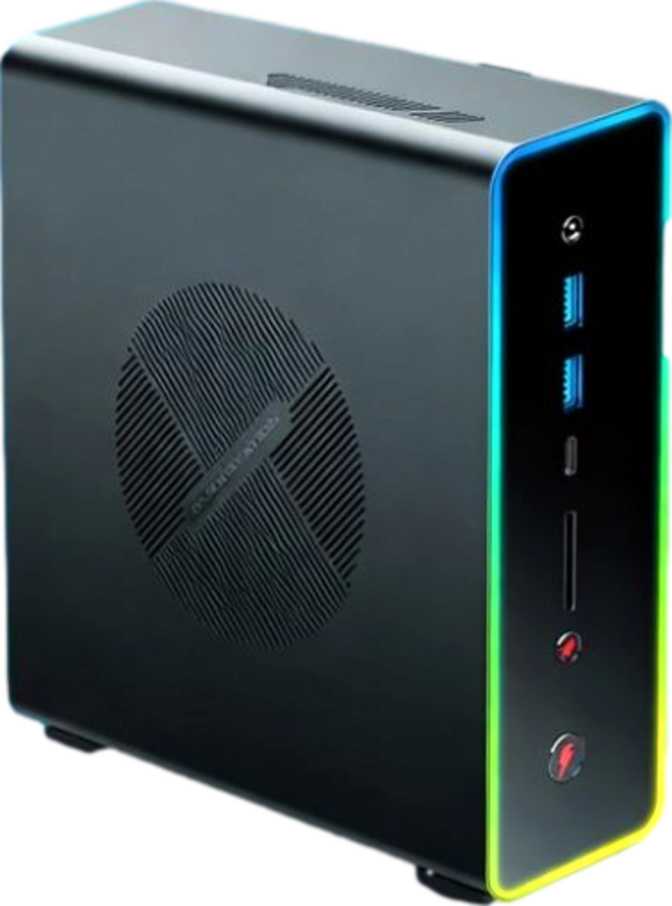
Onexplayer OnexStation Review: Workstation Compute in a Compact Desktop
Mini PCsMini PCs have spent years being the sensible, boring choice — adequate for office work, underwhelming for anything demanding. The Onexplayer OnexStation is a pointed rejection of that pattern. Built around a unified computing architecture that blends a high-core-count processor with serious integrated graphics into a Micro-ATX chassis, it occupies a category that barely existed a few years ago: a genuinely capable compact desktop that does not ask you to choose between portability and performance.
Onexplayer earned its reputation making handheld gaming devices. The OnexStation takes that same philosophy — pack maximum capability into minimum space — and applies it to a form factor that sits on your desk rather than in your hands. The result is a machine that competes with mid-tower workstations on benchmark charts while taking up a fraction of the footprint.
Whether you are a creative professional reconsidering your workstation, a developer who wants serious local AI compute, or a gamer who needs a capable desktop without the bulk, this review will tell you exactly what you are getting — and whether it is the right fit for you.
Design and Build Quality
The OnexStation follows the Micro-ATX standard, which means it is compact by desktop norms but not pocketable like a true mini PC. Think of it as the middle ground: smaller than a traditional mid-tower, larger than an Intel NUC-style box, and designed to accommodate the thermal demands of a 55-watt processor without throttling under sustained load.
The chassis is built for function rather than flair. Ventilation is a priority, which is the correct priority when housing hardware that can sustain significant power draw. Onexplayer's handheld device background shows here — they understand thermal management under constraint better than most desktop OEMs.
Port placement is practical and well-considered, with the full connectivity suite accessible without routing cables awkwardly around the back. The machine is intended to sit on a desk, not be hidden behind a monitor, and the layout reflects that clearly.
Processor Performance
16 Cores · 32 Threads · 5.1 GHz Turbo · 55W TDP · 64 MB L3 Cache
The CPU at the heart of the OnexStation runs sixteen cores across thirty-two threads, with a base operating frequency of 3.0 GHz that climbs to 5.1 GHz when single-threaded tasks demand maximum speed. A 55-watt thermal envelope governs the whole system — and that figure deserves context. A typical desktop processor operates anywhere from 65W to 125W or more. The OnexStation's processor achieves comparable core counts at significantly lower power consumption, which translates directly to quieter fans, less heat, and lower electricity draw over time.
What the Benchmarks Tell You
A multicore PassMark result of 54,021 places this processor in territory normally occupied by enthusiast desktop chips with significantly higher power budgets. The single-core score of 4,142 is strong — competitive with modern high-performance desktop processors — which matters more than people realize for everyday responsiveness, gaming frame pacing, and application launch speed. Geekbench 6 results reinforce this picture across diverse workloads, from compiling code to rendering video to running large language models locally.
The cache hierarchy is substantial: 1,280 KB of L1 cache, 16 MB of L2 spread across sixteen cores at 1 MB per core, and a 64 MB L3 cache. Large L3 cache is particularly beneficial for workloads that keep large datasets warm — machine learning inference, database operations, and simulation work all benefit meaningfully from this.
Instruction Set Support
The processor supports a full suite of modern instruction sets including AVX2, FMA3, and AES. AES acceleration means encryption and decryption operations — VPN tunnels, encrypted storage, secure communications — happen at near-zero CPU overhead. AVX2 support ensures compatibility with optimized scientific and media processing libraries. The multiplier is locked, meaning overclocking beyond the factory-defined turbo is not possible. Given how strong the baseline performance already is, this is rarely a practical concern.
Graphics: Integrated in Name, Discrete-Class in Practice
Radeon 8060S · RDNA 3.5 Architecture · 4 nm Process · DirectX 12 Ultimate
The integrated Radeon 8060S, built on AMD's RDNA 3.5 architecture using a 4-nanometer manufacturing process, delivers 14.85 TFLOPS of floating-point compute. Mid-range dedicated graphics cards typically operate in the 10–16 TFLOPS range. The 8060S competes with them — without being a separate card.
The Shared Memory Advantage
Because the CPU and GPU share the same 128 GB pool of DDR5 RAM running at up to 8,000 MHz across four channels, the GPU has access to 256 GB/s of memory bandwidth. Discrete cards use dedicated video memory that is faster per module but much smaller in total capacity — often 8 GB to 16 GB. The OnexStation's GPU can work with datasets far too large for any discrete card's local memory, which is a fundamental architectural advantage for AI inference, large texture workloads, and content creation with massive assets.
Gaming and Rendering Capability
The GPU's 2,560 shader processors, 160 texture mapping units, and 64 render output units back up the TFLOPS figure with real throughput. Ray tracing is supported natively, which matters for both current games implementing hardware-accelerated lighting and for rendering applications that use path tracing for realistic output. Support for DirectX 12 Ultimate — the most current API tier — ensures full compatibility with all modern games and graphics workloads without feature compromises. The GPU can drive up to four displays simultaneously.
A G3D score of 17,936 would have been considered high-end discrete territory in recent years. For an integrated solution, it represents a significant step change in what is achievable without a dedicated graphics card.
Memory: The Specification That Changes Everything
128 GB DDR5 · Quad-Channel · 256 GB/s Bandwidth · ECC Supported · Up to 8,000 MHz
128 GB of DDR5 RAM is the specification that most sharply separates the OnexStation from conventional compact PCs — and from many full-sized workstations. Running in quad-channel configuration, memory bandwidth reaches 256 GB/s, feeding both processor and graphics from the same pool. For most consumer desktop users this is far beyond what typical tasks require. But the OnexStation is not positioned for typical use.
- AI/ML Developers — running large language models locally, where model size directly determines whether inference is even possible. Many capable models require 24 GB to 96 GB of accessible memory.
- Video Editors — working with high-resolution multicam footage, where large RAM pools allow entire project timelines to be cached in memory.
- Virtualization Users — running multiple operating systems simultaneously, where each VM requires its own dedicated memory allocation.
- 3D Artists and Simulation Engineers — handling scene complexity that exceeds what smaller systems can hold in memory.
ECC Memory Support — A Workstation-Class Feature
The OnexStation supports Error-Correcting Code memory, which automatically detects and corrects single-bit memory errors without crashing. This is a feature found in professional workstations and servers — not consumer mini PCs. For any workload where data integrity matters — financial calculations, scientific computing, long rendering jobs — this is a meaningful reliability advantage that distinguishes the OnexStation from consumer-grade alternatives.
Storage: Fast, Generous, and Expandable
The included 1 TB NVMe SSD uses PCIe 5.0 — the current-generation interface standard — which means sequential read and write speeds at the top of what any consumer storage device can achieve. Real-world impact: large file transfers, game load times, and application launches are as fast as storage currently allows.
1 TB is a reasonable starting point, but with video work, game libraries, and local AI models increasingly consuming hundreds of gigabytes, it is a capacity you may outgrow depending on your use case. The presence of an external memory slot means expandability is built in rather than bolted on as an afterthought.
Connectivity: A Port Selection That Covers Every Scenario
2x USB4 40Gbps · 2x Thunderbolt 4 · 3x USB 3.2 Gen2 · HDMI 2.1 · Wi-Fi 7 · BT 5.4
The OnexStation's connectivity suite is genuinely comprehensive. Two USB4 ports running at 40 Gbps and two Thunderbolt 4 ports give you four high-bandwidth connections capable of driving external displays, connecting to fast NVMe enclosures, and running eGPUs or docking stations. Thunderbolt 4 is Intel's certified standard for guaranteed compatibility with the full ecosystem of Thunderbolt accessories. HDMI 2.1 supports 4K at 120 Hz and 8K at lower refresh rates — relevant for high-refresh gaming monitors or large televisions.
Full Port Breakdown
| Port Type | Count | Speed / Standard | Best Used For |
|---|---|---|---|
| USB4 (Type-C) | 2 | 40 Gbps | External NVMe drives, displays, docking stations |
| Thunderbolt 4 (Type-C) | 2 | 40 Gbps | TB4 ecosystem, eGPU enclosures, certified docks |
| USB 3.2 Gen 2 (Type-A) | 3 | 10 Gbps | External SSDs, high-speed peripherals, hubs |
| USB 2.0 (Type-A) | 2 | 480 Mbps | Keyboards, mice, low-bandwidth accessories |
| HDMI 2.1 | 1 | 4K@120Hz / 8K | Gaming monitors, large televisions |
| DisplayPort | 1 | DisplayPort Out | PC monitors, multi-display setups |
| RJ45 Ethernet | 1 | Wired LAN | Gaming, video conferencing, large transfers |
| 3.5mm Audio Jack | 1 | Headset Combo | Headphones and headset microphones |
Wireless Connectivity
Wi-Fi 7 (802.11be) is the most current wireless standard, offering significantly higher theoretical throughput and lower latency than Wi-Fi 6E in environments where Wi-Fi 7 routers are available. Backward compatibility with Wi-Fi 6E, 6, 5, and 4 means the system works with any existing network infrastructure without configuration headaches. Bluetooth 5.4 covers all current wireless peripherals, including modern audio devices, controllers, and input devices.
Who Should Buy the OnexStation
- Local AI developers and researchers who need large unified memory to run full-sized language models without relying on cloud APIs
- Content creators — video editors, 3D artists, motion designers — working with high-resolution assets and complex scenes
- Software developers running heavy compilation jobs, multiple virtual machines, or containerized development environments simultaneously
- Power users who want a single compact machine handling professional workloads and gaming without compromise
- Professionals where ECC memory reliability and workstation-class compute matter but rack-mounted or full tower hardware is impractical
- Casual users whose workloads consist of browsing, email, and office applications — the capability here is far beyond what those tasks require
- Gamers whose primary metric is maximum frames per second in AAA titles at 4K — a discrete GPU system may still outperform in specific high-resolution scenarios
- Users who need to upgrade individual components over time — the integrated architecture means memory and graphics are not separately replaceable
Competitive Positioning
The OnexStation occupies a specific and not heavily contested market position. The competition worth considering falls into two camps: conventional mini PCs and traditional workstations with discrete GPUs. Against other RDNA 3.5 APU-based systems, the OnexStation differentiates through its maximum memory configuration and full Thunderbolt 4 implementation — features many competing systems omit.
| Comparison Point | OnexStation | Traditional Mini PC | Discrete GPU Workstation |
|---|---|---|---|
| Total Memory Capacity | 128 GB unified | 16–64 GB typical | Separate CPU / GPU pools |
| GPU Memory Available | Full 128 GB | 16–64 GB shared | Discrete VRAM only (8–24 GB) |
| Memory Bandwidth (GPU) | 256 GB/s | 68–100 GB/s typical | 300–600 GB/s (dedicated VRAM) |
| Form Factor | Micro-ATX | Mini-ITX / smaller | Mid-tower or larger |
| Thunderbolt 4 | Yes (2 ports) | Varies | Varies |
| ECC Memory Support | Yes | Rarely | Workstation models only |
Honest Assessment
The OnexStation's core strength is architectural rather than spec-sheet-deep. The combination of high core count, large unified memory pool, fast memory bandwidth, and modern integrated graphics creates a system where the CPU and GPU collaborate on workloads rather than competing through separate memory interfaces. For AI inference, creative production, and technical computing, this cooperation produces results that exceed what raw spec comparisons suggest.
The ECC memory support is genuinely unusual at this form factor and price tier, and it signals that Onexplayer is taking the professional use case seriously rather than treating it as a marketing talking point. The connectivity package is equally rare — most compact systems compromise somewhere, whether through fewer ports, slower USB standards, or absent Thunderbolt. The OnexStation makes no meaningful compromises here.
The honest limitations: integrated graphics, however capable, cannot match what a high-end discrete GPU delivers in rasterization-heavy gaming at 4K. The 8060S handles 1080p and 1440p gaming across most titles with confidence, and it handles creative and compute workloads that discrete cards struggle with due to memory limits — but if your primary measure is hitting 144 Hz at 4K in the most demanding titles, dedicated graphics hardware remains the better tool.
The locked CPU multiplier means you are working within the factory-defined performance envelope. Given how strong that envelope already is, this is rarely a practical concern — but buyers who want to push performance beyond the box should be aware before committing.
Answers to Common Buyer Questions
Final Recommendation
The Onexplayer OnexStation is a specific solution to a specific problem: maximum compute capability and memory capacity in a compact desktop form factor, without the compromises that usually accompany miniaturization.
If your workloads demand large memory pools — local AI development, serious content creation, intensive virtualization — the OnexStation offers capabilities that simply are not available in this form factor from most other vendors. The combination of 128 GB unified memory, 256 GB/s bandwidth, ray-tracing-capable integrated graphics, and full Thunderbolt 4 support is genuinely difficult to match at compact desktop scale.
If your needs are simpler — gaming, everyday productivity, casual creative work — the OnexStation will handle all of it with ease, but the specification and price point represent more machine than those workloads require.
For the buyer who understands why this architecture exists and what it enables, the OnexStation is one of the most technically compelling compact desktops currently available. The hardware is built for serious work, and it delivers on that promise without the bulk traditionally associated with workstation-class capability.