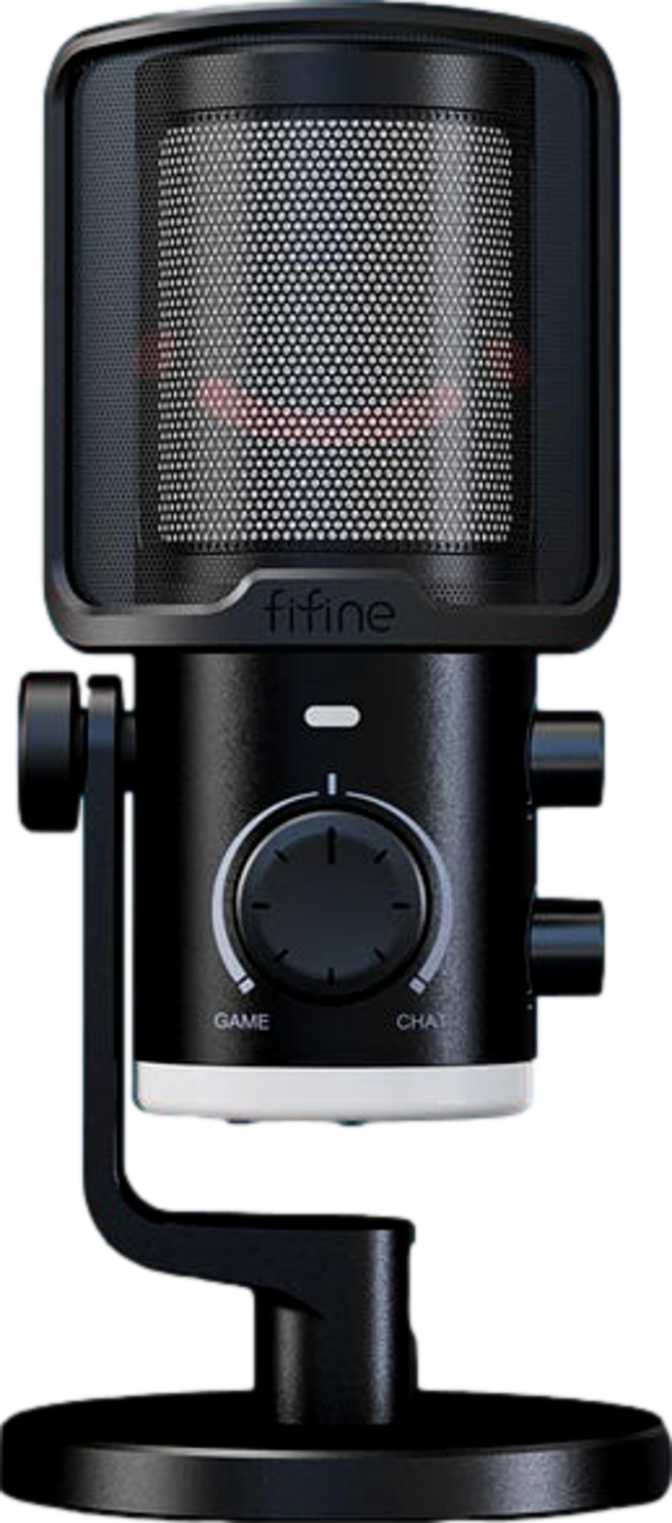
Most people shopping for their first dedicated microphone are stuck between two bad options: a cheap USB mic that sounds tinny and picks up every fan and keyboard click in the room, or a proper XLR setup that demands an audio interface, phantom power, and a learning curve nobody asked for. The Fifine AmpliGame AM6 is built to sit in the gap between those two extremes — a plug-and-play USB microphone styled and equipped for gamers, streamers, and casual podcasters who want clean, controlled vocal audio without turning their desk into a recording studio. Whether it actually closes that gap, and where it quietly falls short, is what the rest of this review is here to settle.
Design, Build Quality, and Desk Presence
Pick the AM6 up and the first thing you notice is that it doesn't feel like a toy. At roughly 600 grams, it has real heft — heavier than the typical lightweight desktop condenser, and that mass works in its favor. A heavier mic body resists wobble, absorbs minor desk knocks better, and feels more like a piece of equipment than an accessory.
Physically, this is not a small, discreet microphone. Standing at just over 26 centimeters (about 10.3 inches) tall, with a body roughly 15.4 cm wide and 11.2 cm deep, the AM6 commands a noticeable footprint on a desk — closer in scale to a chunky thermos or a small desk lamp than to a slim webcam-sized gadget. If your setup is minimalist or your desk is tight, factor that footprint in before you buy; this is a microphone meant to be seen, not tucked away.
That visibility is clearly intentional. The unit features built-in RGB lighting, which immediately signals its target audience: this is a streaming and gaming accessory first, a serious studio tool second. It's designed to look good on camera and on stream, not to disappear into a podcast booth.
Build Details Worth Knowing
Integrated Shock Mount
Built into the mic rather than sold as an add-on, this absorbs vibrations from desk bumps, footsteps, or heavy typing before they reach the capsule.
Included Pop Filter
Tames harsh "p" and "b" bursts right out of the box, saving you a separate purchase and the guesswork of finding a compatible third-party filter.
On-Device Control Panel
Gain, volume, and mute controls live directly on the mic body, so there's one less cable and controls always within arm's reach.
Touch-Mute Control
A tap mutes and unmutes instantly — useful the first time your phone rings mid-stream or you need to cough off-air.
Sound Quality: What the AM6 Actually Captures
This is the section that decides whether a microphone is worth buying, so let's go through it properly rather than just nodding at numbers.
Polar Pattern: One Pattern, One Job
The AM6 ships with a single cardioid polar pattern, and there's no switching between alternate pickup shapes. A cardioid pattern picks up sound primarily from directly in front of the microphone while rejecting noise from the sides and rear. In practical terms, that means it's built to isolate your voice while pushing background noise — PC fans, a roommate's TV, street noise through the window — toward the edges of what it hears.
The trade-off is flexibility. Because there's only one pattern available, the AM6 isn't suited to recording two people facing each other, capturing room ambience, or any multi-speaker setup that pricier multi-pattern condenser mics handle. If your use case is one person talking into a mic, this is exactly the right tool. If it's a co-hosted podcast with two mics on one unit, it isn't.
Frequency Range: Tuned for Voice, Not Instruments
The microphone captures frequencies from 70 Hz up to 20,000 Hz. That range maps almost perfectly onto the human vocal range and its harmonics — every register of speech, from a deep voice to a higher-pitched one, sits comfortably inside that window, along with the upper-frequency detail that gives speech its clarity and presence.
The 70 Hz low-end cutoff means the absolute deepest rumble — desk vibration, HVAC hum, the kind of sub-bass a kick drum lives in — gets naturally rolled off before it reaches your recording. For voice work, that's a genuine advantage. For anyone hoping to use this mic for instruments or deep bass capture, it's a hard limitation.
Noise Floor: Quiet Enough, Not Studio-Silent
The AM6's signal-to-noise ratio sits at 75 dB — the gap between your actual voice signal and the faint electronic hiss every microphone produces. That's a respectable figure for this category; hiss won't be noticeable in a typical bedroom, home office, or gaming setup. It's not, however, the near-silent floor of a high-end studio condenser costing several times as much, where that figure often climbs past 80 dB.
Resolution: Sampling at 48kHz / 24-bit
Internally, the AM6 processes audio at a 48kHz sample rate and 24-bit depth — the same resolution standard used by YouTube, Twitch, Zoom, and most professional video production. For voice, gaming commentary, and streaming, this is the practical ceiling of what matters; going higher wouldn't make your voice sound noticeably better, just make the files bigger.
A Detail Power Users Should Notice: No Flat/Neutral Mode
The AM6 does not offer a flat DSP (digital signal processing) mode. On microphones that do, a flat mode bypasses onboard tone-shaping and hands you a neutral signal to color yourself in post-production. Its absence here suggests the AM6 delivers a voice-tuned sound out of the box, with processing baked in, rather than handing total tonal control to the user. For most buyers that's a convenience; for enthusiasts who like full control in their editing software, it's a limitation worth knowing before purchase.
| Sound Trait | What It Means For You |
|---|---|
| Pickup Pattern | Tightly focused on a single voice; not built for two-person setups |
| Frequency Response | Tuned for speech clarity; rolls off deep rumble and sub-bass automatically |
| Background Hiss | Quiet enough for home and bedroom use; not studio-silent |
| Audio Resolution | Matches platform standards used by YouTube, Twitch, and Zoom |
| Tone Shaping | Voice-tuned by default; no neutral mode for manual color grading |
Features That Actually Change Your Day-to-Day Use
Beyond the raw audio specs, a handful of features shape what it's actually like to live with this microphone.
-
Noise-canceling microphone circuitry
Works alongside the cardioid pattern to suppress common background intrusions — keyboard clatter, case fans, ambient room noise — before they reach your recording.
-
3.5mm headphone output
Built into the mic for zero-latency monitoring through standard consumer headphones. No larger 6.35mm jack, so studio-style cans may need a small adapter.
-
Cross-platform compatibility
Works across Windows, Mac, Android, and iOS — broader than most budget USB mics, useful if you record from more than one device.
-
USB-powered, no internal battery
No charge cycle to manage and no risk of it dying mid-stream, but you're tethered to a powered USB port whenever it's in use.
Setup and Everyday Compatibility
Because the AM6 connects over standard USB and is supported across four platforms, the realistic expectation is plug-and-play: connect the cable, select it as your input device, and start talking. There's no mention of a dedicated companion app, which lines up with the on-device control approach — the controls you need are physically on the mic, not buried in a settings menu. That's a deliberate simplicity trade-off: easier for a beginner to pick up immediately, less granular for someone who wants software-level EQ curves and presets.
Windows
Mac OS X
Android
iOS
Who This Microphone Is Actually For
Great Fit For
- Solo streamers and gamers who want clean commentary without learning audio engineering
- First-time content creators recording voiceovers, YouTube videos, or casual podcasts solo
- Desk-setup enthusiasts who want a mic that looks the part with RGB lighting on camera
- Multi-device creators who occasionally record from a phone or tablet
Not Ideal For
- Co-hosted or interview-style podcasters needing two voices captured on one mic
- Musicians and instrumentalists who need accurate low-frequency capture below 70 Hz
- Audio purists who want a flat, unprocessed signal and full manual tonal control
- Anyone with a genuinely tight desk that can't accommodate a tall, wide mic body
How It Compares to Other Microphones in Its Class
USB microphones at this level generally split into two broad camps, and it's worth knowing which camp the AM6 sits in before comparing prices.
| Microphone Category | Typical Strength | Typical Trade-off | Where the AM6 Fits |
|---|---|---|---|
| Multi-pattern USB condensers | Flexible for interviews, group recording, ambient capture | Usually pricier, more complex gain staging | Skips this — single cardioid only, but simpler to use |
| Single-pattern streaming USB mics | Plug-and-play simplicity, built-in controls, aesthetic lighting | Less flexible, fixed tonal character | This is the AM6's category |
| Entry-level dynamic XLR mics | Excellent noise rejection in loud rooms | Requires an audio interface or mixer | Avoids this complexity entirely via USB |
Inside its own category, the AM6's combination of an included shock mount, included pop filter, on-device controls, and broad OS compatibility is a genuinely strong feature set. Where it asks you to compromise compared to similarly priced alternatives is flexibility: no second polar pattern, no flat signal mode, and no on-mic level metering.
The Honest Strengths and Weaknesses
The Real Strengths
What the AM6 does well, it does well without much asterisk. The cardioid pattern combined with noise-canceling circuitry genuinely earns its keep for solo voice work, and the 70Hz–20kHz range is sensibly tuned for speech rather than padded out with marketing-friendly numbers that don't matter for the use case. Including a shock mount and pop filter out of the box respects a buyer's wallet — those are real costs avoided. The on-device touch mute and control panel make the microphone feel finished, and a two-year warranty is a longer commitment than many budget electronics offer.
Where It Asks for Trade-offs
The single cardioid pattern is a hard ceiling on versatility — buyers who think they might eventually want to record a second voice on the same mic should look elsewhere from day one. The lack of a flat DSP mode will frustrate anyone who likes shaping their own sound in post-production, and the missing on-device level meter means trusting software meters rather than the hardware itself. None of these are deal-breakers for the audience this mic is built for, but they separate "good enough for streaming" from "good enough for everything."
Frequently Asked Questions
Final Verdict
The Fifine AmpliGame AM6 is a well-built, sensibly specified single-pattern USB microphone aimed precisely at solo streamers, gamers, and casual content creators who want noticeably better, cleaner audio than a headset or laptop mic without wading into XLR interfaces, phantom power, or multi-pattern complexity. Its voice-tuned frequency range, respectable noise floor, included shock mount and pop filter, on-device controls, and unusually broad device compatibility add up to a microphone that's genuinely ready to use the moment it's plugged in.
It is not the right choice if you need multiple polar patterns for interviews, a flat signal path for heavy post-production control, or on-mic visual level metering — those gaps are real, and buyers who need them should look at higher-tier or multi-pattern alternatives instead.
For the audience it's built for — someone who wants to sound clearly better on stream or in recorded voiceovers without becoming an audio engineer — the AM6 earns a confident recommendation. If your use case is one voice, one mic, minimal fuss, this is a smart buy.