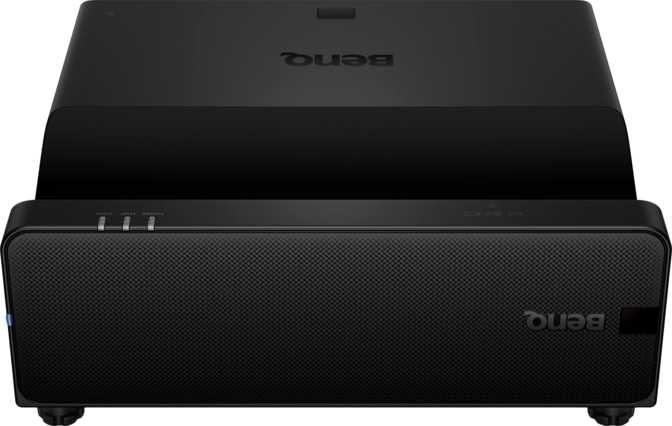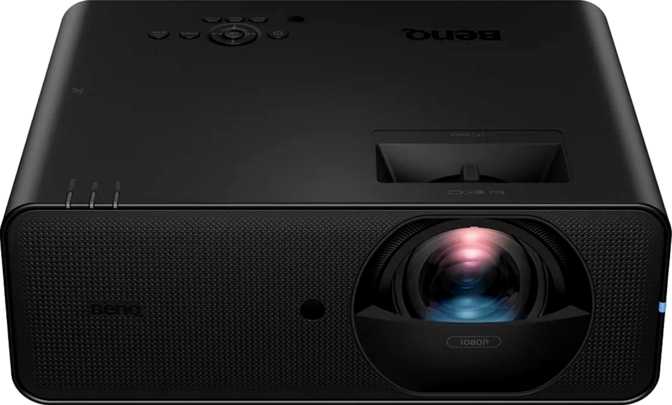
BenQ LH860ST: 4K Short-Throw Laser Projector — Full Review
ProjectorsWalk into most conference rooms, classrooms, or home theater setups, and you'll notice the same fundamental compromise: either the projector is mounted inconveniently far from the screen, or the image is smaller than anyone wants. The BenQ LH860ST is built around the proposition that you shouldn't have to choose. It combines a short-throw optical design with a high-output laser engine and genuine 4K resolution in a package that works just as readily in a boardroom as it does in a living room — and that versatility is exactly what makes it worth examining closely.
5,000
ANSI Lumens
4K
Output Resolution
1.1m
Min. Throw Distance
300"
Max. Image Size
Design and Build: Professional-Grade Without the Bulk
At roughly 5.2 kilograms and with a footprint measuring approximately 344mm wide by 266mm deep and 136mm tall, the LH860ST occupies that middle ground between a portable unit and a full ceiling-mount installation piece. It's heavy enough to feel substantial and permanent on a shelf or trolley, but not so unwieldy that a single person can't reposition it when needed.
The proportions are deliberately understated — BenQ's design language here prioritizes function over flash. There are no gratuitous vents or aggressive industrial styling choices. The result is a projector that disappears into a meeting room or living room without demanding visual attention, which is exactly the right call for a display device whose job is to project images, not to be admired itself.
Installation Note: No Lens Shift
The LH860ST includes no horizontal or vertical lens shift — a deliberate trade-off of the short-throw optical design. Placement precision matters more here than with a standard-throw projector. Plan your mounting or table position carefully, as keystone correction in software handles geometry adjustments but physical lens movement is not available.
The Laser Advantage: Why the Light Source Is the Most Important Spec
The LH860ST uses a solid-state laser light source rather than a traditional lamp, and this distinction affects virtually every aspect of ownership in ways that go well beyond the numbers.
Brightness That Holds Its Ground
With 5,000 ANSI lumens of output, this projector sits comfortably in the upper tier of what most environments will ever need. A typical home theater projector functions adequately at 1,500 to 2,000 lumens in a darkened room. A well-lit conference room or classroom demands at least 3,000 to 4,000 lumens to maintain readable contrast. At 5,000 lumens, the LH860ST handles genuinely bright environments — rooms with large windows and no blackout blinds — without the image washing out.
Longevity Without the Lamp Replacement Cycle
Traditional lamp-based projectors begin degrading in brightness within the first few thousand hours and require expensive bulb replacements around the 3,000 to 5,000-hour mark. Laser light sources are rated to operate for tens of thousands of hours before reaching half their original brightness. There are no replacement lamp costs, no scheduling around usage to extend bulb life, and no sudden mid-presentation failures as aging lamps give out.
Instant-On, Instant-Off
Laser projectors reach full brightness essentially the moment you switch them on — no warm-up period, no cool-down phase before moving the unit. In fast-paced meeting environments where setups happen minutes before a call, this is a meaningfully better experience than waiting for a lamp to reach operating temperature. Instant-off also means no forced wait time after presentations end.
4K Resolution: What It Actually Delivers
The LH860ST outputs at 4K resolution — approximately 8.3 million pixels across whatever surface it projects onto. At the sizes this projector is capable of producing, that matters more than it might seem.
When projecting at large sizes — 150 inches or beyond — a Full HD image begins to show visible pixel structure if viewers are seated within a reasonable viewing distance. At 4K, pixel density stays comfortable at much larger screen sizes and closer seating distances. For a projector capable of producing images up to 300 inches diagonal, having 4K resolution isn't a luxury — it's the minimum you'd want to maintain visual quality at the extremes of that size range.
HDR Format Support
- HDR10 — Wide highlight and shadow range for streaming, Blu-ray, and gaming content
- HLG (Hybrid Log-Gamma) — Broadcast television HDR; live broadcast content works without any additional configuration
- HDR10+ — Not supported; dynamic metadata tone mapping unavailable
- Dolby Vision — Not supported; frame-by-frame optimization unavailable
- 3D Projection — Not available; stereoscopic content is not supported
Who the HDR Omissions Affect
For corporate and educational deployments, the absence of HDR10+ and Dolby Vision is irrelevant. These formats serve cinematic color grading, not business or instructional content.
For dedicated home cinema enthusiasts who've built a Dolby Vision library or specifically value frame-by-frame tone mapping, this is a genuine limitation that warrants consideration before purchase.
Short-Throw Geometry: Big Images in Tight Spaces
The defining characteristic of the LH860ST's optical design is its short-throw capability. With a minimum throw distance of 1.1 meters — roughly the distance from a projector sitting on a conference table to the wall at the end of it — the unit can fill a large screen without needing the projector positioned far back into the room.
What Short-Throw Enables
- Rooms where ceiling-mounting a projector far from the screen would require expensive cable runs or structural work become practical deployment locations.
- A portable trolley setup where the projector sits close to the screen becomes genuinely viable — no long cable management required.
- Presenters are no longer walking through the projection beam and casting shadows across the screen — a perennial frustration with long-throw projectors in smaller rooms.
The Trade-Off
Short-throw lenses are optically complex, and adding mechanical lens shift to that design adds cost and size. The result is a projector that rewards careful placement over flexible optical correction. Keystone correction in software is available, but physical lens positioning cannot be adjusted after installation. Plan room placement precisely before committing to a mount position.
Smart Features and Connectivity
Built-In Smart Platform
The LH860ST ships with a built-in smart TV platform for streaming content directly without additional devices. A dedicated smartphone app extends control capabilities. Wireless mirroring covers all three major ecosystems simultaneously:
- AirPlay — iPhone and iPad
- Chromecast — Android and laptop
- Miracast — Cross-platform wireless display
Wired Connectivity
Physical ports are lean but cover the most common connection scenarios:
- 1x HDMI input
- 1x USB port — direct media playback
- 3.5mm audio output jack
- No Ethernet — Wi-Fi only
- No VGA or DVI (adapters needed)
Audio Output
The integrated stereo speaker system delivers 5 watts per channel — sufficient for small to medium rooms where spoken word clarity matters more than volume.
For larger spaces, music playback, or any situation where sound quality is a priority, routing audio through the 3.5mm output to an external system is the better choice. The internal speakers are functional, not impressive.
Who This Projector Is For
Good Fit
- Corporate meeting rooms — Laser reliability eliminates lamp management overhead; wireless ecosystem covers all guest devices without proprietary adapters.
- Training spaces and lecture halls — 5,000 lumens handles real-world lighting; short-throw keeps the projector away from accidental impacts in busy spaces.
- K-12 and higher education classrooms — Daily high-traffic use with no ongoing maintenance burden and brightness that works without blacked-out windows.
- Home theaters where ceiling mounting isn't practical — 4K and HDR10 are genuine cinema credentials; short-throw opens up living room placement options.
Look Elsewhere If You Need...
- 3D projection — Stereoscopic display with glasses is not supported on this model.
- Dolby Vision compatibility — Dedicated Dolby Vision libraries or frame-by-frame tone mapping are not available.
- Wired Ethernet connectivity — Managed IT environments requiring LAN connections for controlled devices will find no Ethernet port.
- Optical lens shift — Imperfect mounting positions that require physical lens adjustment cannot be accommodated on this unit.
Competitive Context
At the specification level the LH860ST occupies, the competitive landscape is fairly specific. Most projectors at this brightness tier are either standard-throw units or ultra-short-throw models designed to sit centimeters from the wall — each with a different use-case logic. The table below maps where the LH860ST stands.
| Feature | BenQ LH860ST | Typical Lamp-Based 5000L | Ultra-Short-Throw Alternative |
|---|---|---|---|
| Light Source | Laser | Lamp | Laser |
| Throw Distance | Short (1.1m min.) | Standard (2.5m+ typical) | Ultra-short (cm range) |
| Resolution | 4K | Often 1080p at this price | 4K available |
| Maintenance Cost | Near zero | Lamp replacements required | Near zero |
| Wireless Integration | AirPlay + Chromecast + Miracast | Varies, often limited | Varies |
| Lens Shift | None | Often included | Typically none |
| Form Factor | Mid-size | Mid to large | Wide, wall-hugging |
The core differentiator between the LH860ST and lamp-based alternatives at similar upfront prices is the ongoing cost and convenience gap. The laser source doesn't just eliminate lamp replacement costs — it eliminates maintenance scheduling, brightness degradation planning, and the risk of mid-use failure. Over a three to five year deployment lifecycle, that difference compounds significantly.
Strengths and Limitations, Honestly Assessed
The LH860ST's most compelling quality is coherence. Every specification choice points in the same direction: a high-output, low-maintenance, short-throw 4K projector for environments where reliability and deployment flexibility matter more than audiophile-grade audio or cinema-specific HDR formats.
What Works Well
Where It Falls Short
Answers to Common Pre-Purchase Questions
Final Verdict
The BenQ LH860ST earns a confident recommendation for its target audience — corporate meeting rooms, classrooms, training spaces, and home theaters where the installation geometry benefits from a short-throw design. The laser light source and 5,000-lumen output form a combination that genuinely sets this apart from lamp-based alternatives over the long term, and the wireless connectivity breadth is one of the more complete implementations in its class.
The limitations — a single HDMI port, no Ethernet, no lens shift, no Dolby Vision — are real, and any buyer should verify that none of them collide with a hard requirement before committing. But for buyers whose use case matches what this projector is designed for, those limitations are either irrelevant or easily worked around.
Purchase Verdict
This is a projector built for reliability, brightness, and deployment flexibility in real-world environments that aren't carefully controlled dark rooms. If that description matches your situation, the BenQ LH860ST delivers on its specification promises without meaningful compromise where it counts.