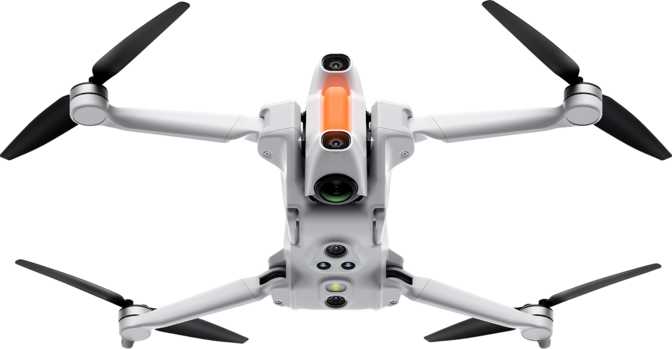
Specifications at a Glance
Six numbers that define what the Antigravity A1 can do — and what each means for real-world use.
A Sub-250g Drone That Shoots 8K Spherical Video
The Antigravity A1 occupies a position in the drone market that almost nothing else does: a sub-quarter-kilogram aircraft with a full-spherical 8K imaging system and a dedicated remote controller that doesn't require a smartphone to operate. At exactly one gram under the registration threshold that triggers mandatory compliance across dozens of jurisdictions, it hands aerial photographers a legal advantage that heavier machines simply cannot offer — and it pairs that regulatory lightness with imaging ambition that rivals platforms weighing three or four times as much.
That combination — weight-class compliance, spherical 8K capture, and self-contained operation — is the A1's core proposition. Whether that proposition fits your specific workflow is what this review is here to answer.
Design, Portability, and Build Quality
At 249 grams, the A1 lands at a precisely engineered weight point. Aviation authorities across the major drone markets draw the mandatory registration line at 250 grams, meaning the A1 is categorized as registration-exempt for recreational use in most countries where you'll want to fly it. This isn't a coincidence; it's a deliberate design commitment that has downstream consequences for every other component choice the engineering team had to make.
When deployed, the A1's frame spans roughly 38 centimeters wide and 31 centimeters deep, with a body height just under 9 centimeters. Fitting a complete spherical 8K camera system within that envelope at under 250 grams implies lightweight composite construction and highly integrated component packaging — there is no unnecessary mass anywhere in this design.
The operating temperature range covers from freezing point up to 40 degrees Celsius, accommodating most temperate and warm-weather flying conditions. Below freezing — cold winter mornings, high-altitude environments, northern climates through significant portions of the year — the A1 is grounded. Battery performance typically degrades before the lower absolute limit is reached, so operators in borderline-cool conditions should fly conservatively and expect reduced effective session length.
| Width (deployed) | 38.2 cm |
|---|---|
| Depth (deployed) | 30.9 cm |
| Height | 8.9 cm |
| Weight | 249 g Reg.-exempt |
| Temp. Range | 0 °C to 40 °C |
Flight Performance
Flight Time and Real-World Sessions
A full charge supports flights of up to 24 minutes. That's a functional window for structured, purposeful shooting: a real estate property exterior, a landscape sequence, a documentary location sweep, or several takes of a tracking shot with time to reposition in between. It is not a duration for open-ended aerial exploration or comprehensive coverage of large, complex sites in a single charge.
The battery is user-removable — and this detail matters more than the raw airtime figure. A charged spare in your bag converts a 24-minute session into a 48-minute operation, or longer with additional packs. Serious operators should treat a second battery as baseline kit from day one.
The A1's control range extends to 10 kilometers under clean line-of-sight conditions. In practice, regulatory requirements, practical visibility, and legal operating zones will place your furthest operational point well within a few kilometers of the launch point. The value of that extended range ceiling is confidence: interference and atmospheric conditions all take a meaningful bite out of real-world range, and starting from a 10km baseline means those reductions don't push you into anxious territory during a normal session.
Speed, Stability, and Obstacle Awareness
At maximum speed, the A1 covers around 57 kilometers per hour — fast enough to track a moving vehicle through a neighborhood, keep pace with a recreational boat, or cover ground efficiently between shooting positions. Cinematic work rarely demands that pace, but the capability to reposition quickly between setups improves overall session efficiency when time on-site is limited.
Positional stability during hover relies on a complete navigation sensor stack: GPS for outdoor position locking, a gyroscope for orientation stability, an accelerometer for movement response, and a digital compass for directional reference. These work together to keep the aircraft anchored in space through calm-to-moderate wind without constant pilot correction — a significant operational requirement when the camera captures in every direction simultaneously and any drift is visible from all angles at once.
Obstacle detection adds a collision-avoidance layer that benefits less experienced pilots in unfamiliar environments and veterans managing complex shots near structures or terrain. Return to Home triggers an automatic return to the launch point when the control signal is lost or battery reserves reach a critical threshold. Intelligent flight modes extend the A1's capability beyond manual control; though specific modes are not enumerated in the available specifications, this feature class typically enables automated orbit patterns, subject-following behavior, and waypoint-based flight paths.
The 360° Imaging System
Why Full-Spherical Capture Changes Your Workflow
The A1's main camera does not capture a frame — it captures everything. A 360-degree field of view means every direction is recorded simultaneously in every moment of flight. This is a categorically different approach to aerial imaging than conventional drones with directional gimbal cameras, and it changes the relationship between flight and creative decision-making in a fundamental way.
The workflow implication is far-reaching: angle selection moves from pre-flight planning to post-production. A single flight pass produces source material for a traditional forward-facing hero shot, a downward overhead view, a lateral pan, and a point-of-interest orbit framing — all from the same recording. For real estate virtual tours, VR media production, immersive travel content, and event documentation, that multiplied output per session eliminates the need for multiple repositioned flight passes. In-camera panorama stitching generates complete wide-field still images automatically during flight, removing that step from post-production entirely.
Video Quality: What the Numbers Mean for Your Footage
Eight-kilopixel video — 4320 vertical lines — at 30 frames per second places the A1 at the upper boundary of consumer aerial imaging capability. For a spherical camera, this resolution means the footage retains sufficient detail that a 4K or even a 6K crop extracted from any angle within the spherical recording stays sharp and usable at output. Every flight produces material from which multiple clean, distinct clips can be extracted without revisiting the location.
The data rate at which footage is written — 170 megabits per second — determines how much visual information survives the compression process. Consumer drones commonly record between 30 and 100 megabits per second; cinema-grade platforms typically operate upward of 200 megabits. At 170 megabits, the A1 holds the upper tier of consumer territory, preserving tonal gradation, fine texture, and shadow detail that are critical during color grading or delivery into professional post-production pipelines. HDR mode retains detail in bright sky and shadowed foreground simultaneously — the persistent challenge of aerial photography at sunrise, midday, and sunset. The 24p cinema mode matches the 24-frames-per-second cadence of theatrical film. The sensor handles sensitivity up to ISO 6400, placing golden-hour, overcast, and early-dusk conditions within confident operating range — though at maximum sensitivity, shadow noise will be visible. Deep-night aerial filming is not within the A1's designed capability.
The FPV Camera
A dedicated first-person-view camera operates independently of the main spherical imaging system, giving the pilot a real-time forward-facing feed during flight. For 360° cameras, this companion feed is a necessary operational feature: a spherical camera doesn't provide a conventional compositional viewfinder — the system records everything rather than composing a specific frame. The FPV feed lets pilots navigate confidently, position the aircraft accurately, and avoid obstacles while the main system handles omnidirectional capture in the background.
Storage: Planning for a Full Session
The A1 includes 30 gigabytes of onboard storage. At maximum recording quality, this capacity holds approximately one full flight's worth of footage before reaching its limit — the internal storage and the battery's flight duration align closely at peak settings, creating a natural session rhythm of fly, land, offload, and repeat. This is unlikely to be a coincidence in the engineering.
An external memory card slot allows storage capacity to be extended before any of that becomes a constraint. For multi-battery sessions, longer deployments, or locations where immediate offloading isn't practical, a high-speed expansion card is essential rather than optional. At 8K recording data rates, a card not rated for sustained high-speed writes will introduce bottlenecks that cause dropped frames or recording interruptions mid-flight. Plan for a card capable of matching the write demands of high-bitrate spherical capture.
- Internal30 GB
- Expansion SlotAvailable
- Recommended CardV60 or V90
- Session Coverage~1 full flight
The Remote Controller: No Smartphone Required
The included remote controller has a built-in display — and this changes the day-to-day experience of operating the A1 more than most buyers anticipate. Every drone system that depends on a phone mount introduces a chain of variables: device compatibility, software updates that push notifications at inopportune moments, sun glare that renders a consumer screen unreadable, mount stability that is never quite confident, and the background unease of committing a personal device to a flight-critical function.
The A1's dedicated controller screen removes all of it. Display behavior is calibrated for this aircraft, software behavior is consistent across sessions, and the complete operational setup begins and ends with a single purpose-built device. For professionals using this drone in repeatable, client-facing workflows, that consistency has real value beyond convenience. Smartphone connectivity is supported for users who prefer a larger screen or want to integrate third-party flight planning apps — but it's an option, not a dependency.
- Built-in display — no phone mount needed
- Purpose-calibrated brightness and consistent software across every session
- No app conflicts, notification interruptions, or mount failures
- Smartphone connectivity supported as an optional preference
Who This Drone Is Built For — and Who It Isn't
The A1's Strongest Use Cases
Real Estate & Architecture
Produce virtual tours, 360° walkthroughs, overhead stills, and traditional aerial video from a single property session. The A1's spherical capture generates source material for every format in one flight pass.
Travel & Documentary
Carry-on-friendly and registration-exempt across most markets. Ideal for filmmakers who need a capable aerial platform without the logistical overhead of heavier equipment.
VR & Immersive Content
Complete environmental records for virtual production, interactive experiences, or spatial media — at the 8K resolution those workflows require.
Site Documentation
Omnidirectional coverage at high resolution justifies fewer total flights than a directional camera would require for equivalent spatial documentation of a location.
Where the A1 Falls Short
Forward-Facing Cinematographers
Narrative directors, sports shooters, and wildlife documentarians will find the spherical camera a mismatch. A conventional gimbal-camera drone is better optimized for traditional framing and composition.
Weather-Prone Environments
Coastal, mountain, or humid tropical environments where weather arrives unpredictably present a genuine operational risk with a non-sealed aircraft.
Cold-Climate Operators
Winter conditions across significant portions of the northern hemisphere ground the A1 entirely. High-altitude environments present the same limitation whenever temperatures drop rapidly.
Maximum Endurance Priority
Operators prioritizing extended airtime will find heavier platforms offering 30 to 50 percent more flight time — at the cost of portability and registration requirements.
How the Antigravity A1 Compares to Its Alternatives
The A1's combination of attributes — sub-250g weight, spherical 8K imaging, and a built-in controller display — has few direct counterparts. Most comparable-weight drones use directional cameras; most full-spherical aerial platforms exceed the weight threshold significantly. The A1 occupies the space between.
| Feature | Antigravity A1 | Lightweight Compact Drone | Professional Aerial Platform |
|---|---|---|---|
| Weight Class | Under 250g | Under 250g (typical) | 600g and above |
| Camera Field of View | Full spherical 360° | Forward-facing | Forward-facing |
| Max Video Resolution | 8K | 4K–5.1K (typical) | 5.1K–8K |
| Controller Display | Built-in | Smartphone required (typical) | Varies by model |
| Registration-Exempt | Yes (most markets) | Yes (most markets) | No |
| Weather Sealing | None | None at this weight | Often available |
| Flight Time per Charge | ~24 minutes | ~30–40 minutes (typical) | ~40–55 minutes (typical) |
Strengths and Limitations
- Sub-250g weight combined with 8K spherical imaging — a combination rarely available at any price point or weight class.
- 55-megapixel sensor provides substantial cropping flexibility without sacrificing output detail at final resolution.
- 170 Mbps recording rate keeps footage in professional territory where demanding post-production pipelines won't reject the source material.
- Internal 30GB storage covers a complete standard session before expansion becomes necessary.
- Removable battery enables a charged spare to extend operations without any technical complexity.
- Self-contained controller with built-in display eliminates smartphone dependency and all associated operational variables.
- Twenty-four minutes of flight time works for structured, planned sessions but creates pressure during open-ended exploration or large-area coverage.
- No weather sealing is the A1's most operationally significant constraint — one unexpected rain shower can result in permanent hardware damage.
- Sub-freezing temperatures ground the aircraft completely — a hard stop for winter operations in cold climates and at altitude globally.
- The 360° workflow requires new post-production skills and software that extends editing time significantly beyond conventional directional footage.
- ISO 6400 ceiling limits low-light shooting to dusk and overcast conditions — deep-night aerial filmmaking is not within the A1's designed capability.
Questions Real Buyers Ask Before Purchasing
Final Verdict
The Antigravity A1 is a purposeful machine — and that purpose is specific: it exists for the creator who needs spherical aerial imaging, regulatory simplicity, and operational independence in a single portable package. For that creator, the A1 delivers on every significant criterion.
The sub-250g weight combined with 8K full-spherical capture, a 55-megapixel sensor, professional-grade recording data rates, and a standalone controller represents a convergence of capabilities that is uncommon at any weight class. Real estate professionals, immersive content creators, and traveling filmmakers who need to operate legally across multiple markets will find the A1 handles their actual workflow requirements with more precision than a conventional drone of any weight class.
Operators whose priorities are extended flight time, weather resistance, or traditional forward-facing cinematography will be better served by platforms built specifically around those requirements. The A1 does not compete in those dimensions — and it doesn't pretend to.
Recommendation
If spherical 8K capture, legal simplicity, and a clean self-contained setup describe your operations, the Antigravity A1 is built for exactly that use case — and it is built for it well. Know what you need, and if the A1 fits that profile, it fits with confidence.