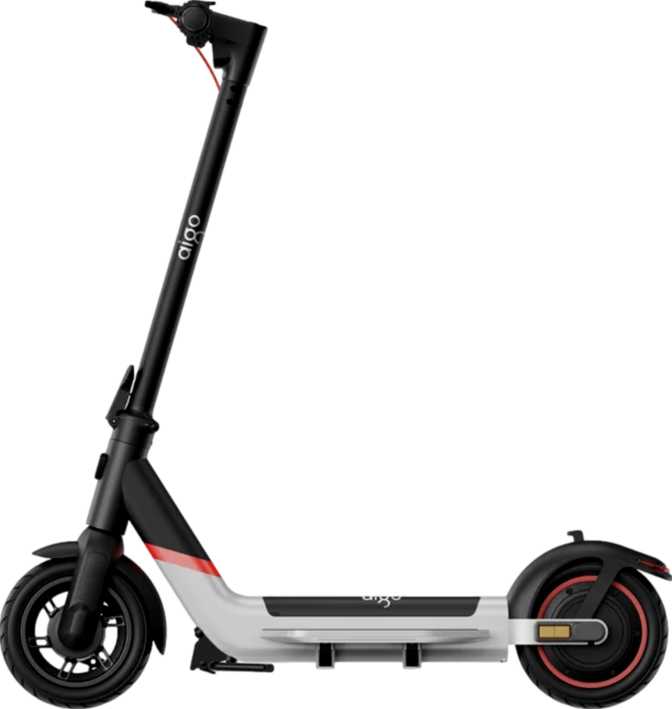
Aigo S80 Electric Scooter: Full Review for Urban Commuters
Electric ScootersAigo S80 At a Glance
Six key numbers — and what each one means for your daily commute
Electric scooters have become a genuine commuting tool, not just a weekend novelty. The market is crowded with options ranging from fragile budget rides to engineering-intensive performance machines that cost more than a used car. The Aigo S80 positions itself in the middle ground — a foldable adult scooter with a serious motor, a respectable battery, and a feature set that suggests it was designed by people who actually commute on one. Whether it earns that positioning is what this review unpacks.
Build Quality and Physical Design
Footprint, weight, tires, ride feel, and the build choices that matter most for daily use
Footprint, Weight, and Everyday Handling
The S80 tips the scales at just under 11.6 kilograms. In practical terms, that is on the heavier side for a folding commuter scooter — you will feel it carrying it up a flight of stairs or lifting it into a car trunk. It is not a deal-breaker, but if your commute involves multiple flights of steps or frequent public transport transfers where you need to carry it with one hand, factor that weight into your decision.
When unfolded, the scooter stands 1,130 mm tall with a handlebar width of 1,080 mm. The height suits most adult riders — those above 185 cm may find the bars slightly low, while shorter riders should have no issues. The 1,080 mm width is wide enough for stable, confident handling without being awkward in tight spaces. The fold mechanism brings the scooter to a manageable footprint for storage — in an apartment hallway, under a desk, or in the boot of a compact car.
Tires and Ride Feel
The S80 rolls on 10-inch pneumatic (air-filled) tires. Air-filled tires absorb road imperfections passively — small cracks, cobblestones, and uneven pavement feel noticeably less jarring compared to solid rubber alternatives. They also provide better grip in wet conditions, a meaningful safety consideration for daily commuters.
No suspension system.
The Aigo S80 has no suspension at any point in its frame. Riders who regularly cross rough urban terrain or who have back or joint sensitivities will feel every bump the tires cannot absorb on their own. On smooth city pavement and well-maintained bike paths, this is a non-issue. On broken asphalt or cobbled streets, it is something to weigh carefully before purchasing.
Integrated Lighting
Front and rear lights are built in, keeping the S80 compliant with night-riding requirements in most urban jurisdictions and removing the need for aftermarket accessories. Integrated lighting is the right call for a commuter-focused scooter — clip-on lights rattle, drain separately, and get forgotten at the wrong moments.
Motor Performance: What 720 Watts Delivers in Real Life
Speed capability, hill climbing, and braking — with honest context around each figure
Motor and Speed
The S80 runs a single 720-watt motor. Entry-level commuter scooters typically use motors in the 250–350W range, which struggle on inclines and feel sluggish with heavier riders. Mid-range scooters cluster around 500W. At 720W, the Aigo S80 sits solidly above average — responsive from a standing start, capable of maintaining speed on gradual slopes, and able to carry adult riders of varying weights without the motor feeling strained on flat ground.
Top speed is capped at 25 km/h. In many countries and city ordinances, this is the legal maximum for electric scooters on public paths and roads, so the S80 is calibrated to operate legally without requiring adjustment. At that pace — roughly equivalent to a fast cycling speed — it is brisk enough for real commuting without becoming a handling challenge for average riders.
Hill Climbing Capability
The S80 is rated to handle inclines up to 15 degrees. A 15-degree slope is steeper than most urban streets and gentler than aggressive hills. Standard urban grades in European and most Asian cities — typically 5–10 degrees — fall comfortably within range. Riders in steeper cities should check their typical route profiles before assuming the S80 will handle them without motor strain.
Braking System
Both front and rear brakes are fitted — the appropriate setup for a scooter at this speed and weight. Dual-brake systems allow for more controlled, balanced stopping than a single-brake configuration. This becomes especially important in wet conditions where over-relying on one brake can cause wheel lock and sudden loss of control.
Battery Life and Range: The Daily Commute Reality
Capacity, real-world range estimates, charging logistics, regenerative braking, and the fixed-battery trade-off
Range in Real-World Terms
The S80 carries a 378 Wh battery — a substantial capacity by commuter scooter standards. The manufacturer rates range at up to 45 kilometers per charge. That figure is almost certainly measured under optimal conditions: flat terrain, mild weather, lighter rider, steady moderate speed. Real-world range under typical mixed conditions — some hills, stop-and-go urban riding, heavier riders — will likely land in the 30–38 km bracket.
Even at the conservative end, that covers a typical urban round-trip commute of 12–16 km with significant headroom. For most daily commuters, charging every night as a habit means range anxiety essentially disappears. If your commute is longer — say 20 km or more each way — you would need to charge at both ends or accept a mid-day top-up.
Charging Time and the Fixed Battery
A full charge from empty takes approximately six hours. Plugging in overnight is the natural rhythm here, and the S80 is ready for the next day every morning. For opportunistic daytime charging, six hours is a long window — you would need to leave it for the bulk of a workday to get a full replenishment.
Non-removable battery.
The battery is fixed inside the frame. You cannot swap a depleted pack for a charged spare, and you must bring the scooter itself to a power outlet. If you cannot charge at your destination and your commute approaches the realistic range limit, this becomes a genuine planning constraint rather than an abstract one.
Regenerative Braking and Battery Monitoring
The S80 includes regenerative braking, which captures kinetic energy during deceleration and feeds it back into the battery. In stop-and-go city riding, this modestly extends real-world range beyond what pure motor efficiency alone delivers — and it adds a subtle braking feel when you ease off the throttle. It is not a dramatic range multiplier, but it is a thoughtful inclusion at this tier.
A battery level indicator is included as standard. Cheaper scooters omit this entirely, leaving riders to guess whether they will make it home. The S80 provides that visibility at a glance — a basic but genuinely important usability feature for any commuter.
Smartphone App and Smart Features
The S80 connects to a dedicated smartphone application. Companion apps on scooters at this tier typically provide riding mode selection — which affects top speed and power draw — alongside real-time speed and battery display, trip statistics, and lock/unlock controls.
The app integration is a genuine usability upgrade. Being able to dial in a power mode for range-conscious days versus performance days gives you a level of control that is noticeably absent on simpler commuter scooters. For riders who want to extract maximum range from the battery on long-commute days, or who prefer greater responsiveness on shorter trips, the flexibility this provides is meaningful — not a gimmick.
Who Should Buy the Aigo S80?
Match your commute profile to this scooter's genuine strengths and real limitations before deciding
Well-Suited For
Not the Right Fit For
How the Aigo S80 Compares to Other Scooters
A structured look at where the S80 sits relative to its category competitors
| Feature | Aigo S80 | Budget Scooter 250–350W |
Premium Commuter Dual Motor |
|---|---|---|---|
| Motor Power | 720W | 250–350W | 1,000W+ |
| Rated Range | ~45 km | 20–30 km | 50–80 km |
| Tire Type | Pneumatic 10″ | Often solid or 8″ | Pneumatic 10″ |
| Suspension | None | Rarely | Usually |
| Top Speed | 25 km/h | 20–25 km/h | 25–45 km/h |
| Foldable | |||
| App Connected | Rarely | ||
| Regen. Braking | Rarely | ||
| Approx. Weight | ~11.6 kg | 8–12 kg | 15–25 kg |
Against budget options, the S80's motor headroom, range, and feature set are clearly superior. Against premium dual-motor scooters, it trades performance ceiling and suspension for a lower price point and a legally compliant speed cap. For riders who do not need to exceed 25 km/h and are not riding over consistently rough terrain, the S80's omissions matter less.
Honest Strengths and Weaknesses
A balanced view of what the Aigo S80 genuinely delivers — and where it genuinely falls short
What the Aigo S80 Gets Right
The S80's greatest strength is the combination of motor power and battery size at its positioning. A 720W motor with a 378 Wh battery is a genuinely capable setup — not a marketing illusion built on inflated specifications. That combination delivers real-world performance that separates it clearly from the budget end of the category.
The pneumatic tires, dual brakes, integrated lighting, regenerative braking, and app connectivity round out a package that checks the commuter essentials without obvious shortcuts. These are features you have to actively look for at the budget end of the market — the S80 includes them as standard.
Where Compromises Show
The absent suspension is the most honest criticism. At nearly 12 kilograms, the S80 is not something most riders want to carry frequently, and without suspension, it absorbs road irregularities only as well as the tires allow. Pairing a rear suspension with this motor and battery would have made it a straightforward recommendation for a wider range of environments.
The fixed battery constrains flexibility in ways a removable pack would not. The six-hour charge time is long relative to competitors who have moved toward faster charging — fine for overnight users, inconvenient for mid-day top-ups. Neither is a fatal flaw, but both are limitations a buyer should understand before purchasing.
Common Questions Before You Buy
Answers to the questions real buyers search for when researching the Aigo S80
Final Verdict: Is the Aigo S80 Worth It?
The Aigo S80 is a well-specified commuter scooter that gets the fundamentals right where they matter most: power, range, braking, lighting, and connectivity. Its 720W motor gives it real-world capability that budget options cannot match, and its battery provides enough range that most urban commuters will rarely feel constrained.
The absent suspension is a genuine trade-off that limits its suitability for rougher riding environments, and the fixed battery means it is not the right tool for riders who need extreme flexibility in charging logistics. At its weight, it will never be the choice for someone prioritizing portability above all else.
The Bottom Line
For the right rider — an adult urban commuter on reasonably maintained streets, with overnight charging available, and a daily round trip under 35 km — the Aigo S80 is a capable, feature-complete choice that punches above its category. If your infrastructure matches its strengths, it earns a confident recommendation.