Buyer's Perspective
Why the Wired USB-C Earphone Deserves a Second Look
There's a version of this story where wireless wins entirely — where every earphone purchase is a conversation about battery life, codec support, and pairing reliability. That version is incomplete. For a growing number of people, a dependable wired earphone does everything they actually need, without requiring a charge, a pairing sequence, or a replacement every two years when the battery degrades past usability.
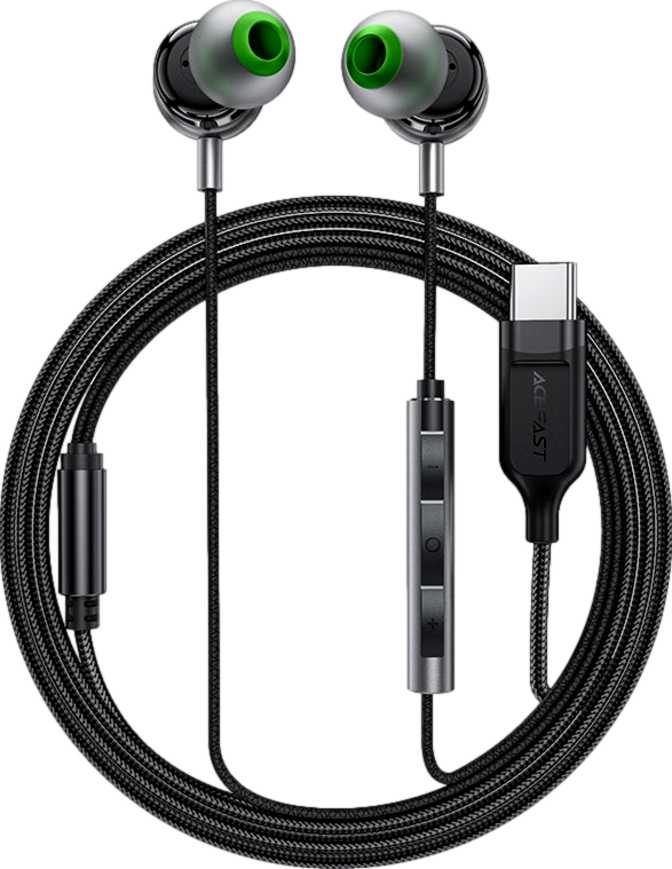
The Acefast L5 is a wired in-ear earphone built around USB-C connectivity — the port now standard on Android phones, iPads, MacBooks, and a new generation of Windows laptops. It isn't trying to be a flagship audio product. It's trying to be genuinely useful to people who need audio that works every time they plug in. Whether it delivers on that modest but important promise is exactly what this review examines.
Acefast L5 at a Glance
Before the full breakdown, here's what matters most about the Acefast L5 in one scannable reference.
| Aspect | What We Found |
|---|---|
| Fit Type | Sealed in-ear design |
| Weight | 17 g — among the lightest in its class |
| Cable | 1.2 m, tangle-free, fixed (non-detachable) |
| Connectivity | Wired, USB-C only |
| Noise Handling | No active noise cancellation; passive seal isolation only |
| Microphone | Single mic, no noise cancellation, no hardware mute button |
| Water Resistance | None — avoid moisture and sweat exposure |
| In-Box Extras | Travel bag included |
| Warranty | 2 years |
Design and Build Quality
Weight: Almost Nothing, in the Best Way
At just seventeen grams for the entire unit, the Acefast L5 is startlingly light. To put that in physical terms: a standard AA battery weighs around the same. For an earphone worn during long work calls, extended commutes, or full-day listening sessions, this near-absence of weight has real practical value. Earphone fatigue — that low-level discomfort from sustained pressure and weight in the ear canal — is a real phenomenon that heavier units accelerate. The L5 doesn't give it much opportunity to develop.
Cable Construction: Tangle-Free Is a Feature, Not a Marketing Line
The cable is 1.2 meters long — enough to reach comfortably from a pocket or desk surface to your ears, with natural slack that doesn't feel restrictive during normal movement. More meaningfully, the cable uses a tangle-free construction. This is achieved through a flattened or reinforced cable geometry that resists the curling and knotting that makes standard earphone cables miserable to unpack.
For anyone who uses earphones daily, this is worth pausing on. The minute you spend untangling a conventional cable before every use adds up. The L5 eliminates that friction by design.
The cable is not detachable — it connects permanently to the earphone housing. This is the most significant durability trade-off in the design. Cable failure (near the plug or at the ear connection) is the most common cause of earphone death, and when that happens here, the entire unit needs replacing rather than just the cable. This is typical for the product tier, but worth knowing before purchase.
Fit and Form Factor
The L5 uses a closed in-ear design — the driver housing sits inside the ear canal, sealed against the outer ear with silicone tips. This closed configuration does two things: it creates the passive noise isolation the earphone relies on for acoustic performance, and it locks the earphone in place reasonably well for sedentary and light movement use.
There is no active detection system to sense whether the earphones are in your ear. Music pauses only when you pause it. For most people, this is a non-issue. For anyone coming from earphones with auto-pause, it's an adjustment.
The earphone does not offer in-ear detection, touch controls on the housing, or any smart features on the ear piece itself. Control interaction happens exclusively through the in-line remote on the cable.
What Comes in the Box
The Acefast L5 ships with a travel bag — a practical inclusion that many earphones at this level skip entirely. The combination of a tangle-free cable and a dedicated carrying pouch means the storage and transport experience is genuinely considered. Pull out the bag, pull out the earphone, plug in. There's no untangling ceremony, and the earphone arrives uncoiled and unscratched.
Water and Sweat Resistance: None
There is no water resistance or sweat resistance rating on the Acefast L5. This is stated clearly in the product's specification, and it matters: gym use, outdoor runs, commutes in rain, or any activity where the earphone encounters moisture are outside what this product is designed to handle.
Sound Performance: What the Specifications Actually Deliver
Full-Spectrum Audio and Stereo Staging
The L5's drivers reproduce the complete range of frequencies that human hearing can perceive — from the deep low end that carries bass texture and cinematic weight, through the midrange where vocals and most instruments live, up to the high frequencies where cymbal shimmer, string brightness, and audio detail reside. Nothing is cut off at either extreme.
Full human-audible range covered, end to end.
This isn't a guarantee of quality — it's a guarantee of completeness. A driver with full-range coverage won't have artificial holes in the frequency response that make bass-heavy music sound thin or vocal recordings sound dull. Whether the tuning within that range is musically satisfying depends on driver quality and voicing, which spec tables can't fully capture.
The earphone delivers true stereo audio — distinct left and right channels — which creates spatial separation between sound sources. For music, this means instruments can be positioned across a left-to-right soundstage. For gaming and film, this allows directional audio cues to read correctly.
One notable technical detail: the L5 does not use neodymium magnet drivers. Neodymium magnets are the industry standard in consumer earphone drivers, prized for their magnetic strength relative to their size and their contribution to driver sensitivity. The L5's departure from this is worth noting for technically-minded buyers comparing options — it's a legitimate point of differentiation, though the sonic implications depend on the specific driver implementation.
Passive Noise Isolation in Practical Terms
The Acefast L5 has no active noise cancellation. What it does have is passive isolation — the physical noise reduction achieved when the in-ear tips form a seal against the ear canal. This seal blocks ambient sound from entering before it reaches the driver, reducing the background noise floor without requiring any electronics or battery power.
In practice, a good passive seal typically reduces ambient noise by a meaningful but limited amount — enough to reduce a noisy open-plan office to a background murmur, or a commuter train environment to manageable levels. It is not on the same level as a dedicated ANC system at its best. The quality of isolation you personally experience depends directly on fit: finding the right ear tip size for your ear anatomy is the most important factor.
There is no ambient sound mode — no way to electronically allow external sound in when you want situational awareness. Removing the earphones is the only method to restore environmental hearing.
USB-C Connectivity: A Deliberate, Practical Choice
The Acefast L5 connects via USB-C and operates entirely as a wired device. This isn't a compromise — it's an architectural choice with specific advantages that wireless cannot replicate.
No Signal Compression
Wired USB-C audio introduces no signal compression. Bluetooth audio, even using high-quality codecs, involves encoding and decoding an audio signal in transit, which can introduce artifacts. USB-C audio bypasses this entirely — what your device sends is what the earphone receives.
Zero Latency
Wired audio also introduces no latency. The gap between a sound event and when you hear it through wireless earphones, while often small, is not zero. For casual music listening, this is irrelevant. For video playback, call timing, or gaming — particularly on mobile — even slight audio delay creates misalignment that the brain detects and finds distracting. Wired USB-C audio arrives at the earphone effectively instantaneously.
No Battery, No Pairing
Wired audio carries no pairing state, no connection drop risk, and no battery. You plug in, and it works. You unplug, and it's done.
For users of modern smartphones with USB-C ports, recent iPad models, MacBooks, and many current Windows laptops, the L5 slots in without adapters or accessories. For iPhones with USB-C ports, the same applies.
Microphone, Calls, and In-Line Controls
Call Quality: Functional with Environmental Limits
The Acefast L5 functions as a complete headset — voice and audio — through a single microphone integrated into the in-line cable module. For calls taken in quiet environments — a home office, a private room, a calm commute — the mic performs the basic function adequately.
The microphone does not feature noise cancellation. In louder settings — a café, a street, a busy office — ambient sound will be captured alongside your voice and transmitted to whoever is on the other end of the call. Callers will hear your environment clearly. For professional call situations in uncontrolled acoustic environments, this is a limitation that matters.
In-Line Controls: Simple and Sufficient
The control panel sits on the cable and provides physical interaction without touching the connected device. Standard call management and playback control are accessible from here. The controls are straightforward: there are no programmable functions, no gesture shortcuts, and no multi-press sequences to memorize. For the majority of daily use cases, simple and reliable outperforms complicated and finicky.
Who the Acefast L5 Is For — and Who It Isn't
The Right Use Case
- Remote workers and home office users who need dependable call audio and daily-use listening without managing battery life on another device
- Commuters and students who move between environments and want earphones that are always ready without checking charge levels
- Owners of modern devices without a 3.5mm headphone jack who want a clean, adapter-free audio solution
- Practical daily listeners whose primary use is podcasts, video content, streaming, and general music — not critical audiophile listening
- Organized, on-the-go users who will appreciate a tangle-free cable and a travel pouch that actually ships with the product
Who Should Look Elsewhere
- Gym users, runners, and athletes — no water or sweat resistance means physical activity exposes this earphone to environments it isn't built for
- Active noise cancellation seekers — passive isolation exists, but electronic noise suppression does not; this won't block out airplane engine noise or road traffic at a meaningful level
- Professional call users in noisy environments — the single non-noise-canceling mic will transmit ambient sound faithfully and unfavorably
- Users who want cable upgradeability — the non-detachable cable forecloses the option of swapping to a higher-quality or different-length replacement
- Anyone primarily needing wireless flexibility — there is no Bluetooth option, no wireless mode, and no way to use this earphone without a physical connection
How the Acefast L5 Sits in the Market
The wired USB-C earphone segment has a visible structure.
Entry-Level
First-Party Earphones
At the accessible end, first-party earphones from major phone manufacturers offer safe, brand-backed options that prioritize simplicity over acoustic engineering. These are often adequate but rarely exceptional as audio products.
Acefast L5: The Practical Middle Ground
The Acefast L5 occupies practical middle ground: a non-specialist brand making a competent, accessory-complete daily earphone with considered packaging details — tangle-free cable, travel bag, USB-C connection — aimed at the widest reasonable audience rather than enthusiast segments.
Premium
Specialist Audio Brands
Further up the range, specialist audio brands have released USB-C earphones with audiophile-grade drivers, interchangeable cable ecosystems, and sophisticated tuning — at price points that price out everyday buyers and demand acoustic literacy to evaluate.
Against wireless earbuds in the same price range, the L5's argument is fundamentally different. Wireless offers spatial freedom and convenience of no cable; wired offers freedom from battery management, lower audio latency, and consistent delivery over time as wireless competitors degrade with battery cycle count. Neither is objectively superior — they serve different primary needs.
The L5's strongest competition within its own wired USB-C category is the increasingly capable range of earphones from established audio-adjacent Asian manufacturers who have moved into this space with similar feature sets at comparable prices. In this context, the Acefast L5 differentiates primarily through its packaging and warranty coverage rather than a unique driver proposition.
Honest Strengths and Real Limitations
Where It Delivers
- Low physical weight
- A cable engineered for daily use, with tangle-free construction
- A full-audible-spectrum driver covering the entire range of human hearing
- Direct USB-C compatibility
- The operational simplicity of wired audio
- A travel bag included at no extra cost
- A two-year warranty that exceeds the one-year coverage standard typical in this segment
Where It Falls Short
- The non-detachable cable creates a single point of failure for the entire unit.
- The absence of any moisture resistance closes off one of the most common real-world earphone use cases.
- The single non-noise-canceling microphone is adequate in calm conditions and insufficient in challenging ones.
- The earphone's full dependence on passive isolation means users in high-noise environments will find it limiting compared to ANC alternatives.
None of these are surprising given the product's positioning — they're rational trade-offs for the price tier. What matters is that a buyer sees them clearly before purchasing, not after.
Questions Buyers Are Searching for Before Purchase
Final Verdict
The Verdict
The Acefast L5 earns a clear, specific recommendation: buy it if its use case matches yours; don't if it doesn't.
The two-year warranty signals that Acefast stands behind the hardware, which matters for a product that will see daily use. The tangle-free cable and included travel bag signal that the product design team thought about how people actually live with earphones, not just how they sound in a demo.
For remote workers, commuters, and daily-use listeners who want wired USB-C audio that's always ready, always consistent, and packaged with genuine daily-use care — tangle-free cable, travel bag, full-range stereo drivers — the L5 delivers on its core promise without meaningful compromise within its defined scope.
For anyone who needs physical activity durability, active noise suppression, professional-grade call quality in loud environments, or the cable upgradability that a detachable connector provides, the L5 is the wrong product regardless of price. These aren't features it does poorly — they're features it doesn't have.
Earphones that know what they are and execute on it reliably are more valuable than earphones that promise everything and deliver unevenly. The Acefast L5 knows what it is.